A mobile crushing plant is a track- or wheel-mounted rock processing unit designed to crush and screen materials directly at a quarry or construction site. Commonly used in mining, quarrying, and construction, it eliminates the need to haul raw materials to a fixed facility, significantly reducing fuel, transport, and operational costs.
Key Takeaways for Mobile Crushing Plant Equipment, Features & Advantages
- Mobile crushing plants eliminate haul costs by processing stone, concrete, asphalt, and demolition debris directly on-site — no trucks, no tipping fees, no delays.
- Setup takes minutes, not weeks — tracked mobile crushers can be operational on a new site in under an hour, versus days or weeks for a stationary plant.
- Lower upfront investment makes mobile units accessible to contractors, recyclers, and demolition crews who can't justify a fixed crushing infrastructure.
- Wagner Equipment covers mobile crushing options for operators who need reliable equipment matched to their specific application and scale.
- Mobile units have real limitations — capacity ceilings, fewer customization options, and cool-down requirements that matter when you're planning high-volume continuous production.
Mobile Crushing Plants at a Glance
Mobile crushing plants solve one of the most expensive problems in construction and demolition: moving material off-site just to crush it somewhere else and bring it back.
For contractors, recyclers, quarry operators, and demolition crews, the ability to crush on location isn't just convenient — it directly affects project margins. Wagner Equipment's breakdown of mobile vs. stationary crushing systems is a strong starting point if you're weighing which direction to go. This guide covers what mobile crushing plants actually are, how they work, what makes them worth considering, and where they fall short.
Mobile Crushers Have Changed the Economics of Crushing
Before compact mobile crushers became widely available, smaller contractors had two options: haul debris to a stationary plant or rent one and pay for the infrastructure to set it up. Neither was cheap. Mobile crushing changed that equation by bringing the plant to the material — cutting out transportation costs, tipping fees, and the logistical overhead of off-site processing. For contractor-scale operations, that shift has been significant.

“File:Lokotrack LT200HP mobile cone …” from commons.wikimedia.org and used with no modifications.
What Is a Mobile Crushing Plant?
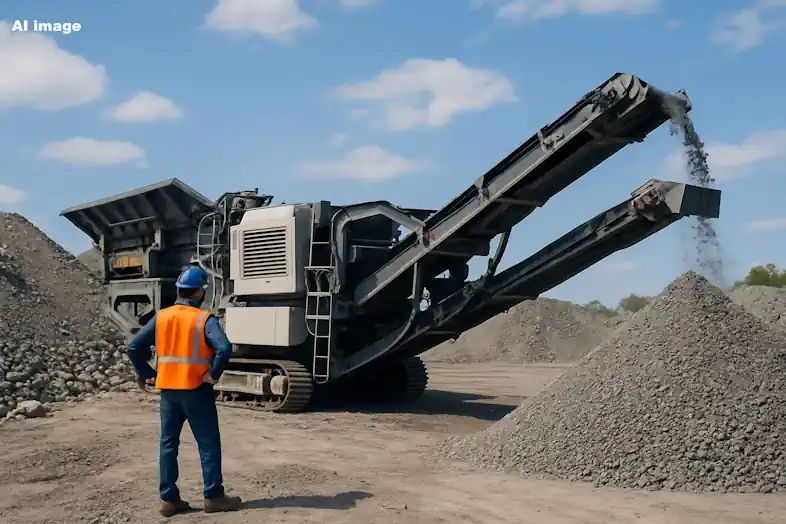
A mobile crushing plant is a self-contained crushing system mounted on a tracked or wheeled undercarriage that can be relocated between job sites under its own power or by trailer. Unlike stationary plants, which are anchored to a fixed foundation with permanent electrical and structural infrastructure, mobile units arrive ready to work. You position the machine, fold out the conveyors, and start feeding material. For more information on how mobile crushing plants fit into the larger picture of waste management, you might find it useful to explore the waste hierarchy in the UK.
These machines are engineered to handle a wide range of input materials in a single pass. Common applications include recycling processes that follow the principles of reduce, reuse, recycle.
- Crushed concrete from demolition sites
- Natural stone and aggregate from quarry operations
- Recycled asphalt pavement (RAP)
- Construction and demolition (C&D) debris
- River rock and gravel processing
- Brick and masonry rubble
The output is usable aggregate that can often be reused directly on the same site — as road base, fill material, or drainage aggregate — without any additional processing or transport. This practice aligns with the principles of the waste hierarchy, promoting sustainability and efficiency in construction projects.
Core Components Built Into One Frame
What makes a mobile crushing plant genuinely self-contained is the integration of multiple processing components onto a single chassis. A fully equipped unit typically includes:
- Primary crusher (jaw, impact, or cone type depending on the model)
- Vibrating grizzly feeder to pre-screen oversized material before it enters the crushing chamber
- Main discharge conveyor to move crushed product away from the machine
- Side discharge conveyor for scalped fines separation
- Integrated screening deck on higher-spec models for product sizing
- Onboard diesel-hydraulic power unit
- Dust suppression system (water spray bars over the crusher and discharge points)
- Remote control panel for single-operator control
This integration is what separates a mobile crushing plant from simply a portable crusher. You're not just moving the crushing unit — you're moving the entire processing circuit.
The compact chassis design also means these machines fit into job sites where a stationary plant would never be practical: tight urban demolition zones, road construction corridors, and remote sites with no existing infrastructure.
Tracked vs. Wheeled Models
Tracked mobile crushers run on rubber or steel crawler tracks, giving them the ability to self-propel across rough, uneven, or soft terrain without requiring a tow vehicle. This makes them the default choice for quarry faces, demolition sites, and any location where ground conditions are unpredictable. Wheeled models, by contrast, are mounted on road-legal trailer frames and require a truck to relocate — but they offer faster highway travel and easier compliance with transport regulations when moving between sites frequently.
The practical difference comes down to how often and how far you're moving the machine. If the crusher stays on one site for weeks at a time and moves across the site under its own power, tracked is the better fit. If you're repositioning between multiple job sites every few days on public roads, a wheeled unit may reduce transport logistics considerably.
How Fast Can You Set One Up?
A tracked mobile crusher can typically be positioned and operational in under an hour on a prepared site. There's no foundation work, no electrical hookup, no structural permitting. You drive it into position, deploy the hydraulically folding conveyors, connect the dust suppression water line if available (or use the onboard tank), and begin feeding. That's a fundamentally different timeline than stationary plant commissioning, which can take days to weeks depending on site prep requirements.

“Crusher – Wikipedia” from en.wikipedia.org and used with no modifications.
Key Features of Mobile Crushing Plants
Not all mobile crushers are built the same. The features that actually drive productivity and reduce operating cost on real job sites go beyond the crusher type — they include how the entire material flow is managed from feed to finished pile.
Integrated Vibrating Screen, Conveyor, and Feeder
The vibrating grizzly feeder at the feed inlet does more than just regulate material flow into the crusher. It pre-screens the incoming feed, allowing undersized material to bypass the crushing chamber entirely and drop directly to the product conveyor. This protects the crusher from unnecessary wear and increases overall throughput. On models like the Komplet K-JC 805, the grizzly feeder gap is hydraulically adjustable, letting operators tune bypass sizing without tools or downtime.
- Pre-screening reduces crusher wear by keeping fines out of the crushing chamber
- Adjustable grizzly gaps allow product size customization without manual intervention
- Integrated conveyors eliminate manual material handling between crushing and stockpiling
- Side conveyors separate scalped fines from primary crushed product in one pass
The main discharge conveyor on most tracked mobile jaw crushers extends far enough to build a meaningful stockpile without the machine needing to reposition frequently. On compact units in the Komplet range, conveyor heights are designed to load directly into dump trucks when needed — which adds flexibility for sites where the crushed material is being removed rather than reused in place.
Secondary screening decks, where fitted, allow a mobile plant to produce two or more sized product fractions in a single pass. This is particularly useful in recycling applications where you might need both a coarse recycled concrete aggregate and a finer material suitable for bedding or backfill — from the same feed stream, in one machine pass.
Onboard Diesel Power and Dust Suppression
Mobile crushing plants run on self-contained diesel-hydraulic power systems, which means they operate independently of any external power supply. This is critical for remote site work, road projects, and demolition jobs in urban areas where temporary power infrastructure isn't available. Dust suppression is handled through water spray bars positioned over the crusher inlet, discharge point, and conveyor transfer zones — reducing airborne silica particulate to levels that comply with worksite health and safety requirements in most jurisdictions.
Hydraulically Folding Conveyors and Remote Controls
Hydraulically folding conveyors reduce transport width and height to legal road dimensions without manual disassembly — a feature that matters significantly when you're moving the machine between sites regularly. Remote control operation, now standard on most modern mobile crushers, allows a single operator to manage feed rate, crusher settings, conveyor speed, and emergency stop functions from a safe distance. On Komplet America's compact units, the remote gives full machine control from up to 100 meters away, keeping the operator clear of the crushing zone during operation.
The Real Advantages of Mobile Crushing Equipment
Bottom line: Mobile crushing plants eliminate the cost of moving material to a crusher. Instead, you move the crusher to the material. For most contractor-scale operations, that single shift in workflow reduces project costs more than any other equipment decision.
The case for mobile crushing comes down to where the money actually goes on a typical demolition or aggregate job. Haul trucks, tipping fees, fuel, driver hours, and off-site processing charges stack up fast — and none of that cost produces a single ton of usable product. Mobile crushing cuts that entire chain out of the equation, making it a more efficient choice than traditional methods often used by waste management companies.
There's also the site efficiency angle. When crushed material is produced on location, it can often be reused immediately as road base, pipe bedding, or fill — removing both the disposal cost and the material procurement cost in a single operation. That's a double saving that stationary plant setups simply can't replicate for short-duration or mid-scale projects.
For contractors comparing options, the advantages aren't marginal — they're structural. Mobile crushing changes the fundamental economics of how a project handles material, and the benefits compound across every job where the machine is deployed. Understanding the waste hierarchy is essential for maximizing these benefits.
No Hauling, No Dump Fees, No Off-Site Processing
On a demolition job producing 500 tons of concrete rubble, the cost of trucking that material to an off-site crushing facility — and then purchasing recycled aggregate to bring back — can easily exceed the cost of running a compact mobile jaw crusher for the entire project duration. Processing on-site eliminates truck movements in both directions, reduces site congestion, cuts fuel consumption across the job, and keeps the crushed product available for immediate reuse. The math is straightforward: fewer trucks moving less material over shorter distances means lower cost per ton of finished aggregate.
Lower Initial Investment vs. Stationary Plants
Compact mobile crushers carry a significantly lower purchase price than stationary crushing installations — and that gap widens considerably when you factor in what stationary plants actually require to operate: engineered foundations, permanent electrical supply infrastructure, structural permitting, site preparation, and in many cases, dedicated haul road construction. A mobile unit avoids every one of those line items. The machine arrives, deploys, and works. For operations that don't have the volume to justify a fixed plant, or that work across multiple sites, the mobile unit's lower capital cost is a straightforward financial advantage. Learn more about top waste management companies that utilize mobile crushing solutions.
Compact Structure Saves Space on the Worksite
Space is a real constraint on urban demolition sites, road construction corridors, and active quarry faces. Compact tracked mobile crushers — particularly units in the Komplet America range — are engineered with a narrow footprint specifically to operate where larger equipment simply won't fit. The machine's self-propelled tracks allow it to reposition within a tight site without needing a crane or support vehicle, and the integrated stockpiling conveyor keeps crushed material organized without requiring additional space for manual handling.
Flexibility to Move Between Job Sites
A tracked mobile crusher can be loaded onto a standard lowboy trailer and transported to a completely different job site in the same day. This portability turns what would otherwise be a fixed infrastructure investment into a versatile asset that earns across multiple projects and locations. For contractors running several sites simultaneously, or rental operations supplying crushing capacity on demand, this flexibility has direct revenue implications that a stationary plant can't match.
Reduced Carbon Footprint Through On-Site Processing
Every truck movement eliminated from a demolition or aggregate project reduces fuel consumption and associated emissions. When concrete and asphalt are crushed on-site and reused in place, the carbon cost of transportation — both for waste removal and new material delivery — drops to near zero for that portion of the project. For contractors working on environmentally sensitive projects, government contracts with sustainability requirements, or jobs in urban areas with strict vehicle movement restrictions, this reduction in truck traffic is both an environmental and a practical compliance benefit. More effort is needed to reduce, reuse, and recycle to further minimize environmental impacts.
The recycling angle matters here too. Mobile crushing enables on-site production of recycled concrete aggregate (RCA) and recycled asphalt pavement (RAP), both of which can substitute for virgin quarried material in many structural and sub-base applications. Using RCA as road base or drainage fill instead of sourcing new crushed stone cuts both the procurement cost and the embodied carbon of the finished project.
Collectively, these environmental benefits are increasingly being recognized in green building certifications and infrastructure procurement scoring — making the mobile crusher a compliance tool as much as a production tool for forward-thinking operations.
Where Mobile Crushers Fall Short
Mobile crushing plants are the right call for a wide range of operations — but they're not without real limitations. Understanding where mobile units underperform compared to stationary plants is essential for making the right equipment decision, particularly for high-volume continuous production operations.
Lower Crushing Capacity Than Stationary Plants
The most significant limitation of mobile crushing equipment is throughput ceiling. Compact mobile jaw crushers typically operate in the range of 30 to 120 tons per hour depending on the model and material. High-capacity stationary crushing plants, by contrast, can process several hundred to over a thousand tons per hour in large-scale quarry configurations. For operations requiring sustained high-volume output — major quarry production, large aggregate supply contracts, or cement plant feed — stationary plants are the appropriate solution, and mobile units can't close that capacity gap.
This doesn't make mobile crushers unsuitable for production work — it means the right mobile unit needs to be matched carefully to the actual production requirement of the job. Undersizing a mobile crusher for a high-throughput application will result in bottlenecks, excessive wear, and maintenance intervals that erode the operational cost advantage the mobile unit was supposed to deliver.
Limited Customization Options
Stationary crushing plants can be engineered with highly specific circuit configurations — multiple crusher stages, custom screen decks, specialized conveyor arrangements, and process controls tailored to a particular material or product specification. Mobile units come in a defined range of configurations, and while there is meaningful variation between models, the ability to custom-engineer a processing circuit around a specific feed material or product requirement is considerably more limited. For operations with tight product specifications or unusual feed characteristics, this constraint matters.
Cool-Down Periods Between Moves
Diesel-powered mobile crushers require cool-down time before transport — typically involving engine shutdown procedures, folding conveyors back to transport position, and ensuring hydraulic systems are properly secured. While this process is measured in minutes rather than hours, it does mean that rapid repositioning within a single work shift has a practical limit. Operations that need to move the machine multiple times per day should factor this into their production planning, as each relocation involves setup and shutdown time that reduces net crushing hours. For effective production planning, consider implementing waste prevention strategies to optimize machine use.
Mobile vs. Stationary Crushing Plants: A Direct Comparison
The choice between mobile and stationary crushing isn't purely about capacity or cost in isolation — it's about matching the right system to the actual operational profile of the work. Both have legitimate use cases, and the decision gets clearer when you look at the specific factors that separate them in practice.
Setup Time and Infrastructure Requirements
Stationary crushing plants require engineered concrete foundations, permanent electrical supply infrastructure, structural permits, and in most cases, dedicated access roads built to handle continuous heavy truck traffic. From ground-breaking to first production, a stationary installation can take weeks to months depending on scale and site complexity. The capital committed before the first ton of material is processed is substantial — and largely non-recoverable if the operation moves or closes. For those interested in sustainable practices, considering waste prevention strategies can be beneficial in reducing environmental impact.
A tracked mobile crusher, by contrast, requires no foundation, no permanent electrical supply, and no structural permitting in most jurisdictions. It self-propels into position, deploys hydraulically, and begins crushing within the hour. For project-based work, contract crushing, or any operation where site tenure is limited, that difference in setup time and infrastructure cost is decisive.
Which Operations Benefit Most From Mobile Equipment
Mobile crushing plants consistently deliver their strongest value case in specific operational contexts. Demolition contractors recycling concrete and masonry on-site, road construction crews processing RAP and base aggregate along a corridor, quarry operators needing to follow the face rather than haul long distances to a fixed plant, and recycling yards handling mixed C&D material all benefit directly from mobile crushing's core strengths: low setup overhead, on-site processing, and the ability to reposition as the work moves. Stationary plants make more sense when production volume is consistently high, the operation is permanent or long-term, and the material feed is predictable enough to justify a custom-engineered processing circuit.
| Factor | Mobile Crushing Plant | Stationary Crushing Plant |
|---|---|---|
| Setup Time | Under 1 hour | Days to weeks |
| Infrastructure Required | None | Foundation, power, access roads |
| Typical Capacity Range | 30–120 TPH (compact units) | 200–1,000+ TPH |
| Upfront Capital Cost | Lower | Significantly higher |
| Portability | Full — self-propelled or trailer | Fixed location |
| Customization | Limited to model configurations | Fully engineered to spec |
| Best For | Project-based, multi-site, recycling | High-volume, permanent operations |
Mobile Crushing Plants Are the Right Call for Most Contractor-Scale Operations
For contractors, demolition crews, recyclers, and mid-scale quarry operators, mobile crushing plants eliminate the two biggest cost drivers in material processing: hauling and fixed infrastructure. When the production volume fits within the capacity range of a well-matched mobile unit and the work moves between sites, a mobile crusher isn't just a convenient option — it's the economically correct one. The limitations around capacity ceiling and customization are real, but they apply at a scale that most contractor-level operations simply don't reach.
Frequently Asked Questions
These are the questions that come up most often when contractors and operators are evaluating mobile crushing equipment for the first time or comparing it against their existing setup.
What materials can a mobile crushing plant process?
Mobile crushing plants are designed to handle a wide range of hard and abrasive materials. The most common input materials include reinforced and unreinforced concrete, natural stone and hard rock, recycled asphalt pavement (RAP), brick and masonry rubble, river gravel, and mixed construction and demolition debris.
The specific materials a given unit can handle effectively depend on the crusher type. Jaw crushers — the most common configuration in compact mobile units — excel at hard, blocky material like concrete and natural stone. Impact crushers handle softer rock and asphalt more efficiently and produce a more cubical product shape. Cone crushers are used for secondary crushing of harder aggregates where tight product gradation is needed. Matching the crusher type to the primary feed material is one of the most important decisions when specifying a mobile plant.
How long does it take to set up a mobile crushing plant on a new site?
A tracked mobile crushing plant can typically be fully operational on a new site within 30 to 60 minutes of arrival. The process involves positioning the machine, hydraulically deploying the folding conveyors to their working positions, connecting the dust suppression water supply if available, and performing a pre-start inspection. There is no foundation preparation, no electrical hookup, and no structural assembly required. Wheeled models on trailer frames take slightly longer due to the leveling and securing process, but the timeline is still measured in hours rather than days. For more insights, check out comparing mobile vs stationary crushing equipment.
What is the typical crushing capacity of a mobile plant vs. a stationary plant?
Capacity varies significantly between mobile and stationary systems, and understanding that range is essential for realistic production planning. Compact mobile jaw crushers — such as those in the Komplet America lineup — typically operate between 30 and 120 tons per hour depending on the model, feed material, and closed-side setting. Larger tracked mobile jaw crushers from manufacturers like Sandvik and Metso can reach 400 to 600 TPH in the right conditions. Stationary plants built for quarry-scale production routinely exceed 1,000 TPH in multi-stage configurations.
Capacity Reality Check: Published throughput figures assume optimal feed gradation, consistent material hardness, and correct closed-side settings. Real-world capacity on mixed demolition debris or variable stone hardness typically runs 15–25% below spec sheet figures. Always size the machine against actual expected throughput, not maximum rated capacity.
For most contractor-scale demolition, recycling, and road construction applications, the 30 to 120 TPH range of a compact mobile unit is entirely sufficient. The capacity gap between mobile and stationary systems becomes relevant only when continuous high-volume production is the core operational requirement — large quarry supply contracts, cement plant aggregate feed, or major infrastructure aggregate supply programs where daily tonnage targets are in the thousands. In such cases, understanding the waste hierarchy examples can be beneficial for optimizing operations.
One practical approach for operations that need more throughput than a single compact unit can deliver is to run two mobile crushers in a primary-secondary circuit — one feeding the other — to achieve both higher throughput and tighter product gradation without committing to stationary infrastructure. This configuration is commonly used in large demolition projects and quarry operations where site tenure justifies the additional equipment investment.
Are mobile crushing plants suitable for remote locations?
Yes — and remote location work is actually one of the strongest use cases for mobile crushing equipment. Because mobile plants carry their own diesel-hydraulic power supply, they operate without access to grid electricity or any external utilities beyond a water supply for dust suppression (and even that can be managed with an onboard tank on some models). This makes them well-suited for quarry operations in areas without infrastructure, road construction in remote corridors, mining access road construction, and resource extraction projects where the site is far from any fixed processing facility.
The tracked undercarriage on self-propelled models adds a further advantage in remote terrain — the machine can move across soft ground, steep grades, and rough site conditions that would be inaccessible to wheeled equipment or impossible to reach with the haul roads a stationary plant would require. For operations where getting a stationary plant to the site would itself be a major logistical and civil works project, a tracked mobile crusher is often the only practical solution.
What is the difference between tracked and wheeled mobile crushing plants?
Tracked mobile crushing plants run on rubber or steel crawler tracks and are self-propelled — meaning they move under their own power without a tow vehicle. This allows them to reposition across rough, uneven, or soft terrain that would be problematic for wheeled equipment. On active quarry faces, demolition sites with rubble-covered ground, or any location where the working surface is unpredictable, tracked machines deliver a practical mobility advantage that wheeled units simply can't match.
Wheeled mobile crushing plants are mounted on road-legal trailer frames and require a truck tractor to relocate between sites. The trade-off is faster and simpler highway transport — wheeled units can often be moved between sites on public roads without the special transport permits that oversized tracked machines may require in some jurisdictions. This makes wheeled models practical for operations that reposition frequently across a network of sites connected by road.
The choice between the two comes down to how and where the machine will spend most of its working life. If the machine stays on-site for extended periods and moves around within the site, tracked is the right configuration. If it moves between sites regularly on public roads and works on reasonably prepared surfaces, wheeled offers a transport logistics advantage that is worth considering against the terrain limitation.