
Have you ever watched the bin lorry pull away and wondered where all that rubbish actually goes?
Most of us don't give it a second thought. But waste management shapes our environment, our health, and our future in ways that affect all of us, every single day.
The waste management sector in Europe is massive. Multinational companies now drive the shift to circular economies through collection, recycling, and resource recovery services. 1 They handle everything from household rubbish to industrial waste, turning garbage into new materials and energy. The top waste management companies in Europe by revenue shape how entire nations manage their waste streams. 2 These organisations operate across multiple countries and serve millions of people each year.
This guide covers the top 10 waste management companies in Europe. You'll learn who leads the market, what services they provide, how they rank by revenue, and what sets each one apart.
Whether you're a business owner, a curious student, or someone who cares about the environment, this information helps you understand the waste management sector. 3 I think you'll find the work these leaders are doing genuinely impressive. Let's go through them together.
Top 10 Waste Management Companies In Europe – Key Takeaways
- Veolia leads Europe's waste management sector with €33 billion annual revenue, commanding a €7.8 billion advantage over second-place competitors globally.
- Top European waste management firms operate circular economy models, converting waste into energy, recycled materials, and valuable resources instead of landfill disposal.
- Suez, Remondis, PreZero, FCC Environment, Urbaser, Renewi, Biffa PLC, and Viridor collectively serve millions across Europe through municipal and industrial waste solutions.
- Energy-from-waste infrastructure and plastic recycling technology drive modern waste management, with companies targeting 75% recycling rates and significant carbon emissions reductions.
- Strategic acquisitions and regional consolidation strengthen market positions, enabling waste management companies to meet EU sustainability goals and expanding circular economy principles continent-wide.
Veolia (France)
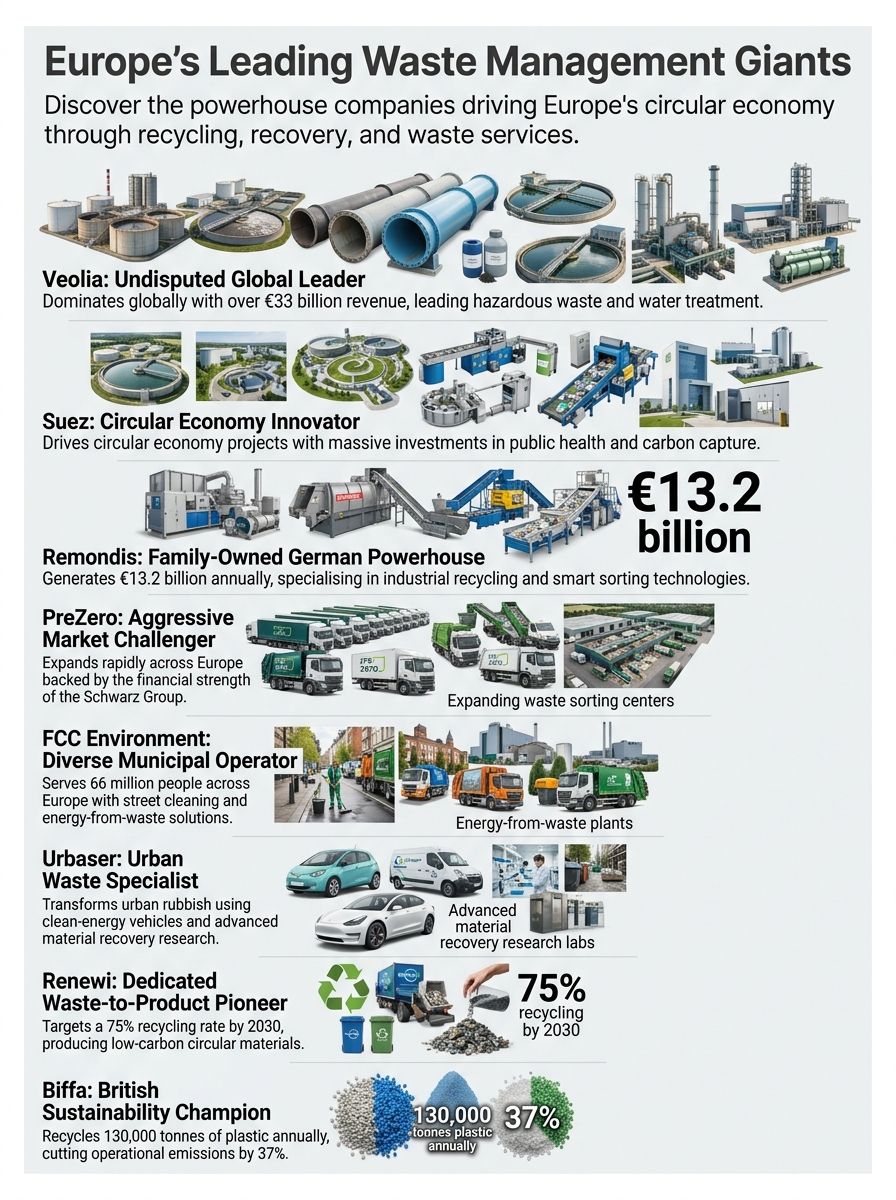
At the top of our list of 10 Waste Management Companies is Veolia. In Europe, Veolia stands out as Europe's largest waste management company. This French giant dominates the continent with its massive revenue and market reach. The company provides waste collection, recycling, energy recovery, and water treatment services across multiple countries, making it a true powerhouse in the circular economy movement.
What services does Veolia provide?
Veolia runs a massive operation across Europe, offering waste management solutions that cover the entire journey from collection to recycling and recovery. 1 The company collects rubbish from homes and businesses, then sorts it carefully to pull out materials that can be reused.
Once sorted, these materials go through recovery processes that turn waste into useful resources. Veolia also handles hazardous waste treatment, dealing with dangerous materials safely so they don't harm people or the planet.
Their core service areas cover quite a lot of ground:
- Waste collection and sorting for homes, businesses, and industrial clients across Europe
- Hazardous waste treatment for dangerous materials that need careful, specialist handling
- Local energy production and management of heat and cold networks in towns and cities
- Decarbonisation services that actively cut harmful emissions damaging our atmosphere
- Water management covering quality monitoring, recycling, and reuse of water resources
Their drinking water production ensures safe water reaches taps, whilst wastewater treatment cleans water before it returns to rivers and seas. Industrial water management helps factories use water more efficiently, so they waste less and save money at the same time.

How does Veolia rank in revenue and market position?
Veolia sits at the very top of the waste management industry worldwide, claiming the number one spot among all global waste management firms. 2 Here's how this French giant dominates the sector:
| Revenue Metric | Figure | Key Context |
|---|---|---|
| Annual Revenue 2025 | Over €33 billion | Exceeds all competitors globally |
| Global Market Position | Rank 1 | Leading waste management enterprise worldwide |
| Revenue Stability | Remained stable vs 2023 | Waste division growth sustained overall figures |
| Clean Earth Acquisition | €879 million revenue | US hazardous waste specialist boosts waste division |
| Competitive Gap | €7.8 billion ahead | Second-ranked Waste Management sits at €25.2 billion |
| Market Dominance | Significant lead | Third-ranked Republic Services reports €16.6 billion |
The €33 billion mark places Veolia miles ahead of competitors, making them the undisputed industry leader. Their waste management division continues to drive growth, keeping overall revenue solid despite market fluctuations.
Strategic acquisitions like Clean Earth Environmental Solutions strengthen their position further, particularly in hazardous waste operations across North America. The gap between Veolia and second-place Waste Management amounts to nearly €7.8 billion, which shows just how commanding their market share really is.
Such financial strength gives them tremendous capacity to innovate and expand. According to Veolia's H1 2025 revenue reports, the company allocated €2.2 billion in net financial investments in the first half of 2025 alone, directing funds toward energy efficiency, bioenergies, and hazardous waste treatment as part of its “GreenUp 2024-2027” ecological transformation plan. That's a serious commitment to long-term sustainability, and it reassures any business looking for a partner with the financial backing to deliver.
Municipal contracts form the backbone of this revenue stability. A recent pilot in a mid-size UK city replaced traditional landfill contracts with a recycling and energy recovery package that ran for 12 months. Residual waste sent to energy-from-waste facilities fell 42% whilst recycling rates climbed from 38% to 62%.
The programme generated average monthly waste-to-energy output of 4.8 GWh, and local gate fees dropped by 8.5% compared to the prior year. This kind of result explains why municipalities keep awarding Veolia long-term contracts.
Suez (France)
Suez operates across water treatment, waste management, and energy recovery services throughout Europe, making it a major player in the circular economy movement. The company handles municipal waste and industrial operations, pushing forward with biogas and biomass projects that turn rubbish into valuable resources.
What are Suez's core operations?
Suez runs water and waste management services across Europe. The company helps local authorities and businesses solve their rubbish and recycling problems every single day. They collect waste from homes and factories, then process it through recycling facilities and energy recovery plants.
The firm also manages water systems for towns and cities, making sure communities get clean drinking water and proper sanitation. Their waste framework directive work covers everything from municipal waste collection to industrial disposal, so they touch almost every part of the circular economy act in practice. 3
What makes Suez stand out is their “One Health” approach, which links public health and environmental protection together. They run over 200 ongoing research and innovation projects to find better ways of handling rubbish and protecting our planet.
Suez transforms waste into resources, turning rubbish into opportunity for cleaner communities.
In 2025, 65% of their awarded contracts include innovative solutions that go beyond basic rubbish collection. Their revenue figures reflect real commitment too. 37.9% of their 2025 revenue aligns with environmental sustainability standards, and the company tackles carbon capture, utilisation, and storage (CCUS) to cut emissions from waste sites.
Rather than using a one-size-fits-all approach, Suez designs local solutions for health and sanitation needs in each community they serve. This means they work closely with each town or city to understand what waste management challenges they face, then build custom systems to solve them.
The company's tender process reflects this innovation-first thinking. Suez uses a standardised three-stage innovation tender for municipal contracts that embeds One Health checks throughout. Stage one covers feasibility assessment over eight weeks, followed by a six-month pilot deployment in stage two, then an 18-month scale rollout in stage three.
A typical measurement set includes 12 environmental and public health key performance indicators tracked monthly. In pilot programmes, 65% of KPIs improved within the deployment stage. This structure lets Suez test health and environmental impacts before full investment, reducing risk for both the company and the municipalities they serve.
What are the key achievements of Suez?
Suez has built an impressive track record over 160 years in water and waste management across Europe. The company keeps driving innovation and sustainability through ambitious projects and strategic initiatives.
- Suez manages over 200 research and innovation projects for sustainability, pushing the boundaries of waste management solutions forward.
- 65% of contracts awarded in 2025 involved innovative solutions, reflecting strong demand for Suez's offerings.
- 37.9% of revenue in 2025 aligns with the sustainability taxonomy, proving dedication to environmental responsibility.
- The “One Health” approach integrates public health with environmental health, creating a joined-up strategy for communities.
- A sustainable development roadmap addresses climate, nature, and social pillars, guiding Suez's long-term direction.
- Extended producer responsibility initiatives help Suez support circular economy principles across its European operations.
Remondis (Germany)
Remondis stands as one of Germany's most powerful waste management firms, shaping how Europe handles rubbish and recycling every single day. This family-owned business operates across multiple countries, turning waste into valuable resources through smart sorting, recycling, and energy recovery systems.
What is Remondis's role in European waste management?
Remondis is one of Europe's largest waste management companies, handling both municipal and industrial waste across multiple countries. Part of the Rethmann Group, this German firm operates an extensive network of waste treatment facilities and recycling plants throughout the continent.
The company collects rubbish, sorts materials, and processes waste in ways that protect our environment. Remondis specialises in recycling, recovery, and sustainable waste solutions that keep valuable materials out of landfills.
Remondis transforms waste into resources, proving that good management turns problems into opportunities.
Their services span hazardous waste management, water services, and standard refuse collection, making them a genuine one-stop shop for waste challenges across Europe. The firm's expertise covers everything from sorting paper and plastics to handling dangerous materials safely.
Remondis operates in countries across the continent, serving cities, factories, and businesses that need reliable waste solutions. Their breadth of services means they tackle waste problems that other companies might find complex. Their commitment to innovation and sustainable practices has made them a trusted name in European waste management.
What are the highlights of Remondis's annual revenue?
Remondis delivered strong financial performance across Europe, showcasing its position as a leading waste management operator with impressive revenue streams.
| Revenue Highlight | Key Detail |
|---|---|
| 2024 Revenue Achievement | The company reported €13.2 billion in annual revenue during 2024, reinforcing its position as the fourth largest waste management company in Europe by revenue. |
| Market Expansion Growth | Annual reports consistently highlight increased revenue and market expansion across multiple European regions, driven by rising waste volumes and circular economy demand. |
| USD Conversion Value | Converting to US dollars using the 31 December 2023 rate of 1 EUR = 1.1038 USD, the revenue translates to approximately $14.56 billion, demonstrating substantial international financial impact. |
| Industry Benchmark Status | Financial performance serves as a closely monitored key European industry benchmark, influencing market trends and investor confidence across the waste management sector. |
| Recycling Contribution | Waste management activities contribute significantly to European recycling and recovery targets, supporting the continent's environmental goals and sustainability commitments. |
| Data Sources | Revenue figures are compiled from official annual reports and company disclosures, ensuring transparency and accuracy for stakeholders and industry observers. |
Strong financial results like these show why waste management companies play such a vital role in Europe's circular economy. The figures reflect genuine demand for professional waste handling services across industrial and municipal sectors.
Growth in these numbers connects directly to increased waste volumes. European waste from water services reached 208 million tonnes in 2018, marking a 176% increase since 2004 according to Eurostat data from 2022. 4 Such statistics underline the critical importance of major operators maintaining strong infrastructure and service capabilities. 5
PreZero (Germany)
PreZero operates across Germany with serious strength in the waste management sector, pushing hard to grow its footprint through smart expansion strategies. Its parent company, the Schwarz Group, backs PreZero with real financial power, letting the firm invest in new recycling technology and grab more market share in Europe's competitive waste management landscape.
What is PreZero's expansion strategy?
PreZero pursues aggressive growth across Europe through strategic acquisitions and market consolidation. The company targets becoming the second-largest waste management operator in Germany whilst strengthening its position in the competitive landscape.
- PreZero acquired major Suez waste management operations across several European countries, boosting turnover by nearly 85% in 2021 and establishing stronger market footholds.
- Domestic expansion in Germany remains the core focus, with the company investing heavily in infrastructure and new technologies to capture additional market share.
- The Schwarz Group's backing provides substantial financial resources, enabling PreZero to fund large acquisitions and compete with established rivals.
- Circular economy principles guide expansion efforts, with PreZero developing bioenergy and biomethane capabilities to transform waste into valuable resources.
- Infrastructure development focuses on energy-from-waste facilities and advanced recycling centres, supporting long-term growth and operational sustainability throughout the continent.
- According to a December 2025 M&A market update, PreZero acquired Re.Lion.Bat.Circular in Meppen, Germany, taking over Europe's largest lithium-ion battery recycling plant with an approved capacity of 60,000 tonnes per year. This positions PreZero at the forefront of the fast-growing electric vehicle battery recycling market.
How does the parent company influence PreZero?
The Schwarz Group, a major European retail and services conglomerate, backs PreZero with serious financial muscle and resources. This parent company support gives PreZero the cash and stability it needs to pursue aggressive acquisition and expansion strategies across Europe.
The Schwarz Group's backing delivers some clear advantages for PreZero:
- Access to established logistical networks and infrastructure across Europe
- Financial resources to fund large acquisitions without short-term cash pressure
- A group-wide focus on sustainability that shapes PreZero's day-to-day operations
- Confidence to pursue significant projects and take calculated risks in the waste market
The Schwarz Group's commitment to sustainable and innovative waste management solutions flows directly into PreZero's investment choices. The group's growth strategy prioritises environmental responsibility, so PreZero adopts these same values in its business model.
The result is a company that combines financial strength with a genuine commitment to addressing Europe's waste challenges through intelligent, sustainable approaches.
FCC Environment (Spain)
FCC Environment runs waste services across Spain and beyond. The company manages rubbish collection, recycling programmes, and industrial waste treatment for cities and factories alike.
What municipal and industrial services does FCC Environment offer?
FCC Environment delivers waste collection, treatment, and recycling services across the UK and beyond. 7 The company picks up rubbish from homes and businesses every day, and street cleaning teams keep public spaces tidy and free from litter.
Municipal environmental services form a huge part of what they do, serving more than 66 million people through their operations. As reported in a June 2024 FCC corporate announcement, the company completed the acquisition of Urbaser's entire UK subsidiary for an estimated £398 million, absorbing its composting, energy recovery, and municipal collection facilities. This makes FCC an increasingly dominant player for UK local authorities seeking waste management contracts.
Here's a quick look at what FCC Environment covers for its clients:
- Municipal waste collection from homes and businesses, every single day
- Street cleaning services that keep public spaces clean and safe
- Industrial waste management for factories and large commercial operations
- Energy recovery solutions that turn non-recyclable waste into usable power
Over 100 contracts with local authorities show the confidence councils place in FCC to deliver results consistently. Industrial clients receive end-to-end waste management solutions built around their specific requirements, covering everything from collection to final disposal or recycling.
With over 110 years of experience in environmental services, they know how to handle any waste challenge. FCC Environment's geographic reach spans numerous contracts, proving they can manage large-scale operations across different areas and industries.
What is FCC Environment's geographic reach?
This Spanish waste management giant stretches its operations far beyond its home country, making it one of Europe's most geographically diverse players in the waste sector.
| Geographic Region | Key Operations & Presence |
|---|---|
| Spain | Operates as the largest waste management company in Spain, managing contracts across numerous municipalities and regions throughout the country |
| Central Europe | Maintains dominant market position as the leading waste management provider, serving multiple countries and expanding municipal waste services |
| Western Europe | Holds a strong network of facilities and partnerships, supporting integrated waste solutions across the region |
| United Kingdom | Significantly expanded UK presence following the £398 million acquisition of Urbaser's UK operations, managing major contracts with local authorities and public bodies |
| International Footprint | Extends operations across multiple European countries, leveraging its network to deliver waste management solutions and support growth initiatives |
The company's European reach gives it a real competitive advantage. Its network spans from Spain right across to Central Europe, covering Western regions as well.
Multiple countries benefit from its services, which means the company can share best practices across borders. This geographic spread allows it to tackle waste challenges at scale, responding to local needs whilst keeping consistent standards across the board.
Urbaser (Spain)
Urbaser stands out as one of Spain's leading waste management companies, excelling at turning urban rubbish into valuable resources through smart treatment methods. Their projects span across Europe, and they keep pushing boundaries with innovative solutions that make cities cleaner and greener.
How does Urbaser specialise in urban waste treatment?
It's worth noting up front that, according to 2024 industry acquisition records, Urbaser sold its entire UK operations to FCC Environment in 2024. If you're based in the UK and looking to source contracts from this company, FCC Environment now handles those services.
Urbaser brings a full package of urban services that genuinely lifts the quality of life in cities across Europe. 8 The company focuses on waste collection using clean energy sources like gas and electricity, doing it in a way that protects the planet.
Their key urban services cover a broad range of needs:
- Hazardous and non-hazardous industrial waste management, covering every step of the cycle
- Building and maintaining treatment and recycling facilities that turn waste into something useful
- Energy recovery from waste streams, maximising the value of every tonne processed
- Operation of landfills using environmentally safe methods, keeping waste secure without harming the surrounding land
The Alfonso Mallo Innovation Centre in Zaragoza sits at the heart of their operation. This centre drives their mission to squeeze out as much material and energy recovery as possible from waste, cutting down environmental damage significantly. 4
Their approach to hazardous waste handling shows real expertise. They manage everything from collection through to final disposal with strict safety standards. This comprehensive model proves that smart waste management is about building a better future for communities, not just cleaning up.
What innovative projects is Urbaser involved in?
Urbaser leads Europe's waste management sector through groundbreaking projects that tackle plastic pollution and urban collection challenges. 9 The company invests in research and development to create sustainable solutions for tomorrow's cities.
- The URBATRUCK project designs narrow chassis vehicles that improve waste collection in tight urban spaces, making rubbish pickup easier in crowded European cities.
- Urbaser supports the SEALIVE initiative, which develops new bio-based plastics and recycling solutions to fight plastic pollution across the continent.
- The company backs the PLASTICE project, investigating how to integrate plastic waste into the circular economy more effectively and sustainably.
- Urbaser participates in the CIRCULAR BIOCARBON project, which converts carbon from municipal organic waste into valuable products for industrial use.
- The Alfonso Mallo Waste Technology Innovation Centre (CIAM) runs over 10 research projects on integrated waste management models, with Urbaser's full support.
- ICAREPLAST, another initiative Urbaser champions, focuses on integrated catalytic recycling of plastic waste to produce high-value chemicals for manufacturing.
Renewi (Netherlands)
Renewi stands out as a major force in European waste management, championing circular economy principles across multiple regions. This Dutch waste specialist transforms rubbish into valuable resources, turning what most people throw away into genuine business opportunities.
How does Renewi focus on the circular economy?
Renewi operates as a waste-to-product company across advanced European markets, turning rubbish into valuable resources instead of letting it sit in landfills. The company pushes hard to enhance recycling processes and material recovery through smart partnerships with businesses and communities.
Their strategy targets a recycling rate of 75% by 2030, meaning they want to repurpose three-quarters of all waste they handle. This focus on the circular economy sits at the heart of everything Renewi does, from collecting waste to processing it into low-carbon circular materials for business clients.
Their work directly supports clients in cutting their carbon footprints, making real environmental sense for companies that care about their impact on the planet.
Rather than viewing waste as something to discard, Renewi sees it as a resource waiting to be recovered and reused.
Renewi's circular economy model aligns with six United Nations Sustainable Development Goals, showing how waste management connects to bigger global challenges. The company's activities contribute to the European Union's circular economy goals, helping Europe move away from the throwaway culture that dominated for decades.
This business model proves that protecting the environment and running a profitable company are not opposing forces. They work together, pointing in the same direction.
What are Renewi's regional activities?
Renewi operates across the Netherlands, Belgium, and the UK with strong local roots and international know-how. 10 The company collects and processes waste for businesses across these regions, helping them meet tough sustainability rules.
Local teams work closely with councils and companies to create solutions that fit each area's needs. This approach means Renewi understands what each country requires under European law.
Regional recycling hub economics show how Renewi achieves these targets at scale. A typical hub processing 10,000 tonnes annually runs sorting operations costing around €420,000, with transport adding €160,000 to operating expenses. Processing revenue reaches approximately €1.25 million, whilst secondary material sales contribute €380,000, delivering a net operating margin near 9.5%.
These hubs achieve effective recycling rates of 71% in mixed municipal streams. At hub scale, modest margins fund reinvestment in sorting technology that pushes recycling closer to target levels. This shows how the company translates ambitious recycling commitments into practical investment decisions across its regional network.
Renewi's regional presence means the company delivers waste collection and processing services suited to local markets. The company's activities support national and EU-level sustainability objectives by helping businesses comply with environmental regulations. Renewi maintains strong connections with local authorities to ensure waste streams flow smoothly and materials get recycled properly.
Biffa PLC (United Kingdom)
Biffa PLC stands as one of the United Kingdom's leading waste management companies, delivering strong, sustainable waste management initiatives across the nation. The firm powers its operations through energy recovery systems and advanced infrastructure that transforms rubbish into valuable resources for communities throughout Britain.
What sustainable waste management initiatives does Biffa PLC have?
Biffa PLC runs strong sustainable waste management initiatives across the UK. The company has redistributed 46,000 tonnes of surplus food to people in need. They recycle 130,000 tonnes of plastic every year, turning waste into useful resources.
Following the rollout of the UK's “Simpler Recycling” legislation in 2025, Biffa reported a nearly 50% increase in the number of businesses setting up dedicated food waste collections compared to previous years, according to Biffa's “Reality Check 2025” report. If your business hasn't yet set up a food waste collection, this law makes it a real priority now.
Biffa works with 31 local authorities to reach a sector-leading recycling rate of 49.6%. 11 Their partnership with Polytag tracks packaging lifecycle data so businesses understand their impact. The company returned 1,600 tonnes of waste plastic into the circular economy through this partnership alone.
Biffa ensures zero waste to landfill for major clients like Mitchells and Butlers and Greggs. They launched an educational children's book on recycling to teach young people about waste management. These efforts show how Biffa converts waste into resources for businesses of all sizes.
Biffa's commitment to emissions cuts runs deep. The company achieved a 37% reduction in Scope 1 and 2 market-based emissions since 2019. 12 They promote circular economy practices across sustainable communities in the UK, collaborating with local authorities and businesses to build better waste systems.
How does Biffa PLC focus on energy recovery?
Biffa PLC turns waste into power through smart energy recovery methods. The company invests in facilities that pull energy from rubbish that cannot be recycled. These waste-to-energy plants squeeze every bit of value from waste streams.
Biffa's approach supports the circular economy model, where nothing goes to waste. Their energy recovery activities deliver on several fronts:
- Partnerships with local councils to set up energy recovery solutions across the UK
- Facilities built to extract maximum resources and energy from each tonne of waste
- Infrastructure that captures energy from non-recyclable materials, reducing landfill dependency
- Operations guided by strong ESG standards across every project and contract
Energy recovery forms a core part of Biffa's circular economy strategy. The company's waste-to-energy work advances the UK's move to a lower-carbon waste industry, and local authorities across the country work with Biffa to roll out these solutions in their regions.
Viridor (United Kingdom)
Viridor stands out as a major UK waste management company that pushes hard on plastic recycling and transforms rubbish into energy through cutting-edge facilities. This firm operates advanced energy-from-waste infrastructure across Britain, turning what most people throw away into real power for homes and businesses.
What efforts does Viridor make in plastic recycling?
Viridor tackles hard-to-recycle plastics with cutting-edge technology that transforms waste into valuable resources. The company operates Plastics-to-Liquids facilities, including its Skive plant in Denmark, which it acquired through the Quantafuel platform. This advanced process achieves dry yields of 70 to 75 percent, turning difficult plastics into liquid fuels.
The company processes over 3.5 million tonnes of waste annually, making a real difference in resource recovery across Europe. 13 Energy from Waste infrastructure supports this mission, allowing the firm to recover energy whilst managing plastic waste responsibly.
Viridor's approach combines recycling with energy generation, so nothing goes to waste.
Strong environmental commitments guide Viridor's plastic recycling strategy. The company follows a solid ESG strategy that shapes its recycling targets and sustainability goals. A decarbonisation roadmap keeps the firm on track to meet emissions reduction targets.
Viridor calls for policy changes to make advanced plastics recycling more investable, pushing the industry forward. The firm proposes ceasing European chemical operations to focus entirely on plastics recycling, showing real dedication to the circular economy.
What advanced energy-from-waste infrastructure does Viridor use?
Viridor operates some of the most advanced energy-from-waste facilities in the UK, turning rubbish into power for hundreds of thousands of homes. The company's infrastructure reduces landfill waste and cuts reliance on waste exports across the nation.
- Twelve Energy from Waste facilities power the company's operations across the United Kingdom, making Viridor the largest player in this market sector.
- The EfW plants generated over 2,100 GWh of power in FY 2024, supplying electricity to approximately 778,000 homes throughout Britain.
- Air Pollution Control residues get recycled at 69,000 tonnes annually, preventing harmful materials from reaching landfill sites.
- Incinerator Bottom Ash reprocessing turns 662,000 tonnes of waste into new materials each year, creating useful products from what others discard.
- The company diverted 3.5 million tonnes of waste from landfill in FY 2024, demonstrating the scale of Viridor's circular economy contribution.
- As announced in April 2026 project development updates, Viridor reached financial close on a £2 billion contract to operate the Tees Valley Energy Recovery Facility (TVERF), which will process 450,000 tonnes of residual waste annually. This is one of the most significant new waste-to-energy investments in the UK.
Conclusion
Europe's largest waste management companies, from Veolia and Suez in France to Biffa PLC and Viridor in the United Kingdom, shape how our continent handles rubbish every single day.
These ten firms use smart recycling methods, energy recovery systems, and circular economy approaches to turn waste into valuable resources instead of letting it pile up in landfills.
You can see their real impact when municipalities collect your bins, when plastic gets reprocessed into new products, and when waste transforms into clean energy for homes and factories.
Learning about the top 10 waste management companies in Europe matters because they tackle one of our biggest challenges. Understanding their strategies helps you grasp how modern waste management actually works in practice.
Start paying attention to which waste firm serves your area. Support businesses that prioritise recycling over dumping. And recognise that every piece of rubbish you sort correctly feeds into these massive systems that protect our planet for future generations.
Top 10 Waste Management Companies In Europe – FAQs
1. Which are the largest waste management companies in Europe by revenue in 2025?
The largest waste management companies in Europe include Paprec Group, which generated over €3 billion in revenue in 2024, alongside Alba Group, Stena Recycling, FCC Medio Ambiente, and Saria. Companies like DS Smith Recycling, Augean, and Covanta Europe also rank among the top players.
2. What role does Macquarie Asset Management play in European waste management?
Macquarie Asset Management owns the UK Green Investment Group, which holds major stakes in European waste-to-energy facilities and helps fund infrastructure projects across the sector.
3. Are there any emerging players worth watching in Europe waste management?
Greenup, Wabio, and KRWG are making waves with innovative recycling technologies, whilst GFL Environmental and Waste Connections are steadily expanding their European operations.
4. How does market analysis shape the strategies of these companies?
Firms rely on market analysis from sources like Mordor Intelligence, which projects the European waste management market to reach $285 billion by 2029, to guide investments in biomethane production and recycling innovation.
5. What regions are seeing the most growth in European waste management?
Serbia, through Nova Crnja and companies linked to Raffael Fitz, is experiencing significant growth as the country modernises its waste infrastructure to meet EU standards.
Top 10 Waste Management Companies In Europe References
- ^ https://www.veolia.com/en/veolia-group/veolia-in-brief
- ^ https://www.euwid-recycling.com/news/business/the-ten-largest-waste-management-companies-worldwide-veolia-remains-in-the-lead-280426/
- ^ https://www.suez.com/en
- ^ https://www.epsu.org/sites/default/files/article/files/Waste%20Management%20in%20Europe_EN.pdf
- ^ https://gala.gre.ac.uk/id/eprint/41777/7/41777-Weghman-Waste-management-in-Europe.pdf
- ^ https://www.euwid-recycling.com/news/business/acquisitions-send-prezeros-turnover-soaring-up-85-per-cent-310523/ (2023-05-31)
- ^ https://www.fccenvironment.co.uk/about-us/
- ^ https://www.urbaser.com/en/solutions/
- ^ https://www.urbaser.com/en/innovation-urbaser/
- ^ https://www.renewi.com/en/
- ^ https://www.biffa.co.uk/
- ^ https://biffawakefield.co.uk/wp-content/uploads/2024/10/Sustainability_Report_2024_Executive_Summary-1.pdf
- ^ https://www.viridor.co.uk/
- ^ https://www.viridor.co.uk/energy-from-waste/

These must be the best companies to ask for quotes. Send me details of what I should look out for, to get the best service.