

Your commercial waste is collected every week. The bins are emptied, invoices arrive, and the service appears to be working.
But how much do you actually know about what happens after your waste leaves?
For UK businesses, commercial waste compliance isn't simply about paying a reputable-looking company to take waste away. Businesses have a duty of care over their waste, including checking that waste is transferred to an authorised person. In England, official guidance specifically tells businesses to check whether the person or business taking their waste is authorised.
That makes a simple question surprisingly important:
Could you demonstrate that your current waste arrangements are what you think they are?
The government's 2026 Waste Crime Action Plan and continuing rollout of digital waste tracking make that question increasingly timely. Digital tracking is intended to improve transparency and give regulators better information about waste movements. ?cite?turn0search6?turn0search15?
The sensible response isn't to become suspicious of every waste contractor. It's to check whether small gaps, unexplained changes or inconsistent records are developing inside an arrangement that everybody has stopped questioning.
Why Normal Waste Collections Can Hide Compliance Weaknesses
Waste has an unusual characteristic compared with most things a business buys.
You pay somebody to make it disappear.
Once the collection vehicle leaves, operational attention usually moves elsewhere.
That creates an obvious visibility problem.
Accounts may know what was paid.
Facilities may know when the bins were emptied.
Procurement may know which contractor was originally appointed.
Site staff may know what goes into each container.
Yet nobody necessarily has the complete picture.
Ask these questions:
- Who actually collects each waste stream?
- When were their current details last checked?
- What is the expected destination or route?
- Have any subcontractors become involved?
- Do recent records reflect what happens operationally?
- Can unexplained changes be accounted for?
Not knowing one answer doesn't prove anything improper.
But not knowing that you don't know is where the greater weakness begins.
Familiarity Isn't the Same as Current Due Diligence
A new commercial waste contractor usually receives scrutiny.
Credentials are checked. Prices are compared. Services are agreed. Documents are collected.
Then the contractor becomes familiar.
“We've used them for years” begins to feel reassuring.
Unfortunately, familiarity isn't verification.
Waste arrangements can change. Companies change. Personnel change. Collection routes and destinations can change. Subcontractors can become involved.
The relevant question isn't:
“Did somebody check this company when we appointed them?”
It's:
“What current information are we relying on now?”
In England, the Environment Agency maintains a public register of waste carriers, brokers and dealers. GOV.UK guidance says businesses should check authorisation before transferring waste and use the public register to check evidence provided. ?cite?turn0search3?turn0search4?
That's a relatively low-effort check with potentially high value.
Don't Confuse a Collection With a Waste Chain
One of the easiest assumptions to make is that the company emptying the bin represents everything that happens to the waste.
It may not.
Waste can subsequently pass through transfer, sorting, recycling, treatment, recovery or disposal operations.
That doesn't mean every waste producer needs to investigate every movement like a detective.
It does mean there is an important difference between these statements:
“XYZ Waste collects it.”
and:
“XYZ Waste collects it, and we understand the expected arrangement and have appropriate records supporting it.”
That distinction becomes particularly useful when something changes.
An unfamiliar vehicle appears.
Another company name enters the paperwork.
The expected destination changes.
A subcontractor becomes involved.
All may be legitimate.
The red flag isn't necessarily the change.
It's a material change nobody can satisfactorily explain.
Three Levels of Concern: Green, Check and Investigate
A useful commercial waste compliance review shouldn't classify everything as either “fine” or “illegal”.
That creates two problems.
It encourages businesses to ignore small uncertainties because they don't appear serious enough.
And it can encourage unnecessary alarm when an ordinary administrative error occurs.
A better approach is to use three levels.
GREEN: Reasonably Explained
The information is current enough to be relied upon, relevant records are available and the arrangement broadly makes sense.
Continue normal monitoring.
CHECK: Something Needs Verification
Information is missing, old, inconsistent or unclear.
There may be an innocent explanation, but somebody needs to establish what it is.
A Check isn't an accusation. It's an unresolved question.
INVESTIGATE: Don't Rely on Assumption
A material discrepancy remains unexplained, several warning indicators overlap, or reasonable attempts to obtain clarification create further questions.
“Investigate” still doesn't mean somebody has committed an offence.
It means the business should no longer simply assume that everything is satisfactory.
Warning Sign: Your Records and Reality Are Drifting Apart
One incorrect date or missing document can be an administrative error.
Repeated inconsistencies deserve more attention.
For example, suppose your records describe one waste stream in a particular way, but operational staff tell you that what goes into the container has changed.
That doesn't automatically indicate waste crime.
It may simply mean the administrative process hasn't caught up with operations.
But it matters because the records are gradually becoming less representative of reality.
Try a simple test.
Choose several recent ordinary collections and compare the available documentation with what responsible site staff say actually happened.
You're looking for consistency, not perfection.
If the same discrepancy keeps appearing, stop treating it as a one-off error.
Warning Sign: Nobody Can Explain the Destination
Ask somebody responsible for waste:
“Where is this waste expected to go after collection?”
Answers such as “for recycling somewhere” or “the contractor sorts all that out” should prompt another question.
Not because those answers prove wrongdoing.
They reveal a knowledge gap.
The distinction is important.
Knowing who takes the bin away isn't necessarily the same as understanding the expected next stage of the waste journey.
If the destination or route has changed, establish why.
If nobody knows, check.
If reasonable attempts to obtain an explanation repeatedly fail, the level of concern increases.
Warning Sign: Different Records Tell Different Stories
Individual documents can look perfectly ordinary.
The useful clues often appear when you compare them.
Look at a recent sample of:
- invoices;
- internal collection information;
- waste documentation;
- contractor details;
- recorded waste descriptions;
- dates and collection frequencies;
- destination information where available.
Then ask:
Do these records broadly describe the same arrangement?
An invoice is particularly easy to overvalue.
An invoice proves that somebody charged your business for a service and records whatever information appears on it. It shouldn't automatically be treated as a complete waste audit trail.
The better question is:
Can we explain the waste movement behind the payment?
The Pattern Matters More Than One Imperfection
Suppose an unfamiliar vehicle collects your waste.
By itself, that may mean very little.
The regular vehicle could be unavailable.
A legitimate subcontractor might have been used.
Now add another fact: nobody recognises the operator.
Then another: the expected destination isn't clear.
Then another: recent documentation contains a different company name.
Then another: attempts to clarify the arrangement produce conflicting explanations.
None of those observations individually proves waste crime.
Together, however, they create a pattern of unresolved uncertainty.
This is the distinction businesses should learn to recognise:
Several connected weak signals may deserve more attention than one dramatic-looking anomaly.
A Quick Commercial Waste Compliance Self-Check
Pick one ordinary recent collection rather than reviewing years of files.
Ask:
WHO? Can you identify who actually collected it?
WHAT? Does the recorded waste reasonably correspond with what left the site?
WHEN? Can you establish when the collection occurred?
WHERE? Can you identify the expected next destination or route?
AUTHORITY? Can you find current information supporting your use of the contractor?
RECORDS? Do the relevant records broadly reconcile?
EXPLANATION? If something doesn't match, can the discrepancy be satisfactorily explained?
Don't simply count yes and no answers.
Look for where certainty disappears.
That's often the most useful discovery.
What Deserves Attention Now?
Prioritise discrepancies that affect your understanding of who handled the waste, what happened to it and where it was expected to go.
Also pay attention to clusters.
An old contact name may be housekeeping.
An unexplained collector change combined with an uncertain destination and conflicting documentation deserves more attention.
Where something needs checking:
- Define the exact discrepancy.
- Check current information.
- Ask a specific question.
- Compare the answer with your records.
- Correct internal record weaknesses.
- Record how the issue was resolved.
- Escalate scrutiny if important questions remain unanswered.
Keep enquiries factual.
Don't accuse when you should verify.
Equally, don't normalise something merely because it has happened repeatedly.
Digital Waste Tracking Makes Traceability More Important
The UK is moving towards substantially more digital visibility of waste movements, but the timetable is phased rather than a single end-of-2026 requirement for every business.
As of August 2026, permitted or licensed waste receiving sites are due to enter mandatory digital reporting from October 2026 in England, Wales and Northern Ireland, with Scotland following in January 2027. Waste collectors are planned to move to mandatory use later, from October 2027. ?cite?turn0search0?turn0search11?
That distinction matters.
Businesses shouldn't assume that every waste producer must implement the full digital tracking service by the end of 2026.
But the direction is clear: waste movements are becoming more digitally visible, and government explicitly links digital tracking with improved transparency and enforcement against rogue operators. ?cite?turn0search6?
There's an important practical lesson here:
Digitising poor information doesn't make it good information.
If your business can't explain its existing arrangements, now is a sensible time to identify those gaps.

Want the Complete 7-Point Warning Check?
This article deliberately gives you enough to begin checking your commercial waste arrangements.
It doesn't reproduce the complete diagnostic resource.
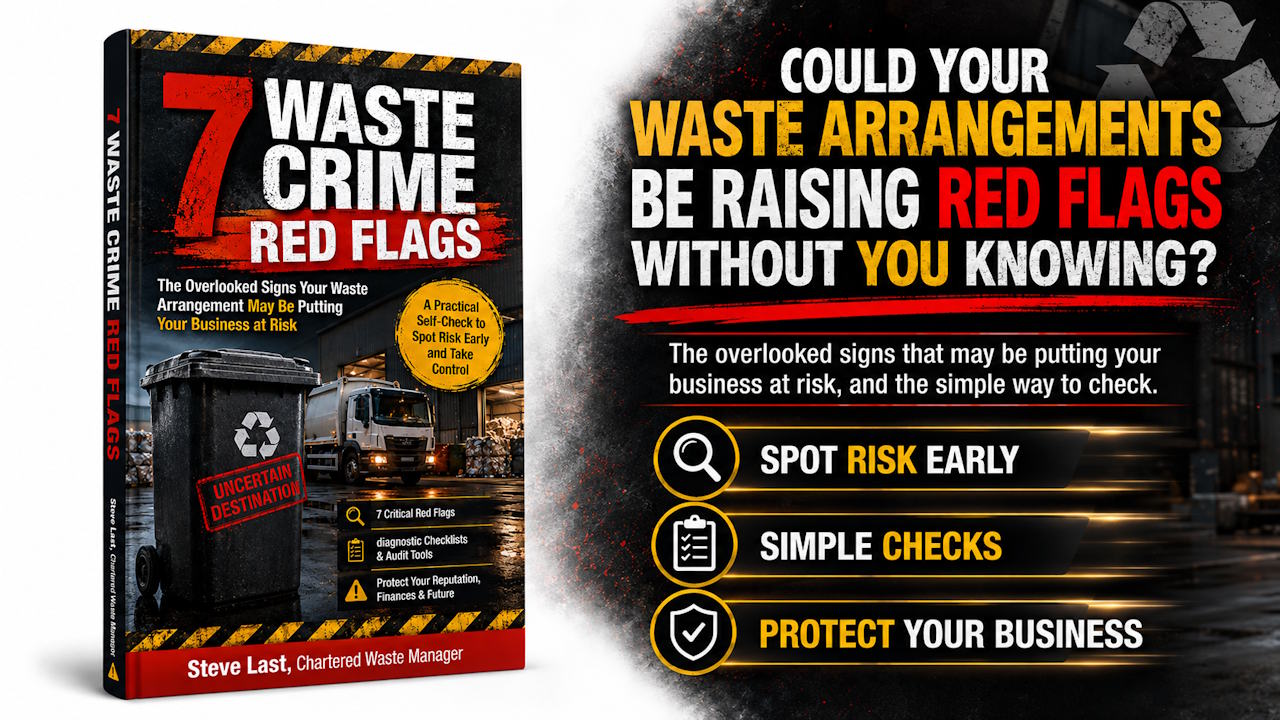
7 Waste Crime Red Flags by Steve Last, Chartered Waste Manager is the focused Warning Report for business owners, facilities managers, operations managers and environmental managers who want to examine their current arrangements in more detail.
It includes the complete seven-red-flag diagnostic approach, the Green / Check / Investigate classifications, the One-Load Trace Test, contractor clarification questions and the Waste Crime Exposure Check.
The purpose isn't to make you assume your contractor is doing something wrong.
It's to help you identify what you know, what you're assuming and what deserves checking.
Get 7 Waste Crime Red Flags and put one ordinary recent waste collection through the complete check.
Don't Wait for a Problem to Discover What You Don't Know
Commercial waste compliance isn't demonstrated simply because the bins disappear on schedule.
The more useful test is whether your business understands the arrangement behind those collections and can support that understanding with appropriate information.
Start small.
Choose one recent collection.
Trace who collected it, what it contained, where it was expected to go and what records support those answers.
If everything reconciles, you've gained reassurance.
If it doesn't, you've discovered where to look next.
And that's exactly when a warning check is most valuable: while the problem is still an unanswered question you can investigate, rather than a history you have to reconstruct.