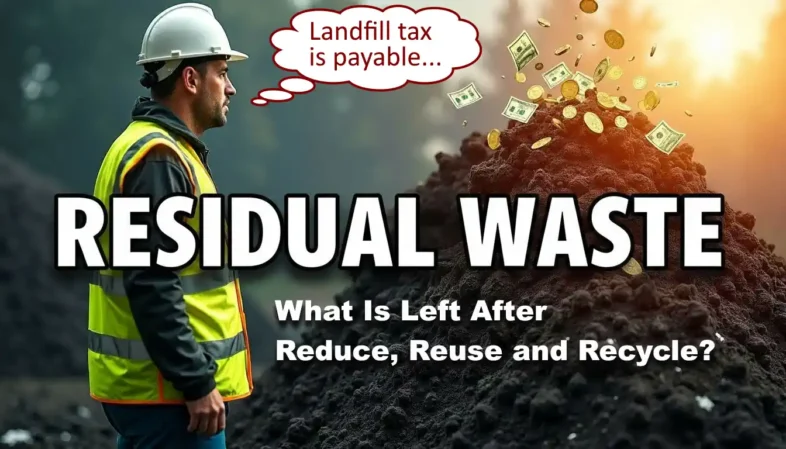
Residual waste is the waste left over after prevention, reuse, recycling, composting and other higher-value options have been used as far as reasonably practical. In everyday language, it is often called black bin waste, general waste or non-recyclable waste.
Residual waste sits near the bottom of the waste hierarchy. It is not the starting point for good waste management. It is what remains after better options have been considered first.
The correct order is simple: reduce first, reuse wherever possible, recycle properly, recover value from what remains, and dispose of as little as possible.
For the full explanation of that order, see our pillar guide: Waste Hierarchy Explained: The Complete Guide to Reducing Waste Before Recycling.
Understanding residual waste matters because it reveals how well the rest of the waste system is working. A heavy residual waste bin often means that too much material has failed to move up the hierarchy.
Key Takeaways
- Residual waste is the material left after better options have been used. It should not include clean recyclables, reusable items or avoidable food waste.
- It is often called black bin waste or general waste, but those terms can hide important differences in what the waste contains.
- Residual waste may go to energy recovery or landfill, depending on local contracts, infrastructure and waste composition.
- The waste hierarchy places residual waste near the bottom. Prevention, reuse and recycling should normally come first.
- Official guidance for England describes residual waste as non-recyclable waste that is sent for energy recovery or landfill.
- Residual waste reduction is now a key part of UK waste policy. England’s waste prevention programme aims to reduce residual waste and support a more circular economy.
- The best way to reduce residual waste is to stop useful materials entering it. That means better prevention, reuse, separation, recycling and public understanding.
What Is Residual Waste?
Residual waste is the leftover waste stream after useful materials have been removed for prevention, reuse, recycling, composting or other treatment.
In a household, residual waste usually means the contents of the general waste bin after recyclable materials, food waste, garden waste and reusable items have been separated.
In a business, it may mean the mixed waste left after cardboard, paper, plastics, metals, glass, food waste, wood, textiles, electrical items and other recoverable streams have been separated.
GOV.UK guidance on Simpler Recycling describes residual waste as non-recyclable waste that is sent for energy recovery or to landfill. Simpler Recycling: household recycling in England
That definition is useful because it makes clear that residual waste should be what is genuinely left after recycling and other options have been considered. It should not be a convenient place for everything people cannot be bothered to sort.
Residual Waste and the Waste Hierarchy
The waste hierarchy ranks waste management options from best to worst. DEFRA guidance places waste prevention first, then preparing for reuse, recycling, other recovery and disposal last. Guidance on applying the waste hierarchy
Residual waste belongs near the lower end of that hierarchy because it is what remains after the better options have been missed, exhausted or judged impractical.
This does not mean residual waste can be eliminated overnight. Some materials are contaminated, difficult to recycle, hazardous, unsuitable for reuse or not accepted by local systems. But the aim should always be to reduce the amount left in the residual stream.
For practical examples of how to move materials up the hierarchy, see: Waste Hierarchy Examples: How Homes, Businesses and Councils Should Apply It.
What Usually Goes into Residual Waste?
Residual waste varies depending on the household, business, council area, collection system and local behaviour. However, it commonly includes:
- non-recyclable packaging;
- contaminated packaging;
- plastic films or flexible plastics where no collection route is available;
- sanitary waste;
- nappies;
- some pet waste;
- vacuum cleaner dust;
- broken mixed-material items;
- small non-repairable household items;
- contaminated paper or card;
- non-recyclable composite materials;
- ashes, where accepted by the local collection authority;
- materials not accepted in local recycling collections.
The exact list varies. Residents should always check local council guidance because different authorities may accept different materials in recycling, food waste, garden waste or specialist collections.
What Should Not Be in Residual Waste?
A well-managed residual waste bin should not contain large amounts of useful material.
Items that should normally be kept out of residual waste include:
- clean paper and card;
- glass bottles and jars accepted by local recycling systems;
- metal tins, cans and foil accepted by local systems;
- plastic bottles, pots, tubs and trays where accepted;
- food waste where separate collection or composting is available;
- garden waste where composting or collection is available;
- usable clothes and textiles;
- working electrical items;
- batteries;
- paint, oil, chemicals and hazardous waste;
- reusable furniture;
- wood, metal or rubble that can be taken to suitable recycling points.
Some of these materials may require specialist collection or a household waste recycling centre rather than a kerbside recycling bin.
Where Does Residual Waste Go?
Residual waste usually follows one of three broad routes:
- Energy recovery – the waste is treated in an energy-from-waste facility or similar plant.
- Landfill – the waste is buried in an engineered landfill site.
- Mechanical or biological treatment – the waste is processed to recover some materials, stabilise organic content or produce a refuse-derived fuel.
The actual route depends on local authority contracts, commercial waste arrangements, infrastructure and the composition of the waste.
Energy recovery is usually considered higher in the hierarchy than landfill where it genuinely recovers useful energy. However, it is still below prevention, reuse and recycling.
Landfill is the lowest option and should be the last resort for materials that cannot reasonably be prevented, reused, recycled or recovered.
Is Residual Waste the Same as General Waste?
The terms are often used interchangeably, but they are not always identical.
General waste is a common everyday phrase used for the mixed waste bin. It may include genuine residual waste, but it may also include recyclable or reusable materials if people use the bin poorly.
Residual waste is a more precise term. It should mean the waste left after the better options have been applied.
So the contents of a general waste bin are not automatically true residual waste. If the bin contains cardboard, food, bottles, cans, reusable textiles or working electrical items, then it contains materials that should probably have been managed higher up the hierarchy.
Is Residual Waste the Same as Non-Recyclable Waste?
Residual waste is often described as non-recyclable waste, but that description needs care.
Some material is genuinely non-recyclable in current systems. Other material is technically recyclable but not accepted locally. Some is recyclable only if clean. Some is recyclable through specialist routes but not through kerbside collection.
For example, a plastic item may be recyclable in one system but not another. A cardboard pizza box may be recyclable if clean but not if heavily contaminated with food and grease. A broken electrical item should not go in household residual waste if a WEEE recycling route is available.
This is why public communication is so important. People need simple local guidance, not just vague instructions to “recycle more”.
Why Residual Waste Matters
Residual waste matters because it is a measure of what the system has failed to prevent, reuse or recycle.
A high residual waste level may indicate:
- too much avoidable consumption;
- poor product design;
- excessive packaging;
- weak reuse systems;
- confusing recycling rules;
- insufficient food waste collections;
- poor business waste segregation;
- contamination in recycling bins;
- lack of staff or public training;
- limited local recycling infrastructure.
Reducing residual waste is therefore not simply a disposal issue. It is a prevention, design, collection, behaviour and infrastructure issue.
The UK Residual Waste Challenge
The UK has improved compared with the old landfill-heavy era, but residual waste remains a major challenge.
Official UK waste statistics show that the UK household recycling rate was 44.6% in 2023. That means a large proportion of waste from households was still not counted as recycled. UK statistics on waste
DEFRA’s estimates of residual waste in England also show why the issue matters. Between 2019 and 2024, the estimated amount of residual waste excluding major mineral wastes sent to landfill fell from 13.4 million tonnes to 10.8 million tonnes. That was a useful reduction, but 10.8 million tonnes is still a large amount of waste. Estimates of residual waste and municipal residual waste in England
England’s waste prevention programme also states that the programme aims to make it normal to reduce and reuse, so that residual waste can be reduced and the economy can become more circular and sustainable. Waste prevention programme for England
This is the balanced picture. The UK has made progress, but residual waste is still too large to ignore.
Residual Waste in Households
For households, residual waste usually means the black bin or general rubbish bin.
Common reasons for high household residual waste include:
- food waste being placed in the general bin;
- recyclable packaging being placed in residual waste;
- confusion about what can be recycled locally;
- lack of space for separate bins indoors;
- broken items being thrown away instead of repaired;
- textiles and small electrical items being put in the wrong bin;
- overbuying and avoidable waste.
Households can reduce residual waste by applying the three Rs in order: reduce, reuse, recycle.
For a plain-English guide to that order, see: Reduce, Reuse, Recycle: Why Recycling Is Not the First Step in Waste Management.
Residual Waste in Businesses
Business residual waste is often more expensive than it first appears. A business may pay to buy materials, pay staff to handle them, pay for storage and then pay a waste contractor to take them away.
Common causes of business residual waste include:
- poor purchasing control;
- excessive supplier packaging;
- lack of clearly labelled recycling bins;
- staff confusion or lack of training;
- food waste mixed with general waste;
- recyclables contaminated with liquids or food;
- no separate collection for high-volume materials;
- unreviewed waste contracts;
- no waste audit data.
From 31 March 2025, workplace recycling requirements in England changed for most businesses, charities and public sector organisations. GOV.UK guidance explains workplace requirements under Simpler Recycling. Simpler Recycling: workplace recycling in England
For many businesses, the fastest residual waste reduction comes from separating cardboard, food waste, plastic packaging, metals and paper more effectively.
Residual Waste and Simpler Recycling
Simpler Recycling is relevant because residual waste should shrink when recyclable and compostable materials are collected more consistently.
For households in England, GOV.UK guidance states that from 31 March 2026, by default, waste collectors must collect food and garden waste, paper and card, other dry recyclable materials and residual waste from all households, including flats. Simpler Recycling: household recycling in England
This should make the distinction between recyclable materials and residual waste clearer. But it will not solve the problem on its own. People still need to use the right container, keep materials clean and avoid putting reusable or hazardous items in the general waste stream.
Residual Waste and Energy from Waste
Some residual waste is sent to energy-from-waste plants. These facilities burn residual waste under controlled conditions and recover energy, usually as electricity, heat or both.
Energy recovery can be preferable to landfill for suitable residual waste. It can reduce the amount of waste buried and recover some value from material that cannot reasonably be reused or recycled.
However, energy-from-waste should not be treated as a reason to relax prevention, reuse or recycling. It sits lower in the hierarchy than recycling and much lower than prevention.
If a waste stream contains large amounts of clean cardboard, plastic bottles, food waste or reusable items, sending it for energy recovery is not a good hierarchy outcome.
Residual Waste and Landfill
Landfill is the lowest option in the hierarchy. It may still be necessary for some wastes, but it should not be the routine destination for material that could have been used more productively.
Biodegradable material in landfill can generate methane, which is why diverting food waste, garden waste, paper and other biodegradable materials from landfill is important.
Official UK waste statistics show that biodegradable municipal waste sent to landfill was 5.3 million tonnes in 2023. This was lower than in 2022, but still significant. UK statistics on waste
The long-term aim should be to make landfill a genuine last resort.
How to Reduce Residual Waste at Home
Households can reduce residual waste by making a few practical changes:
- use food waste collections where available;
- plan meals and avoid overbuying;
- keep recycling clean and dry;
- check local council recycling rules;
- donate usable clothes, furniture and household goods;
- repair items before replacing them;
- use household waste recycling centres for materials not collected at kerbside;
- take batteries and small electricals to proper collection points;
- avoid disposable products where reusable alternatives are practical;
- choose products with less packaging.
The most important step is to stop treating the general waste bin as the easiest option. It should be the last everyday bin used, not the first.
How to Reduce Residual Waste in a Business
Businesses can reduce residual waste through a structured approach:
- Audit the residual bin. Find out what is actually in it.
- Identify the biggest avoidable materials. Cardboard, food waste, paper and packaging are common examples.
- Improve purchasing. Avoid unnecessary materials and excessive packaging.
- Separate waste at source. Put the right bins where the waste is generated.
- Train staff. Explain what goes where and why contamination matters.
- Review contractor services. Make sure the contractor can collect the streams you need separated.
- Monitor results. Track whether residual waste decreases over time.
- Repeat the audit. Residual waste reduction is a continuing process.
A waste audit can be surprisingly revealing. Many businesses discover that their residual waste contains valuable material that could easily have been separated.
Common Residual Waste Mistakes
Mistake 1: Calling everything “general waste”
The phrase general waste can encourage lazy disposal. A better question is: what useful material is still in this bin?
Mistake 2: Putting food waste in residual waste
Where food waste collections are available, food should normally be kept separate. Preventing edible food waste comes before collection.
Mistake 3: Treating energy recovery as the main solution
Energy recovery has a role, but it should not replace prevention, reuse or recycling.
Mistake 4: Ignoring contamination
Contaminated materials often end up as residual waste because they cannot be recycled cleanly.
Mistake 5: Forgetting reuse
Furniture, equipment, clothes, pallets and containers may be reusable even when they are unwanted by the current owner.
Mistake 6: Not checking local rules
Recycling and waste collection rules vary. Incorrect assumptions can push recyclable material into residual waste.
Residual Waste Checklist
Use this checklist to reduce residual waste:
- Have all reusable items been removed?
- Has food waste been prevented or separated?
- Are clean paper and card being recycled?
- Are accepted plastics, metals and glass separated?
- Are batteries and electrical items kept out?
- Are hazardous materials handled separately?
- Are staff or household members clear about the system?
- Are bins placed where waste is generated?
- Is contamination being monitored?
- Is residual waste being measured over time?
More Waste Hierarchy Guides
This article completes our core Waste Hierarchy guide series. You may also find these related articles useful:
- Waste Hierarchy Explained: The Complete Guide to Reducing Waste Before Recycling
- Waste Hierarchy Examples: How Homes, Businesses and Councils Should Apply It
- Waste Hierarchy UK: What the Law Says and How to Apply It in Practice
- Reduce, Reuse, Recycle: Why Recycling Is Not the First Step in Waste Management
Conclusion: Residual Waste Should Be the Remainder, Not the Default
Residual waste is not simply rubbish. It is the material left after better options have been considered.
That distinction matters. A bin full of unavoidable non-recyclable waste is one thing. A bin full of cardboard, food, bottles, cans, textiles and reusable goods is quite another.
The UK has made progress in moving away from landfill and improving recycling, but residual waste remains a major challenge. Better collections, clearer guidance and stronger recycling systems will help. But the biggest gains come from moving waste up the hierarchy before it becomes residual waste.
The goal is not to manage ever larger residual waste streams more efficiently. The goal is to make those streams smaller by reducing, reusing and recycling properly first.
FAQs About Residual Waste
What is residual waste?
Residual waste is the waste left after prevention, reuse, recycling, composting and other higher-value options have been applied as far as reasonably practical.
Is residual waste the same as black bin waste?
In everyday household use, residual waste is often the same as black bin waste. However, a black bin may contain materials that should have been reused or recycled, so not everything in it is necessarily true residual waste.
Is residual waste recyclable?
Residual waste should normally be material that is not recyclable through available systems. However, some recyclable material often ends up in residual waste because of confusion, contamination or poor separation.
Where does residual waste go?
Residual waste may go to energy recovery, landfill or further treatment, depending on local contracts, infrastructure and waste composition.
Is energy from waste better than landfill?
For suitable residual waste, energy recovery can be preferable to landfill. But it is still below prevention, reuse and recycling in the waste hierarchy.
What should not go in residual waste?
Clean recyclables, food waste where separate collection is available, reusable items, batteries, electrical goods and hazardous materials should generally be kept out of residual waste.
How can households reduce residual waste?
Households can reduce residual waste by preventing food waste, using separate recycling and food waste collections, donating usable items, repairing goods and checking local recycling guidance.
How can businesses reduce residual waste?
Businesses can reduce residual waste by auditing bins, improving purchasing, separating materials at source, training staff and using appropriate recycling and food waste collections.
Why is residual waste important?
Residual waste is important because it shows what has not been prevented, reused or recycled. Reducing it is a key sign of better resource management.
Does Simpler Recycling affect residual waste?
Yes. Simpler Recycling should help reduce residual waste by making collection of food waste, paper, card and dry recyclables more consistent in England.
References
- Simpler Recycling: household recycling in England – GOV.UK
- Simpler Recycling: workplace recycling in England – GOV.UK
- Guidance on applying the waste hierarchy – GOV.UK
- UK statistics on waste – GOV.UK
- Estimates of residual waste and municipal residual waste in England – GOV.UK
- Waste prevention programme for England – GOV.UK