The waste hierarchy is easy to understand in theory. Most people agree that we should reduce waste, reuse what we can and recycle materials wherever practical. The difficult part is applying that order in real life.
This article gives practical waste hierarchy examples for households, businesses, schools, councils, shops, offices, construction sites, food businesses and community organisations. The aim is to show how the hierarchy works in ordinary decisions, not just in policy documents.
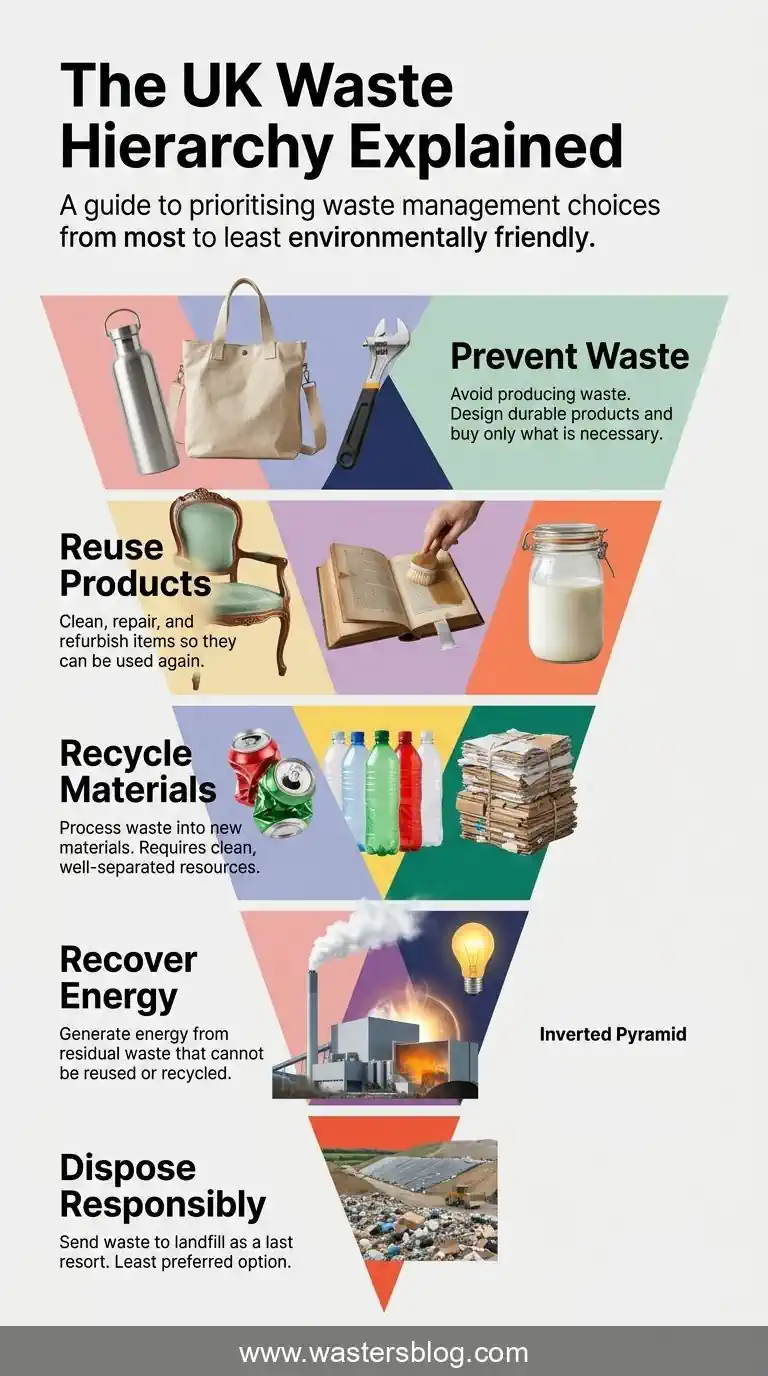
The basic order is simple:
- Prevention – avoid creating waste in the first place.
- Preparing for reuse – clean, repair or refurbish items so they can be used again.
- Recycling – turn waste materials into new products, materials or substances.
- Other recovery – recover value, commonly energy, from waste that cannot reasonably be reused or recycled.
- Disposal – landfill or other final disposal as the last resort.
DEFRA’s guidance on applying the waste hierarchy explains that this order should be considered by businesses and public bodies that generate, handle or treat waste. Guidance on applying the waste hierarchy
For the full explanation of the concept, start with our pillar guide: Waste Hierarchy Explained: The Complete Guide to Reducing Waste Before Recycling.
Key Takeaways
- The waste hierarchy is practical, not theoretical. It can be applied to shopping, food, packaging, offices, construction, schools, councils and waste contracts.
- Prevention is usually the best example of good waste management. Avoiding waste beats recycling it later.
- Reuse often preserves more value than recycling. Repairing a product is normally better than breaking it down into material.
- Recycling works best when materials are clean and separated. Contaminated recycling can lose value or be rejected.
- Recovery and disposal should be treated as lower-order options. They are necessary for some residual waste, but they should not be the first choice.
- UK recycling has improved, but there is still a large gap. The UK household recycling rate was 44.6% in 2023, according to official statistics.
- The best waste hierarchy examples usually save money as well as resources. Waste prevention often reduces purchasing, storage, handling and disposal costs.
Why Examples Matter
Many people understand the phrase reduce, reuse, recycle, but far fewer apply it in the correct order.
For example, a person may feel they have done the right thing by recycling a disposable coffee cup. But a reusable cup would usually sit higher in the hierarchy. Better still, if the cup was unnecessary in the first place, waste prevention would be the better option.
The same logic applies to many everyday decisions. A business may recycle cardboard packaging, but it may be better to ask suppliers to reduce packaging or move to reusable transit packaging. A council may collect food waste for anaerobic digestion, but preventing edible food from being wasted should still come first.
The waste hierarchy is therefore not simply about what happens after something enters a bin. It is about choices made before waste exists.

Example 1: Household Food Waste
Food waste is one of the clearest examples of how the hierarchy should work.
Prevention
The best option is to avoid wasting food in the first place. Practical examples include:
- planning meals before shopping;
- checking cupboards, fridge and freezer before buying more;
- using leftovers for another meal;
- freezing food before it spoils;
- understanding the difference between “use by” and “best before” dates;
- serving realistic portion sizes.
Preventing food waste usually saves money and avoids the environmental impact of producing, transporting, storing and cooking food that is never eaten.
Preparing for Reuse
In a household food context, reuse can mean using edible leftovers creatively, sharing surplus food with neighbours or using community fridges and food-sharing schemes where they exist.
Recycling
Food that cannot be eaten may be collected for composting or anaerobic digestion, where facilities and council services are available. This is better than sending food waste in the residual bin, but it is still below prevention.
In England, household food waste collection is being expanded under Simpler Recycling. From 31 March 2026, waste collectors must by default collect food and garden waste, paper and card, other dry recyclable materials and residual waste from households. Simpler Recycling: household recycling in England
Recovery and Disposal
If food waste is placed in the residual bin, it may go to energy recovery or landfill depending on local arrangements. This is lower down the hierarchy and should be avoided where practical.
Example 2: Clothing and Textiles
Clothing is a useful example because people often move too quickly from ownership to disposal.
Prevention
Waste prevention means buying fewer low-quality garments, choosing durable clothing, avoiding impulse purchases and selecting items likely to be worn many times.
Preparing for Reuse
Reuse examples include:
- repairing zips, hems and buttons;
- altering clothing to fit better;
- donating wearable clothes to charity shops;
- selling good-quality garments second-hand;
- passing children’s clothing to another family;
- using clothes swaps.
Recycling
Textile recycling is useful for damaged or unsuitable garments, but it normally comes after prevention and reuse. Some textile recycling produces lower-value outputs, so the original garment value may be lost.
Recovery and Disposal
Textiles in residual waste may be sent for energy recovery or disposal. This should be the last resort for clothing that cannot be reused or recycled.
Example 3: Office Waste
Offices can produce large amounts of paper, packaging, printer cartridges, food waste, furniture, electronic equipment and mixed residual waste. The hierarchy can reduce both waste and cost.
Prevention
Examples include:
- using digital documents instead of printing;
- setting printers to double-sided printing by default;
- avoiding unnecessary promotional materials;
- buying durable office furniture;
- ordering supplies in sensible quantities;
- reducing single-use cups, plates and cutlery.
Preparing for Reuse
Office reuse can include moving furniture between departments, reusing folders and stationery, refurbishing chairs, donating usable equipment and repairing office appliances.
Recycling
Offices should separate paper, card, plastics, metals, glass and food waste where collections are available. From 31 March 2025, workplace recycling rules in England changed for most businesses, charities and public sector organisations. Simpler Recycling: workplace recycling in England
Recovery and Disposal
Residual office waste should be minimised. If recyclable materials are still going into the general waste bin, the business is not applying the hierarchy properly.
Example 4: Packaging Waste
Packaging is one of the most visible waste streams. It is also one of the most frustrating because the consumer is often left to manage packaging decisions made by producers and retailers.
Prevention
Good prevention examples include:
- removing unnecessary layers of packaging;
- using concentrated products that need less packaging;
- supplying loose produce where practical;
- avoiding oversized boxes;
- using refill systems;
- designing products for returnable packaging.
Preparing for Reuse
Reusable delivery crates, refillable containers, returnable pallets and deposit-based packaging systems all sit above recycling because the packaging remains in use for longer.
Recycling
Packaging recycling works best when materials are simple, clean and easy to separate. Mixed-material packaging is often more difficult to recycle than single-material packaging.
Recovery and Disposal
Packaging that cannot be reused or recycled may end up in energy recovery or disposal. If that is happening frequently, it usually shows a design problem further up the chain.
Example 5: Construction and Demolition Waste
Construction and demolition are among the largest waste-producing sectors. This makes the hierarchy especially important.
Prevention
Examples include:
- accurate material ordering;
- off-site manufacturing to reduce offcuts;
- designing buildings for adaptability and longer life;
- protecting stored materials from damage;
- using standard dimensions to reduce cutting waste;
- avoiding over-specification where safe and appropriate.
Preparing for Reuse
Reuse examples include:
- salvaging bricks, tiles, timber and steelwork;
- reusing doors, windows and fittings;
- careful strip-out before demolition;
- using reclaimed materials in new projects;
- finding outlets for surplus materials before they become waste.
Recycling
Concrete, brick, asphalt, metals, plasterboard, wood and some plastics may be recycled if properly separated. Contamination can reduce value and limit options.
Recovery and Disposal
Energy recovery may be relevant for some timber and combustible residual waste, but disposal should be minimised through careful site waste management.
Example 6: Retail and Supermarket Waste
Retailers handle packaging, food waste, damaged goods, returns, display materials, pallets and customer waste. Applying the hierarchy can reduce both cost and reputational risk.
Prevention
Retail prevention examples include better stock control, improved date management, reduced over-ordering, less promotional waste and packaging reduction with suppliers.
Preparing for Reuse
Examples include reusable crates, returnable pallets, redistributing edible surplus food, repairing display equipment and donating usable non-food goods.
Recycling
Retailers often have good opportunities to recycle clean cardboard, plastics, metal, glass and food waste because materials can be separated at the back of store.
Recovery and Disposal
Residual retail waste should be monitored. If the residual stream is heavy with card, food or plastic film, the waste system is failing to move material up the hierarchy.
Example 7: Schools, Colleges and Universities
Educational sites are excellent places to demonstrate the waste hierarchy because they can combine practical waste reduction with learning.
Prevention
Examples include:
- reducing food waste in canteens;
- using refillable water bottles;
- setting printing limits;
- using digital homework systems where appropriate;
- buying durable classroom materials;
- avoiding unnecessary disposable decorations and event materials.
Preparing for Reuse
Reuse can include book swaps, uniform exchanges, furniture reuse, repair clubs, stationery reuse and donation of usable IT equipment.
Recycling
Clearly labelled bins can help separate paper, card, plastics, metals, food waste and residual waste. The key is to make the system simple enough for pupils, staff and visitors to use correctly.
Recovery and Disposal
Schools should avoid using general waste bins as the default option. Residual waste audits can show where prevention or recycling can be improved.
Example 8: Council Waste Services
Local authorities play a central role in how residents experience waste management. They influence collection systems, communication, contracts, household waste recycling centres, food waste services and local reuse opportunities.
Prevention
Councils can support prevention by promoting food waste reduction, reusable nappies, repair cafes, community sharing schemes, home composting and local campaigns to cut avoidable waste.
Preparing for Reuse
Reuse can be supported through household waste recycling centre reuse shops, charity partnerships, bulky waste reuse schemes and repair networks.
Recycling
Consistent recycling collections, clear guidance and contamination reduction are crucial. Simpler Recycling is intended to reduce confusion by making collection of core recyclable streams more consistent in England.
Recovery and Disposal
Councils still need arrangements for residual waste, but the aim should be to reduce the amount left after prevention, reuse and recycling.
Example 9: Food Businesses, Restaurants and Catering
Catering businesses generate food waste, packaging, cooking oil, glass, card, plastics and residual waste. The hierarchy can often produce quick savings.
Prevention
Examples include:
- better menu planning;
- portion control;
- using trimmings in stocks, soups or sauces where safe;
- improved stock rotation;
- monitoring plate waste;
- training staff to avoid preparation waste.
Preparing for Reuse
Edible surplus food may be redistributed where food safety rules allow. Reusable containers, washable serviceware and returnable supplier crates can also reduce waste.
Recycling
Unavoidable food waste can be collected for composting or anaerobic digestion. Glass, card, metals and plastics should also be separated where services are available.
Recovery and Disposal
Food waste in the residual bin is usually a sign that the hierarchy is not being applied well. It increases weight and can make waste collections more expensive.
Example 10: Electrical and Electronic Equipment
Electrical and electronic waste is especially important because it can contain valuable materials as well as hazardous components.
Prevention
Prevention means buying durable equipment, maintaining it properly, avoiding unnecessary upgrades and choosing products that can be repaired.
Preparing for Reuse
Reuse examples include repairing appliances, refurbishing computers, replacing batteries, donating working equipment and recovering parts.
Recycling
When equipment cannot be reused, specialist recycling can recover metals, plastics and other materials. This should be done through appropriate WEEE recycling routes.
Recovery and Disposal
Disposal of electrical goods in general waste should be avoided because it can waste valuable materials and create environmental risks.
Example 11: Garden Waste
Garden waste is another useful household example.
Prevention
Prevention may mean grasscycling by leaving short grass clippings on the lawn, choosing slower-growing plants or avoiding unnecessary garden clearance.
Preparing for Reuse
Woody prunings can sometimes be reused as stakes, habitat piles, mulch or informal garden edging.
Recycling
Home composting or council garden waste collections can turn garden material into useful compost or soil improver.
Recovery and Disposal
Putting garden waste in the residual bin is usually a poor outcome where composting or separate collection is available.
Example 12: Events and Community Activities
Events can generate a large amount of short-lived waste. The hierarchy should be considered before the event starts.
Prevention
Examples include digital tickets, reusable signage, avoiding giveaways that quickly become rubbish, accurate catering numbers and water refill points.
Preparing for Reuse
Reusable cups, plates, banners, crates, decorations and furniture can all reduce waste over repeated events.
Recycling
Recycling points should be clearly labelled and placed where waste is generated. Volunteers or staff may be needed to prevent contamination.
Recovery and Disposal
The final clean-up should separate recyclable and reusable materials before residual waste is sent for treatment or disposal.
A Simple Waste Hierarchy Decision Test
When deciding what to do with a material or product, use this simple test:
- Can we avoid this waste altogether?
- Can we reduce the amount produced?
- Can the product be repaired, reused, donated or sold?
- Can the material be recycled cleanly?
- Can value be recovered from what remains?
- Is disposal genuinely the only practical option?
If you start at the top and work down, you are applying the hierarchy properly.
Common Mistakes in Real-Life Waste Hierarchy Decisions
Mistake 1: Celebrating recycling while ignoring waste prevention
A high recycling rate can still hide excessive consumption and waste generation. The best example of good waste management may be the waste that never appears in the statistics.
Mistake 2: Recycling items that could be reused
Reusable furniture, equipment, clothes and containers should not be sent straight for material recycling if they can continue to serve their original purpose.
Mistake 3: Contaminating recycling bins
Putting the wrong item into a recycling bin can reduce the quality of the whole load. Clean separation matters.
Mistake 4: Assuming energy recovery is the same as recycling
Energy recovery may have a place for residual waste, but it is lower in the hierarchy than recycling.
Mistake 5: Forgetting procurement
Many waste problems begin with purchasing decisions. If a business buys disposable, over-packaged or short-life products, the waste hierarchy has already been undermined.
Why the UK Still Needs Better Waste Hierarchy Practice
The UK has made useful progress, but the scale of waste generation remains very large. Official UK statistics show that the household recycling rate was 44.6% in 2023. That is far better than a landfill-dominated system, but it also means that a large proportion of household waste is still not recycled. UK statistics on waste
The Office for Environmental Protection has also argued that England’s resources and waste policy needs stronger implementation and better alignment with wider environmental goals. Assessment of resources and waste policy in England
This does not mean that the UK has failed. It means the next stage is harder. The easy gains from basic recycling collections have already been made in many areas. Future improvement will depend more on reducing waste at source, building reuse systems, improving product design and cutting residual waste.
More Waste Hierarchy Guides
This article is part of our Waste Hierarchy guide series. You may also find these related articles useful:
- Waste Hierarchy Explained: The Complete Guide to Reducing Waste Before Recycling
- Waste Hierarchy UK: What the Law Says and How to Apply It in Practice
- Reduce, Reuse, Recycle: Why Recycling Is Not the First Step in Waste Management
- Residual Waste Explained: What Is Left After Reduce, Reuse and Recycle?
Conclusion: The Best Examples Start Before the Bin
The best waste hierarchy examples are not always the most technical. Often they are simple decisions made early enough to stop waste becoming a problem.
A meal planned before shopping. A chair repaired instead of discarded. A supplier asked to reduce packaging. A school uniform passed to another family. A reusable crate used instead of a disposable box. These are all practical examples of the hierarchy in action.
Recycling remains essential, but it should not be treated as the first or best answer. The correct question is not simply, “Can this be recycled?” The better question is, “Could this waste have been prevented or reused before recycling became necessary?”
That is the real value of the waste hierarchy. It turns waste management from a disposal problem into a resource management decision.
FAQs About Waste Hierarchy Examples
What is a simple example of the waste hierarchy?
A simple example is a glass jar. The best option may be to avoid buying unnecessary packaging. The next best option may be to reuse the jar for storage. If reuse is not practical, the jar can be recycled. If it cannot be recycled, recovery or disposal may be considered lower down the hierarchy.
What is an example of waste prevention?
Meal planning to avoid food waste is a good example of waste prevention. It stops waste before it is created.
What is an example of preparing for reuse?
Repairing a chair, refurbishing a laptop, donating wearable clothes or cleaning a container so it can be used again are all examples of preparing for reuse.
What is an example of recycling?
Recycling examples include collecting clean paper, card, glass bottles, metal cans and plastic packaging so they can be processed into new materials or products.
What is an example of recovery?
Energy recovery from residual waste is a common example of recovery. It is below recycling in the hierarchy but may be preferable to landfill for suitable non-recyclable waste.
What is an example of disposal?
Landfill is the most familiar example of disposal. It sits at the bottom of the waste hierarchy and should normally be the last resort.
How can a business apply the waste hierarchy?
A business can apply the hierarchy by reducing unnecessary purchasing, reusing packaging, repairing equipment, separating recyclables properly and minimising residual waste.
How can councils support the waste hierarchy?
Councils can support the hierarchy through waste prevention campaigns, reuse shops, repair networks, food waste collections, clear recycling guidance and residual waste reduction strategies.
Why is reuse usually better than recycling?
Reuse usually keeps the original product in service and preserves more of its value. Recycling often breaks the product down into material, which may require more processing.
Why does the waste hierarchy matter?
The waste hierarchy matters because it helps people choose the best environmental option. It prioritises preventing waste and preserving resources before lower-value treatment or disposal.