Waste prevention involves taking action before a material or product becomes waste. Its primary goal is to reduce the total volume and environmental impact of discarded items by promoting repair, reuse, and sustainable consumption. It sits at the very top of the waste hierarchy.
Summary of this Waste Prevention Article
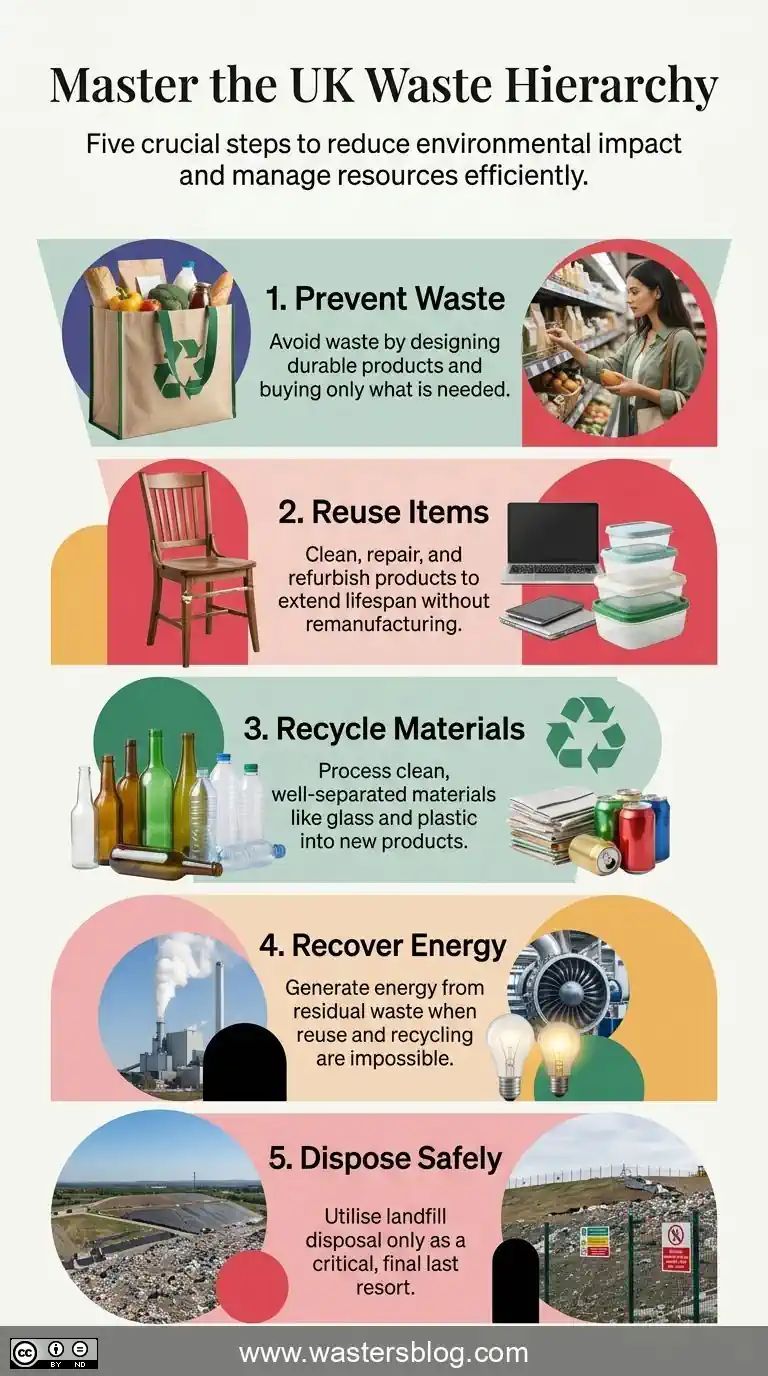
- The most effective and tested framework for minimizing waste is the waste hierarchy — Reduce, Reuse, Recycle. Following this hierarchy in order can make a significant impact.
- Source reduction is the most effective waste prevention strategy as it prevents waste before it's even produced.
- Waste audits and tools like the EPA's Waste Reduction Model (WARM) provide households and businesses with actionable data, not just assumptions.
- Walmart reduced landfill waste by over 80% through structured waste reduction programs, proving that zero-waste policies can be effective on a large scale.
- Continue reading to learn which everyday habits have the greatest collective impact and how small choices can lead to significant environmental and financial savings.
The best strategy for preventing waste is simple, it's just not often followed in the correct sequence.
Many of us think recycling is the end-all-be-all of waste management, but it's actually the third-best option. The best waste prevention strategies start before anything even gets thrown away. Whether you're dealing with waste at home, running a business, or setting policy for a school, the same basic rules apply. Frontier Waste Solutions works with communities throughout Texas to help residents and businesses rethink how waste is handled from the ground up, which makes them a good example of waste reduction in practice.
Knowing where to begin — and why the sequence is important — is what distinguishes successful waste prevention from well-meaning but ineffective recycling efforts.
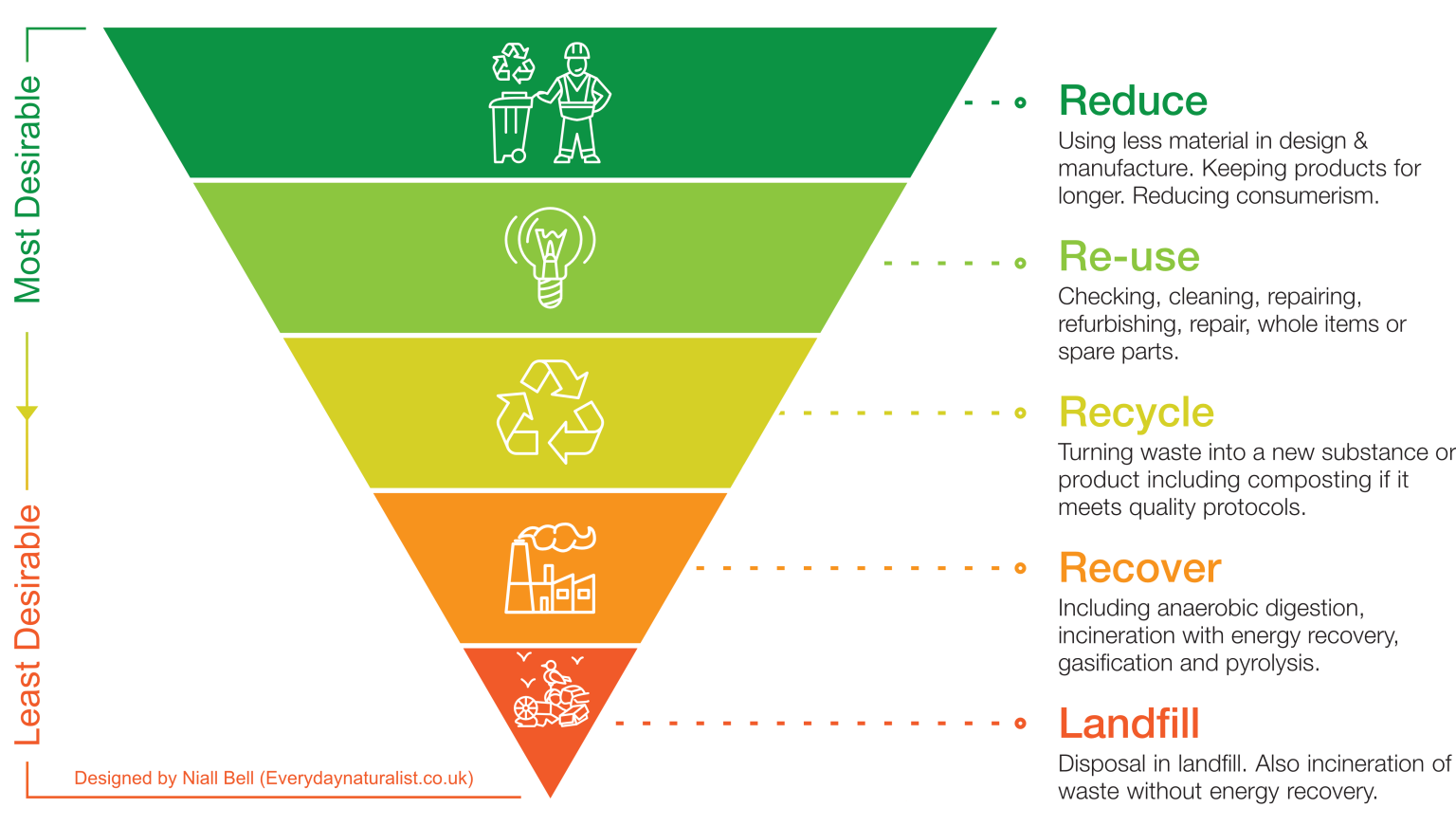
“The hierarchy of waste – WasteOnline” from wasteonline.uk and used with no modifications.
Waste Hierarchy: Your Action Plan
The waste hierarchy is a priority-based structure that provides clear guidance on how to handle waste and in what sequence. This strategy, which is supported by the EPA and applied worldwide, arranges actions from the most to the least favored based on their environmental consequences. If implemented correctly, it can help to decrease disposal expenses, reduce greenhouse gas emissions, and significantly reduce the amount of material sent to landfills.
1. Reduce: The First Step is Prevention
Reduction is at the top of the waste hierarchy because it's the only strategy that completely avoids waste, rather than dealing with it after it's created. This involves buying less, choosing products with less packaging, and reconsidering buying habits before making a purchase. Every item that isn't bought is one less item that needs to be recycled, composted, or put in a landfill.
For businesses, reduction could mean making their production processes more efficient so they use less raw materials, going paperless, or getting rid of extra inventory that would otherwise be thrown away. For individuals, it could be as easy as planning meals to prevent food waste or using a refillable water bottle instead of single-use plastic bottles.
2. Reuse: Repurposing Materials
Reusing a product or material without reprocessing it extends its life and is much less energy-intensive than recycling. This could mean donating furniture, repurposing glass jars, using refillable containers, or buying secondhand. Businesses can also implement reuse programs, such as using returnable packaging or refurbishing equipment instead of replacing it.
3. Recycle: Transform Trash Into Treasure
While recycling is beneficial, it should not be your first line of defence. The process of collecting, sorting, and reprocessing materials requires energy, which is why reduction and reuse should be prioritized. However, well-executed recycling programs can result in substantial savings. Materials such as aluminium, cardboard, and some plastics have value as commodities, and efficient recycling programs can even generate income instead of just offsetting disposal costs.
Effective Strategies for Source Reduction
Source reduction is the key to the most significant victories. By reducing waste before it's produced, you can lower disposal costs, reduce raw material purchases, and decrease your environmental footprint all at the same time. The strategies below are practical, proven, and scalable, whether you're a single household or a large organization.
Purchase Large Quantities to Minimize Packaging Waste
Purchasing large quantities significantly cuts down the amount of packaging per product. For instance, a big container of dish soap generates much less plastic waste per use than purchasing several small bottles. For businesses, buying in large quantities also lessens the number of deliveries and related transport emissions. Most households today can do this through warehouse-style shopping and bulk-bin grocery stores.
Opt for Long-Lasting Items
One of the most overlooked ways to prevent waste is simply by choosing products that are built to last. For example, a stainless steel travel mug that you can use for ten years will prevent thousands of disposable cups from ending up in a landfill. This is a direct way to reduce waste. When shopping, prioritize quality over cost and look into how long a product is expected to last before you buy it. Some products even come with repair programs, warranties from the manufacturer, or modular designs that can be upgraded instead of replaced.
Intelligent Buying Choices for Home and Business
Before buying anything, three questions can help avoid a lot of waste: Do I really need this? Can I borrow or rent it? Is there a version with less packaging? These questions can be incorporated into purchasing policies by business procurement teams. At home, keeping to a shopping list helps avoid impulse purchases that often go unused and end up in the trash.
Uncovering Hidden Savings with Waste Audits
Many companies are unknowingly losing money due to waste they aren't aware they're producing. Waste audits can transform this unclear issue into a quantifiable one by providing precise information on what is being discarded, its weight, and the disposal fees it incurs.
What Really Happens During a Waste Audit
A waste audit is the process of sorting and classifying waste over a specific time period, typically one to two weeks. The waste is divided into categories such as food waste, paper, plastic, metal, and general landfill waste. Each category is weighed and recorded. This process provides a detailed analysis of your waste stream, showing which areas produce the most waste and where the most straightforward reductions can be made. For businesses, this information directly affects purchasing decisions, changes in procedures, and the design of recycling programs.
Understanding the EPA's Waste Reduction Model (WARM)
The Waste Reduction Model (WARM) provided by the EPA is a complimentary tool that quantifies the impacts on energy and greenhouse gases of various waste management practices. It evaluates and contrasts the environmental effects of source reduction, recycling, composting, landfilling, and combustion for a wide range of materials, including everything from cardboard and food waste to steel and glass.
Walmart utilized WARM to pinpoint high-impact recycling opportunities and packaging inefficiencies throughout its supply chain, leading to its groundbreaking accomplishment of diverting more than 80% of waste from landfills. WARM is available at no cost through the EPA's website for any business or municipality, making it one of the most accessible and data-driven waste planning tools on the market.
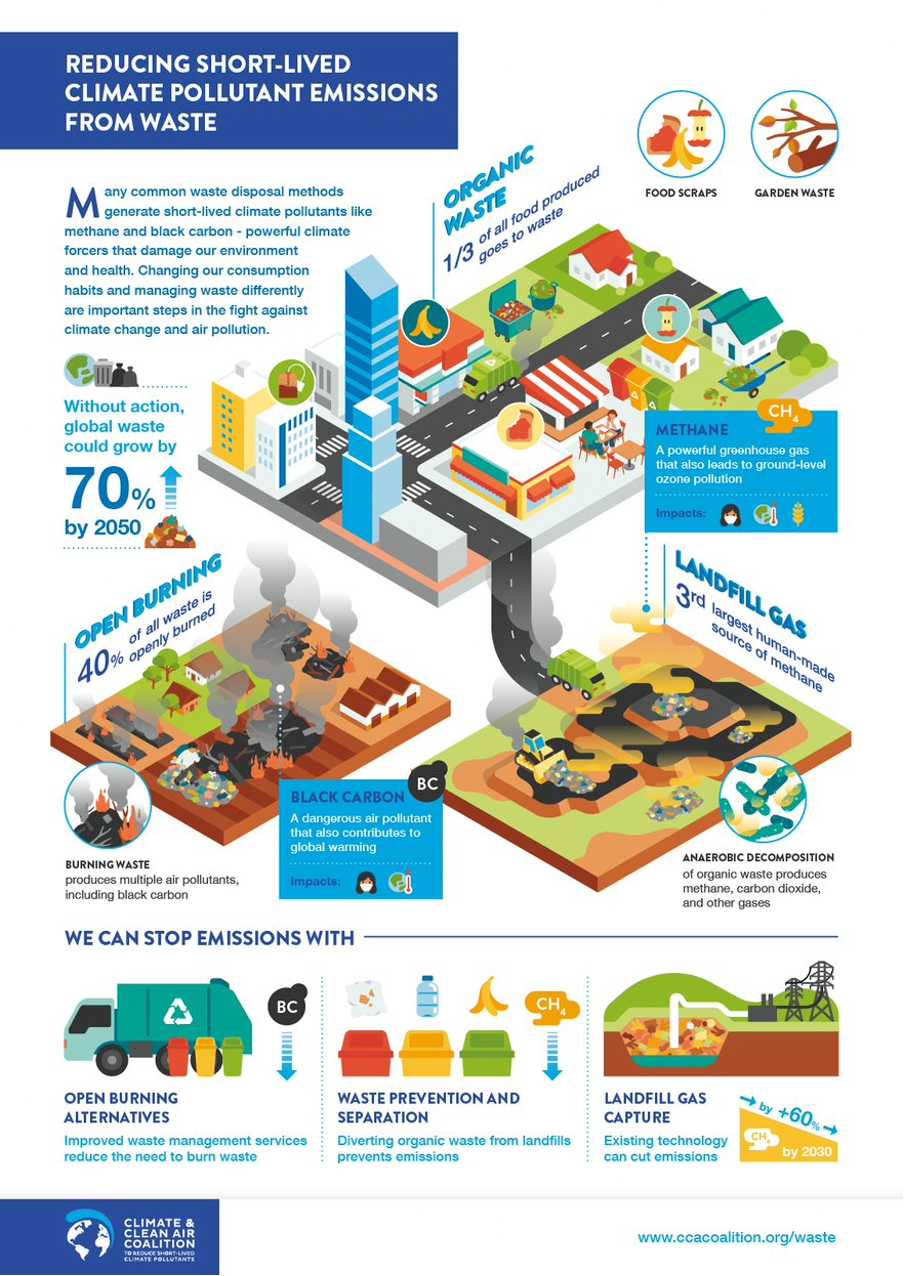
“Waste sector solutions | Climate …” from www.ccacoalition.org and used with no modifications.
Improving Recycling: More Than Just Using the Blue Bin
Just because you put something in a blue bin doesn't mean it will be recycled. One of the main reasons recycling programs don't reach their full potential is contamination — when non-recyclable items are mixed in with recyclable ones. To truly make your recycling program effective, you need to look beyond just the bin. You need to consider the systems, behaviors, and partnerships that actually determine whether or not materials get recycled.
Correct Waste Sorting Using Clearly Marked Bins
One of the easiest and most successful methods for reducing recycling contamination is to use clear labels. Bins that have visual cues, such as pictures of the items that should be placed in them, rather than just text, perform better than bins with text-only labels in shared spaces like offices, schools, and public places. Color coding is also important: using a consistent system (blue for recycling, green for compost, black for landfill) throughout a facility reduces confusion and the chance of items being put in the wrong bin.
Location is also key. Recycling bins should always be placed right next to waste bins — never on their own. When people have to walk across a room to recycle, they don't. Putting bins together at every point where waste is generated is a cheap, effective strategy that most facilities still don't use.
How Automated Sorting Technology Reduces Contamination
Automated sorting technology is revolutionizing recycling efficiency at the municipal and industrial level. Today's materials recovery facilities (MRFs) employ optical sensors, infrared scanners, and AI-powered robotics to sort mixed recyclables at a pace that humans can't keep up with. These systems can identify and separate materials by type and grade, such as HDPE and PET plastics, with a high degree of precision.
For businesses that produce a large amount of recyclable waste, working with a MRF that utilizes high-tech sorting methods can lead to increased recovery of materials and fewer rejections due to contamination. Some of these facilities even provide real-time reports on what is being recovered from your waste, which gives companies valuable data they can use to improve their programs.
Haggling for Improved Rates With Recycling Associates
Recycling is not just a choice for the environment — it's also a financial decision. The worth of recyclable materials changes with the world markets, and establishments that are aware of this can haggle for improved service contracts with waste hauliers and recycling vendors.
First, understand what you're producing. If your waste audit reveals that you're generating large quantities of high-value materials like aluminium or clean cardboard, you can use that to your advantage. Some recycling vendors will pick up these materials for a lower price or even for free because the value of the recovered commodity covers their operating costs.
Make sure to take a look at your hauling contracts every year and compare rates with competitors. A lot of companies are paying too much for recycling services just because they haven't renegotiated since they first signed the contract. If you switch to a vendor that uses a revenue-sharing model for recyclable commodities, you can change a cost centre into a small source of income.
Don't Forget About Composting Organic Waste
One of the most substantial — and most avoidable — types of waste is food and organic waste. In the U.S., food waste makes up a large percentage of what ends up in landfills. There, it breaks down without oxygen and creates methane, a greenhouse gas that's much more potent than CO2 in the short term.
Composting is a great way to prevent organic waste from ending up in a landfill. It turns this waste into a useful soil amendment. It's easy for households to compost. A simple backyard compost bin can handle fruit and vegetable scraps, coffee grounds, eggshells, and yard waste. If you live in an apartment, you can do worm composting — also known as vermicomposting — indoors. It takes up very little space and produces high-quality compost.
Especially for businesses like restaurants and food service operations, composting to divert food waste can lead to substantial savings in disposal costs. Nowadays, many cities provide commercial composting pickup services, making it as straightforward as regular trash collection. Some businesses take it a step further by working directly with local farms to donate edible food before it becomes waste — dealing with the issue even higher up the hierarchy.
Effective Zero-Waste Strategies for Businesses
Key Elements of a Zero-Waste Strategy
Strategy Component What It Entails Anticipated Result Baseline Waste Audit Assess current waste types and amounts Identify most impactful reduction targets Source Reduction Objectives Establish measurable reduction targets by category Decrease total waste produced at source Segregation Facilities Set up labeled, co-located bin stations Decreased contamination, increased recycling rates Staff Training Program Regular workshops and onboarding modules Uniform compliance across departments Supplier Partnerships Source compost, recycling, and reuse suppliers Systematically divert materials from landfill Performance Monitoring Monthly waste diversion reporting Ongoing improvement and accountability
A zero-waste strategy doesn't mean literally achieving zero — it means systematically eliminating the conditions that lead to unnecessary waste. The most successful strategies integrate changes to infrastructure, behavioural training, and supplier partnerships into a single coordinated system, rather than addressing each component separately.
Many businesses think they're taking a step towards zero waste by simply placing recycling bins around the office, but that's not enough. Genuine zero-waste initiatives start at the source with things like what you're buying, the requirements you have for your suppliers, and how you're designing your products. Recycling is not the main strategy, but the last option.
Having someone in charge is crucial. If every department has a sustainability coordinator or waste champion, there will be a sense of ownership, and progress will be consistently tracked and reported. Without someone in charge of the numbers, even the best programs tend to revert to old habits within a few months.
Adoption can be sped up with financial incentives. Some businesses use internal carbon pricing or chargebacks for waste costs by department. This makes the cost of generating waste visible to the teams that control it. When a department's budget reflects the real costs of disposal, behavior changes quickly.
How Walmart Reduced Landfill Waste by Over 80%
Walmart's success in reducing waste is often used as an example of corporate sustainability — and it's easy to see why. By using the EPA's WARM tool to examine their waste stream, they were able to identify specific recycling opportunities and packaging inefficiencies across their supply chain. By combining this with a company-wide zero-waste policy, standardized bin infrastructure across stores, and supplier packaging requirements, Walmart was able to divert more than 80% of its waste from landfills. This program didn't just reduce their environmental impact — it also saved them a significant amount of money by recovering commodity value from materials that were previously being thrown away.
Compliance-Driven Employee Training and Signage
Training is the backbone of zero-waste policies. If it's not done right, the policy will fail. A policy document that no one reads is useless. However, a 30-minute orientation session that shows new employees exactly what goes in each bin and includes hands-on sorting practice can create habits that last. The most successful programs provide training every quarter, not just when someone is hired. This is because staff changes and seasonal workers can erase institutional knowledge.
Signage is the quiet taskmaster. Studies have shown time and again that visual cues — pictures of the actual items that should be placed in the bin printed right on the lid of the bin — work better than written instructions in communal spaces. There's a measurable difference in contamination rates between a laminated sign that reads “Plastics Only” and one that has a picture of a water bottle, a yogurt tub, and a milk jug. Keep it simple, specific, and visual.
- Use images for bin labels that show exactly what goes in each bin
- Place bins in pairs or sets of three — waste, recycling, and compost next to each other at every point where waste is generated
- Hold refresher sessions every quarter instead of just a single onboarding session
- Appoint waste champions for each department who can answer questions and reinforce good habits every day
- Display the monthly diversion rate results in break rooms and common areas to encourage accountability
Businesses that are most successful at diverting waste view compliance as an ongoing process, not a one-off initiative. When employees can see the impact they’re making in real numbers posted on the wall, they naturally become more engaged. For more information on effective waste management practices, consider exploring habits for real eco impact.
Real-Time Waste Reminders Through Digital Displays
Organizations can use digital signage in high-traffic areas like break rooms, cafeterias, and hallways to promote waste reduction behaviors. This approach is dynamic and doesn't require reprinting materials every time guidelines change. The screens can alternate between waste sorting reminders, monthly diversion stats, sustainability tips, and program milestones, keeping the message fresh and visible. Some facilities even connect their waste tracking software directly with their display systems, showing real-time landfill diversion percentages that update as new data is logged. It may seem like a minor detail, but live data creates a feedback loop that static signage simply cannot match.
Small Daily Actions That Make a Big Difference
Individual actions may seem trivial until you consider them across millions of households and thousands of working days. Taking a reusable bag to the grocery store, saying no to a plastic straw, composting coffee grounds, buying a product with less packaging — none of these seem like they would make a big difference on their own. But the EPA's own modeling shows that widespread source reduction behaviors, when taken together across communities, can make a measurable difference in landfill volume, greenhouse gas emissions, and municipal disposal costs. The math is simple: small consistent actions, when scaled broadly, can achieve results that no single large intervention can achieve on its own. Start with one change. Then add another. The cumulative effect is real.
Start Your Waste Prevention Strategy Today for the Best Results
The waste hierarchy provides the blueprint. Audits provide the statistics. Source reduction, reuse, composting, and recycling optimization provide the methods. It's not about having the information, it's about choosing to use it, beginning with whatever is most achievable at the moment. Whether that means carrying out your first waste audit, transitioning to bulk buying, setting up a compost bin, or simply placing your recycling and trash bins next to each other — each action brings you nearer to a system that produces less waste, is less expensive to run, and has a lesser impact on the environment.
Those businesses and families who are making the most progress aren't necessarily doing everything right. They began with something manageable, observed the changes, and then expanded on that. That's all there is to it.
Common Questions
Looking at waste prevention as a whole can be daunting. But, when you break it down into simple, straightforward answers, it becomes a lot more manageable. The questions below address the most common areas of confusion — from getting started at home to how businesses can establish enduring programs. For those interested in going beyond recycling, consider adopting habits for real eco impact.
It's important to make one thing clear before we start: waste processing and waste management are similar, but not the same. Prevention is all about stopping waste before it even begins. Management is about dealing with waste once it's already been created. The best approach is to do both — but always with a focus on prevention first.
These are the most common queries about waste prevention techniques, answered in detail rather than broadly.
- What is the most effective waste prevention strategy for households?
- How does source reduction differ from recycling?
- What is the Waste Reduction Model (WARM) and who can use it?
- Can small businesses realistically implement zero-waste policies?
- How often should organizations conduct waste audits?
What is the most effective waste prevention strategy for households?
The most effective waste prevention strategy for households is source reduction — specifically, buying less and buying smarter. This means choosing products with minimal packaging, purchasing in bulk where practical, avoiding single-use items, and planning meals carefully to eliminate food waste before it starts. For more tips, check out reducing waste at home.
One of the biggest contributors to household waste is food, but it's also one of the easiest areas to prevent waste. By simply planning meals each week, making a shopping list, and using a first-in-first-out system in your fridge (where you use older items before newer ones), you can significantly reduce your household's food waste without needing to buy anything new or fancy.
Apart from food, the most impactful changes you can make in your home usually involve reducing packaging. If you start using concentrated cleaning products, opt for items sold in recyclable or compostable packaging, and stop using single-use plastics such as sandwich bags, cling wrap, and disposable cutlery, you'll see a significant reduction in the amount of waste you throw away each week.
The next best thing you can do is compost. Even just a simple compost bin in your backyard can keep things like fruit and vegetable scraps, coffee grounds, eggshells, and yard waste out of the landfill — and turn them into free soil amendment for your garden. If you live in an apartment, a countertop compost collector paired with a city organic pickup program can deliver the same benefit without needing any outdoor space.
- Plan meals for the week and shop with a list to prevent food waste
- Buy in bulk to reduce packaging waste
- Switch to reusable items like water bottles, coffee cups, bags, and food containers
- Start composting fruit and vegetable scraps, coffee grounds, and yard waste
- Choose durable products instead of disposable ones whenever possible
- Donate or sell items you no longer want instead of throwing them away
What is the difference between source reduction and recycling?
Source reduction and recycling are both part of the waste hierarchy, but they happen at different stages of a product's life. Source reduction happens before waste is created. It's the decision to not create waste in the first place. Recycling happens after waste has been created. It's a way to recover materials that have already been thrown away.
The difference is important because recycling still needs a lot of energy, water, and transportation to gather, sort, and reprocess materials into new items. Source reduction removes that whole process by preventing the material from becoming waste in the first place. A product that was never over-packaged never needs its packaging to be recycled. Food that was never wasted never needs to be composted or thrown into a landfill.
Recycling is important and needed — but when we use it as the main way to prevent waste instead of a last resort, it can lead to what people in the sustainability field sometimes call “recycling theater”: it feels like we're doing something good, but the real problem of creating too much waste isn't being solved. True waste prevention starts at the source.
Factor Source Reduction Recycling When it occurs Before waste is created After waste is generated Energy required Minimal — no reprocessing needed Moderate to high — collection, sorting, processing Waste hierarchy rank #1 — Most preferred #3 — Third preference Example action Buying a product with no packaging Recycling the packaging after use Financial impact Reduces purchasing and disposal costs Can offset disposal costs; variable commodity value
What is the Waste Reduction Model (WARM) and who can use it?
The Waste Reduction Model (WARM) is a free tool developed by the U.S. Environmental Protection Agency that calculates the greenhouse gas emissions and energy impacts of different waste management approaches. It compares outcomes across source reduction, recycling, composting, landfilling, and waste combustion for dozens of specific material types — including food, paper, plastics, metals, glass, and textiles.
WARM is a tool that can be used by a variety of users, from large corporations and city governments to nonprofits and schools. You don't need to be an environmental expert to use it. You input the amount of waste you have by material type, select how you manage it, and WARM will tell you the comparative environmental impact in metric tons of CO2 equivalent. This makes it easy to see the real impact of, say, switching from landfilling to composting, or to justify investing in a new recycling program with hard data on emissions.
Walmart's proven use of WARM to pinpoint packaging inefficiencies and lucrative recycling opportunities is one of the most well-known real-world examples of the tool being utilized. The model assisted them in focusing on the changes with the most impact first — contributing to their achievement of diverting over 80% of waste from landfills. The tool is available directly through the EPA website at no cost to any organization ready to start measuring and improving their waste outcomes.
Is it possible for small businesses to realistically adopt zero-waste policies?
Absolutely — and in numerous instances, small businesses have an edge over big corporations in terms of adopting zero-waste policies, because decision-making is quicker, teams are smaller, and changes in behavior can occur without having to go through multiple levels of corporate approval.
For small businesses, it's best to begin with a waste audit instead of attempting to change everything at once. Sorting and weighing waste for a single week can provide a clear picture of your largest waste sources. This information allows you to focus on the two or three changes that will have the most immediate effect, rather than spreading your efforts too thin by trying to tackle every possible initiative at the same time.
There is no need to worry about the cost of infrastructure. It is possible to reduce disposal fees in the first month with low-cost changes like co-located bin stations with photo-based labels, a compost collection arrangement with a local hauler, and a bulk purchasing adjustment to your supply orders. Many small businesses have found that their waste-related costs have actually decreased since they started diverting materials from general waste into recycling and compost streams, which are often collected at lower rates or even for free.
It's not the cost that's the biggest obstacle — it's maintaining the program. Having one person in charge of the program, even if it's not their full-time job, can be the difference between a policy that sticks and one that fizzles out within three months. For example, understanding the importance of waste recovery facilities can significantly contribute to the program's success.
- Conduct a one-week waste audit before making any other changes
- Start with the two highest-volume waste categories identified in the audit
- Install co-located bin stations with visual labels at every waste generation point
- Arrange compost collection through a local hauler or municipal program
- Designate a waste champion to track progress and keep the program accountable
- Review and renegotiate hauling contracts annually based on actual diversion data
How often should organizations conduct waste audits?
Most sustainability frameworks recommend conducting a formal waste audit at least once per year as a baseline minimum. Annual audits capture seasonal shifts in waste generation, reflect changes in operations or purchasing, and provide year-over-year comparison data that shows whether reduction programs are actually working.
Companies that are in the process of introducing a new zero-waste policy or making substantial operational modifications should perform audits more often. During the first year of a new initiative, quarterly audits provide the necessary feedback loop to identify and correct issues early on, preventing bad habits from becoming ingrained. Once a program is stable and diversion rates are steady, annual audits are usually enough to maintain control.
For smaller companies that don't have a sustainability team, even a simplified audit — sorting and weighing waste by category for just one representative week per quarter — provides actionable data without requiring a significant time commitment. The goal is consistent measurement, not perfection. Data collected imperfectly over time is far more valuable than a single comprehensive audit conducted once every few years.
The key is to link the findings of the audit to real-world actions. An audit that only results in a report that is filed away and forgotten is of no use to anyone. The audit should be the first step in making changes, not the last step in the process. The findings of the audit should be used to make decisions about what to buy in the next quarter, who to negotiate with, what kind of training is needed, and what the reduction targets should be.
For more information about the waste hierarchy, you might like to visit Waste Hierarchy Explained.