The waste hierarchy is one of the most important ideas in modern waste management. It explains why the best answer to waste is not simply to recycle more, but to create less waste in the first place.
For many years, the public message was summed up in three familiar words: reduce, reuse, recycle. That phrase is still useful, but it is only a shortened version of a wider principle. The full waste hierarchy places waste options in order of environmental preference: prevention first, then preparing for reuse, recycling, other recovery and disposal last.
That order matters. Recycling is valuable, but it still requires collection, transport, sorting, processing and energy. Reuse usually preserves more value than recycling. Prevention is better still because it avoids the material, energy, cost and pollution of making, transporting and disposing of something that was not needed in the first place.
The UK has made real progress since the days when landfill was the routine destination for much of our everyday waste. Household recycling is now normal. Food waste collections are expanding. Businesses are under greater pressure to separate waste properly. Landfill is no longer the automatic answer.
But there is still a long way to go. Official UK waste statistics show that the UK household recycling rate was 44.6% in 2023, while biodegradable municipal waste sent to landfill was still 5.3 million tonnes. That is an improvement on the past, but it also shows why the waste hierarchy remains so important. UK statistics on waste
The challenge now is not just to recycle better. It is to move more decisions up the waste hierarchy, especially toward waste prevention, reuse, repair and smarter design.
Key Takeaways
- The waste hierarchy ranks waste options from best to worst. Prevention is at the top and disposal is at the bottom.
- Reduce, reuse, recycle is still useful, but the full hierarchy also includes recovery and disposal.
- Recycling is not the first choice. It is normally better to prevent waste or reuse products before recycling materials.
- The UK has improved by moving away from landfill and expanding recycling, composting, anaerobic digestion and recovery.
- Progress is not enough. The UK still produces very large amounts of household, commercial, industrial and construction waste.
- Businesses, councils and households all have a role in applying the hierarchy in practical daily decisions.
- The next stage of improvement is about reducing waste before it exists, not just dealing with it better afterwards.
What Is the Waste Hierarchy?
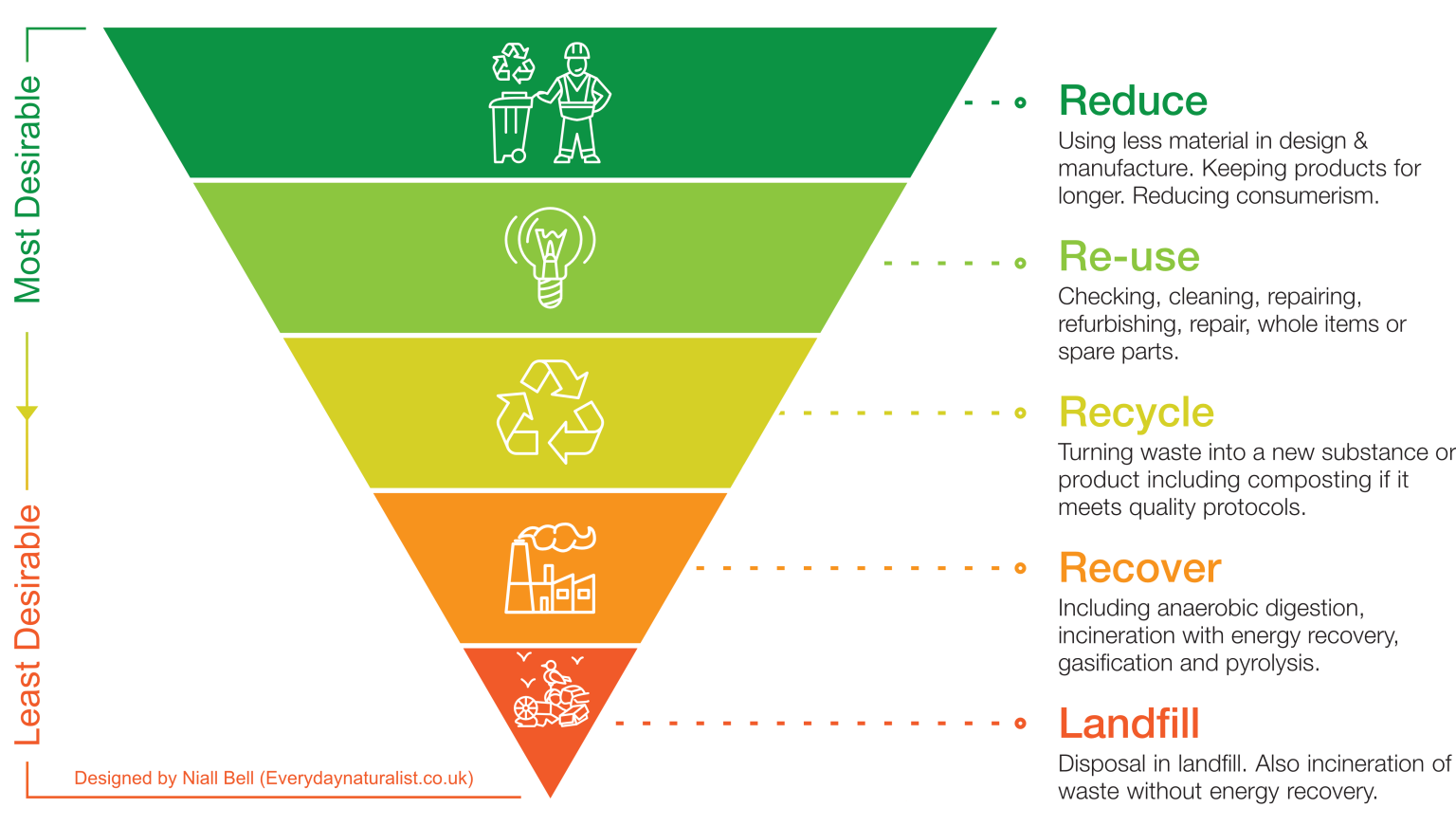
The waste hierarchy is a framework for choosing the best environmental option for materials and products that might become waste.
It is usually shown as a five-level pyramid, with the preferred option at the top and the least preferred option at the bottom:
- Prevention – avoiding the creation of waste in the first place.
- Preparing for reuse – checking, cleaning, repairing or refurbishing items so they can be used again.
- Recycling – turning waste materials into new products, materials or substances.
- Other recovery – recovering value from waste, often as energy.
- Disposal – landfill or other final disposal as the last resort.
DEFRA’s guidance on applying the waste hierarchy explains this order and places waste prevention at the top, followed by preparing for reuse, recycling, other recovery and disposal. Guidance on applying the waste hierarchy
This is why the phrase “reduce, reuse, recycle” is not just a slogan. It reflects a real order of preference. Reducing waste is better than reusing it. Reusing it is usually better than recycling it. Recycling is usually better than energy recovery or disposal.
Why Reducing Waste Comes Before Recycling
Recycling receives a great deal of public attention because it is visible. People can see their recycling bins, boxes, bags and collection vehicles. They can feel that they are doing something positive, and in many cases they are.
But the most important waste decision often happens before anything reaches the bin.
Ask these questions:
- Did the product need to be bought in the first place?
- Could the product have lasted longer?
- Could it have been repaired?
- Could it have been shared, refilled, reused or returned?
- Could the packaging have been avoided?
- Could the same function have been provided with less material?
If the answer is yes, then recycling is not the best environmental outcome. The better outcome would have been prevention or reuse.
For example, recycling a glass bottle is useful. Reusing the same bottle many times may be better. Avoiding unnecessary single-use packaging in the first place may be better still.
The same principle applies to furniture, electrical goods, clothing, pallets, construction materials, catering waste, office equipment and many business consumables.
The Five Levels of the Waste Hierarchy
1. Prevention: The Best Waste Is the Waste Never Created
Prevention is the top of the hierarchy. It means stopping waste before it appears.
Waste prevention can include:
- buying only what is needed;
- designing products that last longer;
- using fewer raw materials;
- reducing unnecessary packaging;
- preventing food waste;
- maintaining equipment so it has a longer life;
- using refillable or returnable containers;
- choosing durable goods instead of disposable goods.
This stage is often the most difficult because it challenges habits of production and consumption. It also asks awkward questions about convenience, product design, marketing, fashion, procurement and cost.
However, it is also where some of the biggest environmental gains can be found. Preventing one tonne of waste can be better than collecting and recycling one tonne of waste later.
2. Preparing for Reuse: Keeping Products in Service
Preparing for reuse means making products or components suitable for use again without turning them back into raw materials.
Examples include:
- repairing electrical appliances;
- refurbishing office furniture;
- cleaning and reusing containers;
- recovering spare parts;
- selling second-hand goods;
- donating usable items to charities or reuse organisations;
- using reclaimed construction materials.
Reuse matters because it preserves the value already built into a product. A reused chair, pump, pallet or laptop avoids the need to manufacture a replacement.
The Office for Environmental Protection has also stressed the importance of stronger action on resources and waste policy, including moving beyond recycling alone and doing more to reduce residual waste. Assessment of resources and waste policy in England
3. Recycling: Turning Waste Materials Back Into Resources
Recycling turns waste into a new material, product or substance. This includes familiar streams such as paper, card, glass, metals and plastics. It can also include organic recycling such as composting, where the output is used beneficially.
Recycling is essential, but it works best when materials are clean, separated and suitable for the recycling process.
Common recycling problems include:
- food contamination in dry recycling;
- non-recyclable items placed in recycling bins;
- mixed materials that are hard to separate;
- poor product design;
- weak end markets for some recycled materials;
- public confusion about local collection rules.
The UK household recycling rate has improved compared with the old landfill-dominated era, but it is still not high enough. The official UK household recycling rate was 44.6% in 2023, which shows why recycling remains important but also why it cannot be the only answer. Official UK waste statistics
4. Other Recovery: Getting Value From Residual Waste
Other recovery means recovering useful value from waste that cannot reasonably be prevented, reused or recycled.
In practice, this often means energy recovery from residual waste. It may be preferable to landfill for suitable non-recyclable waste, especially where it reduces methane emissions from landfill. However, recovery is still below prevention, reuse and recycling in the hierarchy.
Energy recovery should not become an excuse for poor product design, weak recycling systems or avoidable waste creation. A well-designed waste system should minimise the amount of residual waste left for recovery.
You can read more about the lower end of the hierarchy in the related guide: Residual Waste Explained: What Is Left After Reduce, Reuse and Recycle?
5. Disposal: The Last Resort
Disposal is the bottom of the waste hierarchy. Landfill is the most familiar example.
Some waste still requires disposal, especially where it is hazardous, contaminated or unsuitable for reuse, recycling or recovery. But disposal should be the final option, not the default.
The UK has made major progress in reducing reliance on landfill, particularly for biodegradable municipal waste. However, landfill has not disappeared, and historic landfill sites continue to require management of issues such as leachate, landfill gas, settlement and long-term environmental risk.
How the Waste Hierarchy Applies to Households
For households, the waste hierarchy can be applied through ordinary daily choices.
At the prevention stage, households can reduce waste by planning meals, avoiding overbuying, using leftovers, choosing durable products and avoiding unnecessary single-use items.
At the reuse stage, people can repair, donate, sell, share or give away items that still have life left in them.
At the recycling stage, households can separate materials carefully, keep recycling clean and dry, and follow their local collection rules.
At the recovery and disposal stages, the aim should be to leave as little residual waste as possible.
England’s household recycling rules have also been changing under Simpler Recycling. From 31 March 2026, waste collectors must by default collect key waste streams separately from households, including food and garden waste, paper and card, other dry recyclable materials and residual waste. Simpler Recycling: household recycling in England
For a more practical follow-up, see: Waste Hierarchy Examples: How Homes, Businesses and Councils Should Apply It
How the Waste Hierarchy Applies to Businesses
For businesses, the waste hierarchy is not just an environmental idea. It can affect purchasing, compliance, storage, staff training, waste contracts and operating costs.
Businesses can apply the hierarchy by asking:
- Can this waste be avoided through better purchasing?
- Can suppliers use less packaging?
- Can packaging be returned or reused?
- Can products, pallets, containers or equipment be repaired?
- Can materials be separated more effectively?
- Can food waste be prevented before it becomes a disposal problem?
- Are waste contractors collecting materials in a way that supports recycling?
In England, workplace recycling requirements changed on 31 March 2025 for most businesses, charities and public sector organisations. Businesses are expected to arrange for the separate collection of core recyclable waste streams, with temporary exemptions for micro-firms until 31 March 2027. Simpler Recycling in England policy update
The waste hierarchy is especially useful for businesses because waste is often paid for more than once. A company may pay to buy materials, pay to handle them internally and then pay again to dispose of them. Preventing waste can therefore reduce both environmental impact and cost.
For the UK legal and compliance angle, see: Waste Hierarchy UK: What the Law Says and How to Apply It in Practice
Why “Reduce, Reuse, Recycle” Is Still Not Enough
The phrase reduce, reuse, recycle is useful because it is easy to remember. However, by itself, it can make waste management sound simpler than it really is.
There are at least three problems with relying on the phrase alone.
First, it leaves out recovery and disposal. These are not the preferred options, but they remain part of real waste management systems.
Second, people often focus on recycling and forget reduction. The phrase may be remembered, but the order is often ignored.
Third, it can hide the importance of product design. Consumers can only do so much if products are poorly designed, over-packaged, short-lived or difficult to repair.
A more complete approach asks manufacturers, retailers, councils, businesses and households to think about the whole life of a product.
For a public-facing explanation of this familiar phrase, see: Reduce, Reuse, Recycle: Why Recycling Is Not the First Step in Waste Management
The UK Has Improved, But the Job Is Not Finished
It is right to be reasonably optimistic about UK waste management. Compared with the old landfill-heavy era, there has been a real change in public behaviour, local authority collections, business practice and waste treatment infrastructure.
Many households now separate dry recyclables, garden waste and food waste. More businesses understand the importance of waste contracts, duty of care and material separation. Modern materials recovery facilities, composting sites, anaerobic digestion plants and energy recovery facilities all play a role in reducing reliance on landfill.
The reduction in biodegradable municipal waste to landfill is particularly important because biodegradable waste in landfill can generate methane, a powerful greenhouse gas.
However, optimism must be tempered by the scale of the challenge. The UK still produces very large amounts of waste from households, businesses, industry, construction and demolition. Even when recycling rates improve, total material consumption can remain high.
That is why we must continue to try harder. Better bins and better collection systems are helpful, but they are not enough. The UK also needs longer-lasting products, less avoidable packaging, more repair and reuse, better food waste prevention, stronger recycling markets and a serious reduction in residual waste.
Common Mistakes When Applying the Waste Hierarchy
The waste hierarchy is simple in principle, but it is often applied badly in practice.
Mistake 1: Treating recycling as the best option
Recycling is usually better than recovery or disposal, but it is normally worse than prevention or reuse.
Mistake 2: Ignoring waste prevention
Prevention is the top of the hierarchy, but it is often overlooked because it happens before the waste contractor becomes involved.
Mistake 3: Confusing energy recovery with recycling
Energy recovery can extract value from residual waste, but it is not recycling. It sits lower in the hierarchy.
Mistake 4: Sending reusable items for recycling
If an item can be repaired or reused, breaking it down into material may waste much of its remaining value.
Mistake 5: Failing to separate materials properly
Poor separation can reduce the quality of recycling and increase contamination.
Mistake 6: Forgetting commercial waste
Household recycling receives public attention, but commercial and industrial waste is also a major part of the national waste picture.
How to Move Waste Up the Hierarchy
Moving waste up the hierarchy means choosing better options before poorer options.
For households, that may mean:
- planning meals to prevent food waste;
- repairing clothes or appliances;
- using refillable bottles and containers;
- buying second-hand when practical;
- separating recycling properly.
For businesses, it may mean:
- reviewing purchasing policies;
- reducing packaging with suppliers;
- introducing reusable transit packaging;
- separating waste streams at source;
- training staff on contamination;
- using waste audits to identify preventable losses;
- checking that waste contractors provide suitable recycling and recovery routes.
For councils and policy makers, it may mean:
- clearer public communication;
- more consistent collection systems;
- support for repair and reuse networks;
- better food waste collection and treatment;
- procurement policies that favour circular economy outcomes;
- planning for waste infrastructure that supports the hierarchy.
More Waste Hierarchy Guides
This article is the pillar guide for our Waste Hierarchy category. The following supporting guides explain the subject in more practical detail:
- Waste Hierarchy Examples: How Homes, Businesses and Councils Should Apply It
- Waste Hierarchy UK: What the Law Says and How to Apply It in Practice
- Reduce, Reuse, Recycle: Why Recycling Is Not the First Step in Waste Management
- Residual Waste Explained: What Is Left After Reduce, Reuse and Recycle?
Conclusion: Recycling Matters, But Reduction Matters More
The waste hierarchy is a useful reminder that waste management should not begin with the bin. It should begin with the decision to design, buy, use, repair, share, reuse or avoid something in the first place.
Recycling remains important. It keeps useful materials in circulation and reduces the need for virgin resources. But recycling is not the top of the hierarchy. It is the third option, after prevention and preparing for reuse.
The UK has improved since the days when landfill dominated municipal waste management. That improvement should be recognised. But the country still produces a very large amount of waste, and the household recycling rate remains far below what would be expected in a truly circular economy.
The next stage of progress will come from moving more decisions up the hierarchy. That means less avoidable waste, more durable products, stronger reuse systems, better repair options, cleaner recycling and less residual waste.
The message is simple: reduce first, reuse wherever possible, recycle properly, recover value only when better options are not practical, and dispose of as little as possible.
FAQs About the Waste Hierarchy
What is the waste hierarchy?
The waste hierarchy is a ranked order of waste management options. It places prevention first, followed by preparing for reuse, recycling, other recovery and disposal last.
Why is prevention at the top of the waste hierarchy?
Prevention is at the top because it avoids waste before it is created. This can save raw materials, energy, transport, processing costs and environmental impacts.
Is recycling better than reuse?
Usually, no. Reuse normally preserves more of a product’s value. Recycling is important, but it often requires the product to be broken down and reprocessed.
Where does energy from waste fit in the hierarchy?
Energy from waste is usually classed as other recovery. It sits below prevention, reuse and recycling, but above disposal where it meets recovery criteria.
Is landfill always the worst option?
Landfill is usually at the bottom of the hierarchy. Some wastes still require disposal, but landfill should normally be the last resort.
Does the waste hierarchy apply to businesses?
Yes. Businesses should consider the waste hierarchy when they produce, handle, transfer or treat waste. It can also help reduce costs and improve compliance.
How can households apply the waste hierarchy?
Households can apply it by buying less, wasting less food, repairing items, donating usable goods, recycling carefully and minimising residual waste.
Why is the UK still not doing enough?
The UK has improved, but total waste generation remains very large and recycling rates still leave a substantial amount of residual waste. The next step is stronger prevention and reuse.
What is the difference between recycling and recovery?
Recycling turns waste materials into new products, materials or substances. Recovery extracts value from waste in other ways, often by producing energy from residual waste.
Why is the waste hierarchy important for climate change?
The hierarchy can help reduce emissions by preventing waste, reducing demand for raw materials, cutting landfill methane and improving resource efficiency.
References
- Guidance on applying the waste hierarchy – GOV.UK
- UK statistics on waste – GOV.UK
- Simpler Recycling: household recycling in England – GOV.UK
- Simpler Recycling in England policy update – GOV.UK
- Assessment of resources and waste policy in England – Office for Environmental Protection
- Waste prevention programme for England – GOV.UK