
- On average, you can expect to pay between $294 and $800 per week to rent a dumpster, although the national average is around $385. Keep in mind that the size of the dumpster, your location, the type of debris you're disposing of, and how long you need the dumpster for can all affect the final price.
- The 15-yard dumpster is the most cost-effective option for most residential projects, as it offers the best balance between capacity and cost.
- Hidden fees can quickly blow your budget — if you go over the weight limit, need a permit, or dispose of prohibited items, you could end up paying hundreds more than you anticipated.
- Whether you need a dumpster for one day or one week, you'll likely pay the same price — most companies charge a flat rental rate regardless of how long you keep the dumpster.
- Continue reading to learn which projects could actually be cheaper with junk removal — you might be surprised by the answer.
When you rent a dumpster, the base price is just the beginning — the final price you pay will depend on several factors that most companies don't explain upfront.
For easy-to-understand guidance on size, price, and what to look out for, Dumpsters.com provides clear, all-inclusive pricing so you won't be surprised when the bill comes. That kind of transparency is important when you're already dealing with a renovation or cleanout project.
Summary: The Cost of Renting a Dumpster
| Size of Dumpster | Average Cost Range | Best Suited For |
|---|---|---|
| 10-Yard | $220–$580/week | Minor cleanouts, bathroom renovations |
| 15-Yard | $265–$620/week | Most home projects |
| 20-Yard | $280–$700/week | Large cleanouts, roof work, deck removal |
| 30-Yard | $311–$718/week | Major remodels, new construction |
| 40-Yard | $350–$800/week | Commercial projects, large demolitions |

The Actual Cost of Dumpster Rentals for Homeowners
Many homeowners underestimate the cost of dumpster rentals because they only consider the advertised base price. The true cost — the amount you'll see on your final bill — includes dump fees, fuel surcharges, and sometimes permit costs in addition to the base rate.
Angi and HomeAdvisor data show that the average cost to rent a dumpster in the US is approximately $385. Most homeowners spend between $294 and $480 for a standard rental. However, larger projects, heavier debris, or dumpster rentals in urban areas can cost over $800.
Country-Wide Average: $294–$800 Each Week
The $294–$800 span incorporates the lion's share of home dumpster rentals all over the nation. At the lower end, you're seeing a small 10-yard bin in a rural or suburban location with light debris and no permit necessary. At the upper end, you're handling a bigger bin in a high-cost city, heavier materials like concrete or roofing shingles, or extended rental periods. For more insights on waste management and its impact, you can explore waste management strategies. Most standard 5–10 day rentals for home projects land right in the centre of that span.
It's also good to know that renting for a single day usually costs the same as renting for the full standard period. Companies structure their pricing as a flat rental rate — not a daily rate — so there's no financial incentive to rush your project. For more information on waste management practices, you can explore this waste management guide.
Why There's Such a Big Price Gap Between Companies
You might wonder why two companies in the same zip code can give you quotes that are $150 or more apart. The reason is usually because of how each company structures its fees. Some companies bundle all of the fees into one flat price. Others charge separately for delivery, pickup, disposal, and fuel. Always ask for a detailed breakdown of the fees before you book. Also, make sure to ask whether the quoted weight limit is included in the price or if it's billed separately.
Why Junk Removal Might Be More Cost-Effective Than Dumpster Rental
If you're only cleaning out a single room or need to dispose of a few large items, hiring a junk removal service could actually be more cost-effective than renting a dumpster. Junk removal services usually cost between $100 and $600, depending on how much stuff you have. Plus, the team does all the heavy lifting for you. Dumpsters are the better choice for bigger, longer projects — like getting rid of renovation debris, tearing off a roof, or cleaning out an entire house — because you can keep the container on your property for several days, saving you time and multiple trips to the dump.
Typical Dumpster Rental Prices Based on Size
The size of the dumpster you rent is the most significant factor in the cost of your rental. Selecting the correct size from the start can help you avoid two of the most frequent (and expensive) blunders: renting a dumpster that's too small and needing a second one, or renting a dumpster that's too big and paying for space you didn't use.
Each increase in dumpster size results in a significant increase in both capacity and cost. For example, a 10-yard dumpster can hold approximately the same amount of debris as three pickup truck loads. On the other hand, a 40-yard dumpster can hold roughly the equivalent of 12 pickup truck loads. Understanding the scope of your project before you make a reservation can help you avoid paying more than necessary. For more information on pricing, you can check out roll-off dumpster prices.
| Size | Capacity | Price Range | Average Cost |
|---|---|---|---|
| 10-Yard | ~3 pickup truck loads | $329–$1,307 | $582 |
| 15-Yard | ~4–5 pickup truck loads | $306–$1,334 | $600 |
| 20-Yard | ~6 pickup truck loads | $374–$1,362 | $672 |
| 30-Yard | ~9 pickup truck loads | $450–$1,460 | $801 |
| 40-Yard | ~12 pickup truck loads | $512–$1,583 | $891 |
10-Yard Dumpster: $220–$580 (Ideal for Small Cleanouts)
The 10-yard dumpster is the smallest roll-off container available in most markets, and it's the best choice for specific, single-area projects. Consider bathroom renovations, garage cleanouts, or hauling away a small deck.
10-Yard Dumpster Ideal For: Bathroom remodels • Small attic or garage cleanouts • Single-room renovation debris • Heavy materials like concrete or dirt (small volumes)
Renters often underestimate the volume of debris when renting 10-yard dumpsters. A bathroom remodel may seem small, but when you add tile, drywall, old fixtures, and subfloor material, it quickly adds up. If you're unsure, it's better to opt for a 15-yard dumpster. The price difference is small compared to the cost of a second pickup.
15-Yard Dumpster: $265–$620 (Best Bang for Your Buck)
The 15-yard dumpster is the Goldilocks of roll-off containers for residential projects. It's bigger than a 10-yard bin but doesn't cost much more, making it the most economical choice for room remodels, yard cleanups, and deck demolitions. If you're on the fence about sizes, the 15-yard dumpster is usually the smartest choice. For more detailed pricing, you can check roll-off dumpster prices.
20-Yard Dumpster: $280–$700 (Ideal for Large Cleanouts and Roofing)
A 20-yard dumpster is the go-to option for cleanouts of entire homes, roofing projects, and removal of large furniture. With a capacity equivalent to six pickup truckloads, it can accommodate the debris from most projects in single-family homes without needing to be replaced. Roofing contractors in particular favour 20-yard bins because asphalt shingles are heavy — the volume is filled up before the weight limit is reached.
The average cost of a 20-yard dumpster rental is around $672 across the country. However, prices can fluctuate quite a bit depending on where you live and the type of debris you're disposing of. For example, heavier materials like shingles usually have a higher per-ton disposal rate than regular household waste.
30-Yard Dumpster: $311–$718 (Ideal for Large-Scale Renovations)
For larger projects such as multi-room renovations, home additions, or demolishing a large structure, a 30-yard dumpster is the perfect solution. This size gives you the ability to handle the project without having to constantly swap out dumpsters. The average cost is $801, which is a significant price increase. However, renting two smaller dumpsters usually ends up costing more and causes scheduling issues.
40-Yard Dumpster: $350–$800 (Ideal for Business Projects)
- Large-scale demolition and construction waste
- Home flipping projects involving several rooms or complete gut jobs
- Commercial cleanouts and office building renovations
- Roofing or siding replacement on large buildings
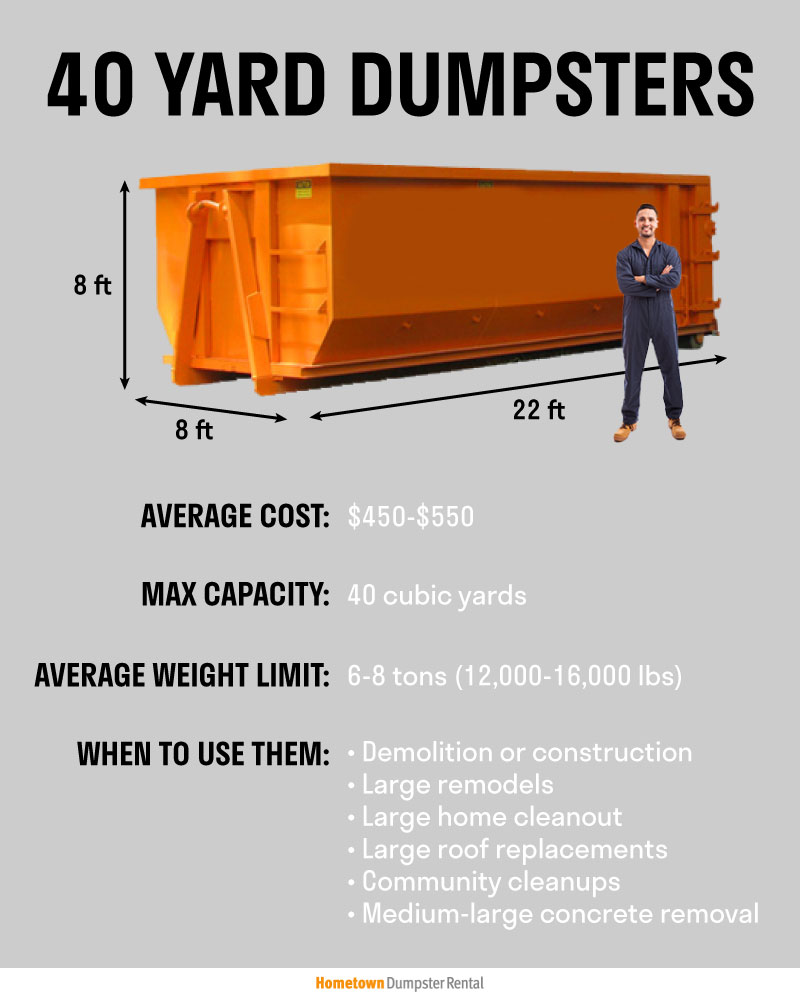
“40 yard waste bins for hazardous waste” from ewastedisposal.net and used with no modifications.
The 40-yard dumpster is the biggest container that most residential providers offer, and it's usually reserved for projects that produce a significant amount of waste. With an average cost of $891 — and going up to $1,583 in high-cost markets — it's not the best choice for the average homeowner doing a weekend project. For more details on pricing, you can visit Dumpsters.com.
Keep in mind that 40-yard rentals need a lot of room for placement, and many cities require a permit if the container is close to a public road or easement. You should budget an extra $10–$200 for permit fees depending on where you live.
Many commercial contractors opt for the 40-yard dumpster because having one large container on-site from the start is far less expensive in terms of logistics than swapping out multiple smaller bins over the course of a project. This approach can also contribute to efforts to reduce waste on construction sites.
How Your Location Can Affect What You Pay
Your location can alter your dumpster rental cost by a few hundred dollars, even if you're getting the same size container and rental duration. Factors such as local landfill tipping fees, fuel costs, competition among providers, and local regulations all contribute to the final price. These factors can vary greatly from one area to another.
City vs. Country Cost Variations
City dwellers consistently pay more for dumpster rentals than those living in the country. In densely populated cities, higher landfill tipping fees, heavier traffic affecting fuel costs, and stricter permit requirements all drive prices up. A 20-yard dumpster in New York City or San Francisco can cost $200–$400 more than the same container in a mid-sized Midwest city. Country areas benefit from lower disposal costs and less regulatory overhead, though availability can be more limited with fewer competing providers. For more detailed pricing information, check out roll-off dumpster prices.
Most Expensive Places to Rent a Dumpster
The priciest places to rent a dumpster are usually found along the coasts. California, New York, Massachusetts, and Washington are typically the most expensive states. This is due to high landfill tipping fees, strict environmental laws, and increased haulier operating costs. In cities like San Francisco, Boston, and Seattle, a normal 20-yard rental can quickly surpass $700–$900 before any extra fees are added.
Generally, the cheapest markets are in the South and Midwest – states like Kansas, Missouri, Arkansas, and Mississippi have significantly lower starting prices, mainly because landfill tipping fees are lower and competition among providers is stronger in suburban and rural areas. A 20-yard dumpster rental that costs $700 in Los Angeles might be around $350-$450 in a medium-sized city in Tennessee or Ohio.
Before you book a dumpster rental, especially if you live in an expensive city, call at least three local providers to get quotes. The prices in cities vary more than in rural areas, and local hauliers sometimes have significantly lower prices than national companies for standard residential rentals.
How Local Landfill Fees Affect Your Total Bill
Landfill tipping fees — what the disposal facility charges the haulier per ton of waste — are one of the biggest hidden cost drivers in dumpster rental pricing, and they vary enormously by location. These fees get passed directly to you, either built into the base rate or itemised separately. States with aggressive environmental regulations or limited landfill capacity charge hauliers significantly more per ton, and that cost flows downstream to the customer. For more information on waste management practices, you can explore waste management strategies that might influence these costs.
The type of waste you’re disposing of also plays a role in the cost. Heavy materials like concrete, dirt, and roofing shingles are more expensive to dispose of because they’re heavier and take up more space in the landfill per ton. If you’re getting rid of these types of materials, you can expect to pay more per ton than you would for standard household waste. For more information, you can check out roll-off dumpster prices to understand the cost implications.
The Effect of Rental Duration on Your Total Cost
Contrary to popular belief, rental duration isn't a big factor in the total cost, at least not within the standard rental period. Most dumpster rental companies have a flat rental fee that covers a specific period, rather than a daily rate. This means that whether you keep the dumpster for three, seven, or ten days, you'll pay the same amount. The duration only starts to affect the cost once you exceed the standard rental period.
Typical 5–10 Day Rentals vs. Longer Term Options
Most dumpster rental companies offer a standard rental period of 5–10 days, which is usually sufficient time to finish most home projects without feeling pressured. Some companies offer a 7-day rental period, while others provide the full 10 days at no extra cost — always double-check the exact rental period when you make your reservation, because if you assume you have more time than you actually do, you could end up with surprise extension fees on your final bill.
For projects that will take a while — like major renovations, house flips, or construction jobs that last a few weeks — some providers offer monthly rental agreements. Monthly rates usually run $400–$800 per month based on the size of the container and location, which is a lot cheaper than paying weekly extension fees on a regular rental. If your project will take longer than two weeks, ask about long-term pricing before you decide on a short-term rental.
Overage Charges: $10–$25 For Each Day Past Your Agreement
Even a single day past your rental agreement will usually result in most companies charging an overage fee of $10–$25 per day. This may not seem like a lot, but a project that runs two weeks late can quietly add $140–$350 to your bill. It's a good idea to build in some extra time when you book, and if you know you'll need more time, negotiate a longer rental period upfront — it's almost always less expensive than paying for each day you go over after the fact. For more insights on efficient waste handling, check out this article on waste management.
Unexpected Costs That Surprise Renters
The initial rental price is usually not your final price. Unexpected costs are the most common grievance among dumpster rental customers, and most of them can be completely avoided once you know what to watch out for. These four charges appear most often on final invoices — and they can collectively add an extra $200–$500 or more to what you initially thought you would pay. For more insights on waste management, you might want to explore Biffa's 30 facts about the industry.
Extra Weight Charges: $40–$200 for Each Additional Ton
Each dumpster rental includes a weight allowance, which is included in the price quote. This is usually 1–3 tons, but it can vary based on the size of the container and the provider. If you exceed this limit, you'll be charged for the extra weight, typically at a rate of $40–$200 per extra ton. The most common items that cause this are heavy materials like concrete, brick, soil, and roofing shingles. A full 10-yard bin of concrete can weigh more than 10 tons, which is much higher than the included allowance of most standard rentals. If your project will involve heavy debris, you should either ask for a higher weight allowance upfront or rent a container that is specifically designed for heavy materials.
Street Placement Permit Fees: $10-$200 Varies by City
Almost never will you need a permit to place a dumpster in your driveway or on private property. However, the second that container is on a public street, sidewalk, or easement, most cities require a placement permit. Fees for this permit range from $10 to more than $200 based on your city. Some bigger cities like Chicago and New York have permit requirements that include specific time windows and placement restrictions.
Some dumpster rental services will take care of the permit process for you, sometimes for an additional fee, while others will leave the responsibility to you. Before you book a dumpster, check to see if the location where you plan to place it requires a permit, and if so, who is responsible for obtaining it. If you skip this step, you could end up paying fines that are much more expensive than the cost of the permit itself.
Extra Charges for Forbidden Items: $50–$150 Per Prohibited Material
There are certain items that are not allowed in a standard roll-off dumpster. If you throw them in, it doesn't make them vanish — it makes them costly. Prohibited materials usually include:
The following items are typically not allowed in a dumpster rental:
- Chemicals, paint, and solvents that are hazardous
- Tires (these are usually banned by most providers)
- Electronics and e-waste
- Appliances that contain refrigerants (like refrigerators and air conditioning units)
- Materials that contain asbestos
- Batteries and propane tanks
- Medical waste
If your hauler finds any banned items in your bin at the landfill, you could be charged a surcharge of $50–$150 per item. If the entire load is rejected, you could also be charged a rejection fee. To avoid any unexpected charges on your final bill, make sure to sort these items out before you start loading your bin.
Expect Additional Charges for Fuel and Environment: Up to 15% of Base Rate
Some dumpster rental businesses sneak in additional charges for fuel and environment on top of the rental price they quote you. These can range from a flat fee of $15–$30 to a percentage-based fee of up to 15% of your base rental rate. On a $500 rental, that's an additional $75 you didn't anticipate. For more on how companies handle waste, check out this article on waste management.
Before you book a dumpster, make sure to ask about any additional fees you may be charged. These can include:
- Fuel surcharge: This can be a flat fee of $15–$50 or up to 15% of the base rate.
- Environmental/recycling fee: This fee can range from $10–$30.
- Delivery fee: Some companies charge this separately from the base rate.
- Pickup fee: This fee is sometimes billed separately.
- Permit acquisition fee: If the company handles obtaining a permit for you, this can cost $25–$75.
- Same-day delivery fee: If you need the dumpster delivered the same day you order it, this can cost an additional $50–$100.
To avoid any surprise fees, ask each provider you're considering the same question before booking: “What is the total cost, including fuel, environmental fees, disposal, and delivery?” Companies that offer transparent, all-inclusive pricing will give you a straight answer. If a company can't or won't give you a straight answer, the final bill may end up being much higher than the original quote.
A few providers, especially those operating on a national level, include all costs in one upfront price. This approach simplifies budgeting and removes all uncertainty. When you're comparing quotes from different companies, always convert them to a real all-in number before making a decision. For instance, companies like Veolia offer comprehensive pricing models that can aid in making informed choices.
The Real Cost of Your Project's Waste Removal
| Kind of Project | Suggested Size | Estimated Total Cost |
|---|---|---|
| Remodeling a Bathroom | 10-yard | $329–$580 |
| Cleaning Out a Home | 15–20 yard | $307–$729 |
| Roofing Job | 10–20 yard | $336–$700 |
| Removing a Deck | 15–20 yard | $306–$672 |
| Major Home Renovation | 30-yard | $450–$1,460 |
| Commercial Building Demolition | 40-yard | $512–$1,583 |
The type of project you're working on will influence the cost of your dumpster rental in two ways: it will determine the size of the dumpster you need and it will affect how much you have to pay per ton for disposal fees. For example, you might be able to fit the debris from both a deck removal and a full home cleanout into a 20-yard dumpster, but the cost to dispose of the deck debris (which includes pressure-treated wood, hardware, and concrete footings) will be higher per ton than the cost to dispose of general household items and furniture. To understand more about waste disposal options, you can explore mechanical biological treatment techniques.
Getting a handle on this difference can help you budget more accurately. Don't just estimate by volume. Consider the density and composition of what you're disposing of, because those factors drive disposal costs just as much as the size of the container does.
Another factor that surprises many people is mixed loads. If the rubbish from your cleanout includes a combination of lightweight furniture, heavy appliances, and construction materials in the same dumpster, the disposal fee will usually be calculated at the higher rate for the heaviest category of material. If you separate heavy debris – such as concrete, dirt, or roofing shingles – into its own load or choose a provider that offers specific dumpsters for heavy materials, you can lower your total cost for larger projects.
On average, the total cost, including all fees, for most residential projects will range from $300 to $900. The bill can climb toward and beyond $1,000 for projects involving heavy materials, multi-week timelines, or large containers in high-cost urban markets.
Household Cleanups: $307–$729
When you're cleaning out your house, you'll probably need a 15- or 20-yard dumpster. This size is perfect for getting rid of furniture, appliances, and other household items. On average, you can expect to pay between $307 and $729 for this service. The lighter your debris, the lower your per-ton disposal rate will be. Most household items are considered general waste, so you'll pay less in tipping fees than you would for construction or heavy materials.
Clearing out an estate or an entire home after moving usually falls on the pricier end of the spectrum, especially if you're dealing with bulky appliances. Certain appliances that contain refrigerants, such as old fridges or window air conditioning units, can't be tossed into a regular dumpster. They need to be disposed of separately, which increases the total cost of the project.
Roofing Jobs: $336–$435 Per Dumpster
Roofing waste is some of the heaviest material that can be placed in a dumpster. Asphalt shingles weigh around 150–300 pounds per square (a 10×10 foot area), meaning a medium-sized roof replacement can produce 3–5 tons of waste. Most roofing contractors use 10- or 20-yard dumpsters that are specifically rated for heavy materials, and the disposal cost per ton for shingles is higher than general waste in most markets. For a typical residential roof, plan for one to two dumpster loads — and make sure to confirm your weight allowance before the first shingle goes in the bin.
Deck Demolition and Major Renovation Waste
Deck demolition fits into a unique category — the waste is large in size but not as heavy as roofing shingles or concrete, so you get better disposal rates per ton but still need a good-sized dumpster. A typical home deck usually produces enough waste to fill a 15- or 20-yard dumpster, with total costs ranging from $306 to $700 depending on the size of the deck, the type of material, and whether concrete footings are being demolished along with the deck.
If you're taking on a large renovation project that involves multiple rooms — such as remodelling your kitchen and bathroom at the same time — you'll need to carefully consider the size of the dumpster you rent. If you underestimate the size you need, you could end up paying more in the long run. For example, it's usually cheaper to rent a 30-yard dumpster from the start of a multi-room renovation than to rent a 20-yard dumpster, have it swapped out for a larger one mid-project, and pay a second delivery and pickup fee. Each time you swap out a dumpster, you can expect to add $100–$300 to your total cost. So, when in doubt, go with a larger size for big renovation projects.
Securing the Best Price for Your Dumpster Rental
Securing a reasonable price for a dumpster rental isn't a complex process, but it does necessitate asking the appropriate questions before making a reservation. The majority of renters pay too much not because the prices are intrinsically expensive, but because they are unsure of what to request — and businesses do not willingly provide information that could result in a loss of income. For more insights on effective waste solutions, you might explore the benefits of waste management strategies.
Request a Comprehensive Quote
The best way to prevent unexpected charges is to request a comprehensive, itemised quote before finalising any rental. Ask the company to verify the total cost, including delivery, pickup, disposal fees, fuel surcharge, and environmental fees. If they can't provide you with a single, all-inclusive number, that's a warning sign. Trustworthy companies — especially those with clear online pricing — will provide you with a firm total in advance, leaving no room for confusion about what's included.
Choose the Correct Size to Avoid Extra Charges
One of the most frequent and expensive errors made by renters is ordering a bin that is too small. If the bin fills up before the project is completed, a swap-out is required. This means the company will pick up the full bin, empty it, and return it (or deliver a second one). This service usually costs an extra $100–$300 on top of the original rental fee. This risk is completely eliminated by selecting the correct size from the beginning.
Here's a good rule of thumb: calculate how much debris you have and then choose the next size up for your dumpster. The price difference between a 15-yard and a 20-yard dumpster is typically only $50–$100, which is much cheaper than the cost of a swap-out. For more information on efficient waste management practices, check out this article on waste management. So, if you're not sure which size to choose, it's usually a better financial decision to go with the larger size.
Understand What You Can't Toss Before You Reserve
One of the simplest ways to stay on budget is to sort out items that are not allowed before you begin filling the dumpster. Don't wait until the dumpster is half full to look at the provider's list of prohibited items. Instead, review it when you reserve the dumpster. Plan ahead for how you will dispose of hazardous materials, tyres, electronics, and appliances that contain refrigerant. Many cities have programs where you can drop off these items for free or a small fee. This can save you from having to pay the haulier's surcharge for these items.
It's also a good idea to check if the materials you're throwing away — such as tile containing asbestos, debris from lead paint, or treated lumber — need to be handled in a special way where you live. Some states have strict rules about these materials that involve more than just an extra fee and may require a licensed contractor to remove and dispose of them. Knowing this ahead of time can help you avoid delays in your project and unexpected costs for complying with the rules.
Dumpster Rental or Junk Removal: Which is Cheaper for Your Project
The truth is, it completely depends on the size of your project and the amount of work required. Junk removal services — where a team comes to your property, loads everything up, and takes it away — usually cost $100–$600 for small to medium loads. That's comparable to a dumpster rental for smaller jobs, and the work is included. However, for big, multi-day projects where you need a container on-site while you work, junk removal requires multiple trips that quickly add up to more than a single dumpster rental. For whole-home cleanouts, renovation debris, and roofing tear-offs, a dumpster is almost always the cheaper option. Learn more about waste management strategies to make an informed decision.
Common Questions
Whether it's your first time renting a dumpster or your fifth, these are the questions we hear most often. The answers will help you feel more confident when you make your reservation.
What is the cost of a one-day dumpster rental?
Even if you only need a dumpster for one day, you'll likely pay the same amount as if you were to rent it for the standard rental period, which is typically 5-10 days, depending on the company. This is because most dumpster rental companies charge a flat rental fee, not a daily rate. So, whether you keep the dumpster for one day or seven days, you can expect to pay the same amount. The cost to rent a dumpster can range from $306 to $1,583, depending on the size of the dumpster and your location, regardless of the rental duration.
The lesson here is simple: don’t hurry your project just to save a few bucks on the rental period. You’re paying for the entire duration regardless, so take advantage of the time you’ve paid for and fill the bin at a pace that’s suitable for your project.
What's the Least Expensive Dumpster Size to Rent?
- The 10-yard dumpster is the smallest and cheapest container you can get from most providers
- Typical cost varies from $329 to $1,307 depending on where you live and what type of debris you have
- It can hold roughly 3 pickup truckloads of debris
- Perfect for small garage cleanouts, bathroom remodels, and single-room renovation projects
- Heavy materials like dirt or concrete may reach the weight limit before the dumpster looks full
The 10-yard dumpster is the best option when your project is truly small and limited. Many renters make the mistake of thinking that because a project seems small — a closet cleanout, a bathroom remodel — the volume of debris will be small as well. But tile, fixtures, drywall, and cabinetry can pile up quicker than you might think, and a 10-yard dumpster that's crammed with heavy tile can reach its weight limit long before it's actually full.
If you're not sure whether a 10-yard dumpster will be big enough, you might want to consider a 15-yard dumpster instead. In most markets, the average price difference is less than $100, and the larger dumpster can hold about 1.5 more pickup truckloads of debris. This could save you from having to rent a second dumpster if your project ends up being bigger than you thought.
There is one exception to note: if you are only disposing of heavy materials such as concrete, brick, or dirt, some providers offer specialized mini dumpsters or heavy-debris containers that are priced differently than the standard roll-off bins. These are worth inquiring about if your project is primarily composed of heavy material, as they are specifically rated for high-density loads and may offer better weight allowances per dollar. For more on managing waste efficiently, you might want to explore waste management strategies.
Do I Need a Permit to Put a Dumpster in My Driveway?
Generally, if you're putting a dumpster entirely on your own property—like your driveway—you won't need a permit in most cities and counties. Your private property is typically outside the jurisdiction of municipal right-of-way rules. But if any part of the dumpster hangs over onto a public sidewalk, street, or easement, you'll almost always need a permit. Permit fees can be anywhere from $10 to over $200, depending on where you live. And some cities have specific rules about where you can place a dumpster in relation to fire hydrants, intersections, and utility lines.
Before you think you're okay, check with your local city or ask your dumpster provider about the specific rules in your area. Some companies will get the permit for you — sometimes for a fee of $25–$75 — while others leave it entirely to the customer. Either way, not getting a required permit can result in fines from the city that are much more than what the permit would have cost in the first place.
What Happens If I Exceed the Weight Limit on My Dumpster Rental?
If you exceed your included weight allowance, you will incur overage charges of $40–$200 per extra ton. These charges are billed after the container is weighed at the disposal facility. You won't know the exact overage amount until after the dumpster has been collected and processed, which means the surprise shows up on your final invoice, not before. The best way to avoid this is to either confirm a higher weight allowance upfront for heavy-debris projects, or choose a provider that offers weight-inclusive pricing with a generous built-in allowance for the type of debris you're disposing of.
What's More Affordable: Renting a Dumpster or Hiring a Junk Removal Service?
For small cleanouts that only require one visit, junk removal is often the more affordable option. You pay a flat fee that covers labour and disposal, and you don't have to worry about managing a rental period or getting hit with overage charges. But for larger projects that span multiple days and require a container on-site, renting a dumpster is almost always the more cost-effective choice.
Here's a helpful guide to understanding when each option is more cost-effective:
- Go with junk removal if you don't have a lot to get rid of, don't have any heavy debris from demolition, and don't want to do the loading yourself
- Go with a dumpster rental if your project is going to take a few days, involves debris from renovation, or will generate more than 3–4 pickup truckloads of material
- Junk removal usually costs $100–$600 for small to medium loads — this is competitive with renting a 10-yard dumpster for smaller volumes
- Dumpster rentals are better for larger projects — a single 20-yard bin at $500–$700 can replace what would otherwise require 3–4 junk removal visits at $200–$400 each
It's easier to decide when you think about it in terms of labour and timeline. Junk removal crews do the heavy lifting for you, which is a big plus if you're not very mobile or if the project is really small. Dumpster rentals require you to do the loading, but they let you control your timeline and are much more efficient for anything involving demolition, roofing, or debris from renovating multiple rooms.
Some projects work well with a combination of methods — renting a dumpster for construction waste and hiring a junk removal team specifically for large appliances or banned items that aren't allowed in the bin. This keeps the weight of your dumpster under control while making sure every item is properly disposed of in the correct manner. For more information on pricing, you can check out roll-off dumpster prices.
What it all comes down to is this: if your project fills more than half a pickup truck, a dumpster rental will almost certainly cost less per cubic yard of debris than repeated junk removal visits. Use junk removal for targeted, labour-intensive small jobs — and use a dumpster for everything else.
If you're looking for a dumpster rental with clear, straightforward pricing, Dumpsters.com is the place to go. They offer a range of sizes at fair, all-inclusive prices, so you won't have to worry about hidden fees or unexpected costs.