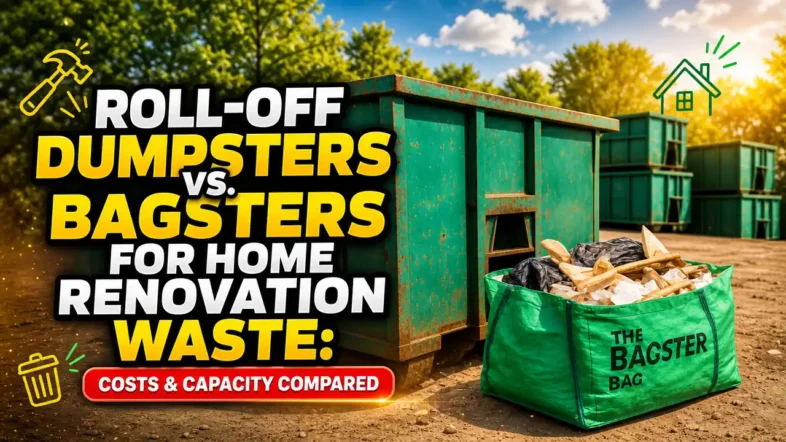
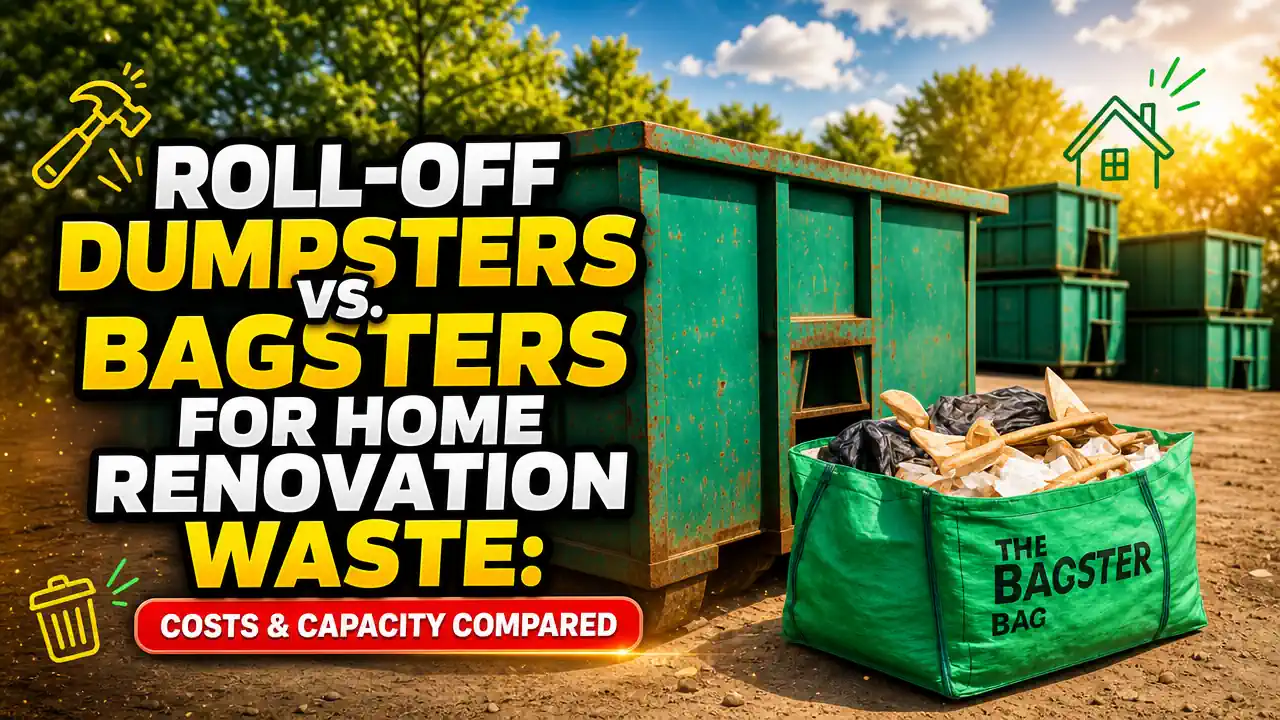
Roll-Off Dumpsters vs Bagsters: Here's the quick version:
- A Bagster can only contain 3 cubic yards and 3,300 lbs of debris — making it only useful for very small cleanups, whereas roll-off dumpsters range from 10 to 40 cubic yards for larger jobs.
- Total Bagster costs can easily surpass a dumpster rental when you consider the bag purchase price plus separate pickup fees — especially if your project requires more than one bag.
- Roll-off dumpsters are the more adaptable choice, accepting heavier materials like concrete, roofing shingles, and demolition debris that Bagsters often can't handle.
- Placement rules vary greatly — Bagsters can be placed on a driveway or curb, but roll-off dumpsters may need permits depending on your municipality.
- Keep reading to discover which option actually saves you money based on your specific project size — the answer might surprise you.
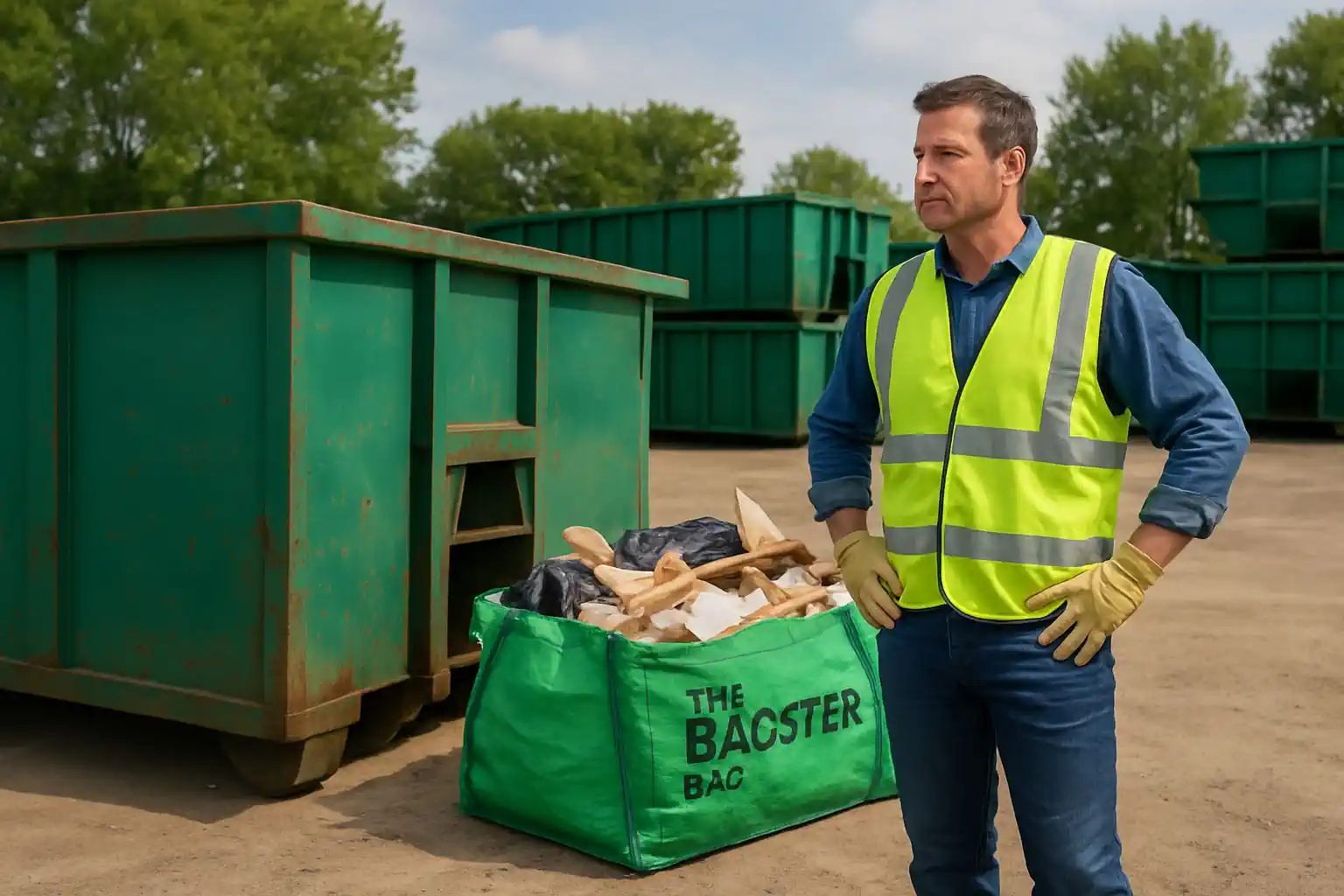
Roll-Off Dumpster or Bagster: What You Need to Know Before Deciding
Choose the wrong waste removal option for your home renovation, and you'll either run out of room halfway through the job or pay way more than you needed to.
Roll-off dumpsters and Bagsters are both designed to help you get rid of renovation debris without having to make multiple trips to the dump. However, they are intended for different sizes of projects, and using one when the other would be more suitable can result in wasted time, money, and a lot of unnecessary stress.
Whether you are decluttering a single room or doing a full-scale renovation, it's important to understand the key differences between the two before you make a decision. Dumpsters.com provides a detailed comparison of the actual costs and capacities of both, so you can make an informed choice right from the start.
Here's a brief overview of their differences:
- Size: Bagsters max out at 3 cubic yards; roll-off dumpsters start at 10 cubic yards
- Weight limits: Bagsters cap at 3,300 lbs; roll-offs can handle up to 10 tons depending on size
- Cost structure: Bagsters have a split cost (purchase + separate pickup fee); roll-off rentals bundle everything
- Availability: Bagsters are sold at retail stores like Home Depot; roll-offs are ordered directly from rental companies
- Ideal use: Bagsters work for small DIY cleanouts; roll-offs are built for renovations, construction, and large cleanups
The right choice depends almost entirely on the scale of your project and the type of materials you're throwing away. Let's break both options down completely. For more insights on waste management, you can explore how to reduce waste in manufacturing.
Understanding Bagsters
Bagsters are essentially foldable waste collection bags that are sold by Waste Management. You can buy them at a home improvement store, fill them with debris, and then schedule for pickup separately. They resemble a heavy-duty tote bag and will sit flat until you're ready to use them. The appeal is clear — you can buy them when you need them, fill them at your own pace, and call for pickup when you're finished. This kind of flexibility can be genuinely useful for a very small project. For more details on how Bagsters compare to other waste disposal options, check out this comparison between dumpster bags and rentals.
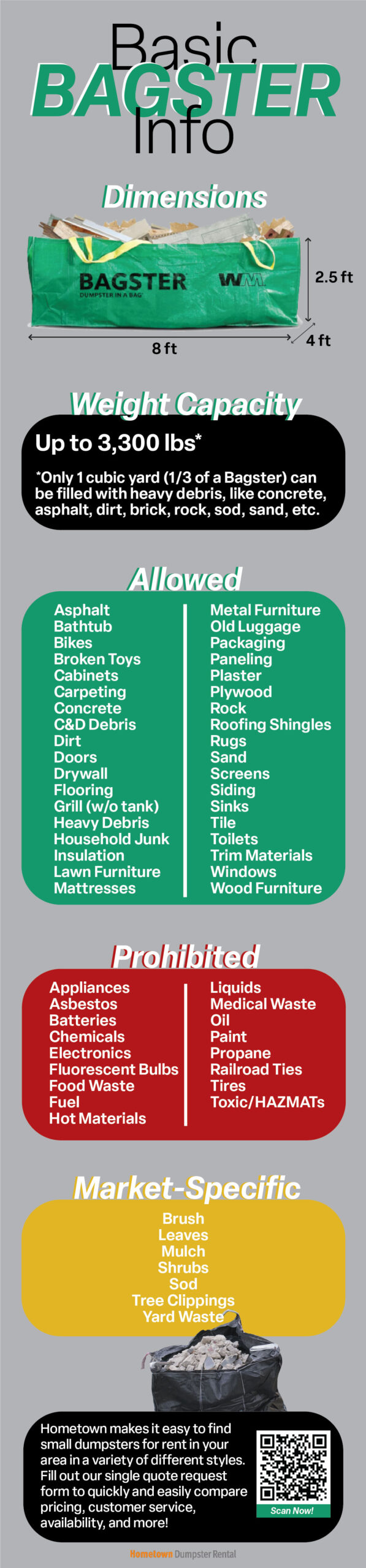
“What Items Can and Can't Go in a Bagster? | Hometown Dumpster Rental” from www.hometowndumpsterrental.com and used with no modifications.
Understanding the Bagster Pickup Procedure
After your Bagster is full, you arrange a pickup via Waste Management's website or over the phone. The cost of pickup is not included in the bag's purchase price — it's a separate charge that changes based on your location. Waste Management employs a specialised truck to pick up and remove the bag from your property, so the bag must be accessible and positioned in a spot where the truck can get to it without any blockages. Pickups are usually scheduled within a few business days, but Waste Management does provide a Guaranteed Day Service in certain areas for an additional cost.
Something that people often don't expect is the waiting time. If you fill the bag on a Saturday and plan for it to be picked up the next week, that bag is sitting in your driveway the whole time — which is important if you're in the middle of a renovation and need the space cleared quickly.
Bagster Dimensions and Weight Capacity
The Bagster is available in only one size: 3 cubic yards, with a maximum weight limit of 3,300 pounds (1.65 tons). When filled to capacity, it measures approximately 8 feet in length by 4 feet in width by 2.5 feet in height. This is roughly the same amount of waste generated from cleaning out a single small room or completing a minor landscaping project. If your project is larger than that — for example, you're remodelling a bathroom and also cleaning out a garage — a single Bagster won't suffice.
Understanding Roll-Off Dumpsters
A roll-off dumpster is a sizable, open-top metal container that is delivered to your property via a specialized truck, stays for the duration of your project, and then is picked up and removed when you're finished. In contrast to the Bagster, it's a rental — meaning the pickup cost, dumping fees, and removal are usually included in one upfront price. Roll-off dumpsters are the preferred solution for contractors and homeowners dealing with significant amounts of debris.

“Roll-off (dumpster) – Wikipedia” from en.wikipedia.org and used with no modifications.
Roll-Off Dumpster Sizes
Roll-off dumpsters are available in a variety of sizes to suit almost any project:
- 10-yard dumpster: This one can handle about three to four pickup truckloads of debris. It's perfect for small cleanouts or single-room renovations.
- 15-yard dumpster: This one is a middle-of-the-road option that's great for moderate bathroom or kitchen remodels.
- 20-yard dumpster: This is the most popular size for home renovations. It can handle multi-room projects with ease.
- 30-yard dumpster: This one is designed for large-scale renovations, new construction, or whole-home cleanouts.
- 40-yard dumpster: This is the largest option. It's designed for major commercial or construction projects.
Weight limits can vary based on the size and location of the dumpster, but most residential dumpsters have limits that range from 4,000 to 12,000 pounds depending on the container. That's a lot more than what a Bagster can handle, especially when you're dealing with heavy materials like concrete, tile, or drywall.
The Rental Process Explained
It's a simple process to rent a roll-off dumpster. You start by reaching out to a rental company, then choose the size you need, and decide on the rental period (which is typically 7 to 14 days). After that, you'll schedule a delivery date. The dumpster will be delivered to your property, and you can fill it up at your own pace while you work on your project. Once you're done, you'll call the company to schedule a pickup. The rental price you're quoted at the beginning usually includes everything — delivery, pickup, and disposal.
Comparing Costs: Bagster and Roll-Off Dumpster
For most homeowners, cost is the first thing they consider. At first glance, the Bagster seems to be the cheaper option. However, once you factor in all the associated fees, the situation may not be as it initially appears.
Bagster Total Cost: Purchase Price and Pickup Fees
Generally, the Bagster bag itself retails at about $30 to $40 at home improvement stores like Home Depot or Lowe's. This price does not include pickup. Pickup fees are charged separately by Waste Management and can vary greatly depending on your location, typically ranging from $130 to $200 or more in most U.S. markets. This means that your total cost for a single Bagster is usually $160 to $240 before any overage or service upgrades. If your project requires two Bagsters, you're looking at $320 to $480 or more, and at this point, you've likely exceeded roll-off dumpster pricing with far less capacity to show for it.
Cost of Renting a Roll-Off Dumpster
The cost of renting a roll-off dumpster depends on a variety of factors, including your location, the size of the dumpster, the type of waste you're disposing of, and the length of time you need the dumpster. However, you can expect to pay between $200 and $400 for a 10-yard dumpster. A 20-yard dumpster, which is the most popular size for home renovations, usually costs between $350 and $600. Larger 30- and 40-yard dumpsters can cost anywhere from $400 to $800 or more, depending on local market rates and disposal fees.
Roll-off pricing seems more manageable because it's bundled. The delivery, pickup, and disposal fees are almost always included in the quoted price, so you don't have to worry about any surprise charges later on — as long as you stay within your weight limit and rental period. Some companies do charge overage fees per ton if you go over the included weight allowance, so it's a good idea to confirm those details when you make your reservation.
Which Option is More Cost Effective for Larger Projects
For small, single-room cleanouts, a Bagster may be the more cost-effective option — but only slightly, and only if one bag is sufficient. As soon as your project requires two or more Bagsters, the numbers quickly shift in favour of a roll-off dumpster. Two Bagsters can cost anywhere from $320 to $480 combined, but they still only provide 6 cubic yards of total capacity — much less than even the smallest 10-yard roll-off dumpster.
When you consider the type of waste, the comparison becomes even more striking. Heavy debris like tile, concrete, and drywall quickly reach the Bagster's 3,300-pound weight limit. Just one layer of ceramic floor tile from a typical bathroom can weigh nearly 1,000 pounds — that's almost one third of the Bagster's total weight allowance before you've even added a single piece of wood or drywall. For more insights on waste management, you can explore ways to reduce waste in manufacturing.
For the majority of home renovation projects that are more than a simple declutter, a 10- or 15-yard roll-off dumpster provides better value, more space, and a more transparent total cost upfront. The Bagster's low price tag at the store is actually deceptive when you consider the full cost.
Capacity Showdown: How Much Can They Really Hold?
The differences in volume and weight capacity between these two choices are stark and undeniable. Knowing what can fit — and what can't — can prevent a mid-project panic.
What Bagster Capacity Limits Mean in Practice
When you consider that the Bagster's 3 cubic yards of space is equivalent to approximately one to one-and-a-half pickup truck loads of debris, it's clear that it's suitable for smaller projects. For example, it should be sufficient for a small bathroom cleanout, such as removing a vanity, toilet, some tile, and light drywall. It's also ideal for a garage declutter if you're primarily disposing of lightweight items like old furniture, boxes, and general household junk. However, if you're dealing with heavy construction materials, you'll reach the weight limit before you reach the volume limit.
Let's put it this way: if you're redoing a 200-square-foot kitchen and removing old cabinets, countertops, flooring, and appliances, you could easily need three to five Bagsters to handle all of that waste. At that point, you're spending potentially $500 to $1,200 on bags and pickup fees for a fraction of the capacity a single roll-off dumpster would provide.
Matching the Size of a Roll-Off Dumpster to the Size of Your Project
Roll-off dumpsters are designed to be flexible for your project. A 10-yard dumpster holds about three to four pickup truckloads — that’s already three times what a Bagster can hold. A 20-yard dumpster holds about six to eight truckloads, making it the right fit for full bathroom remodels, kitchen gut jobs, or multi-room flooring replacements. For whole-home renovations or additions, a 30-yard container can handle the kind of volume that would require a dozen or more Bagsters to match.
The weight limits increase proportionally. A standard 10-yard roll-off usually comes with a 2-ton weight allowance, with larger containers accommodating up to 6 tons or more. That's a whole different ballgame from the Bagster's 1.65-ton maximum — and it means you can load heavy materials like concrete blocks, roofing shingles, and thick hardwood flooring without reaching the limit before the container is half full.
Consequences of Overfilling a Bagster
Waste Management is stringent about the Bagster's fill line — waste cannot surpass the top of the bag. If it does, the pickup crew has the right to decline collection, leaving you with a full bag still in your driveway and a squandered pickup fee if one was already scheduled.
Overfilling can also lead to safety hazards. The bags are lifted by crane-like mechanisms on trucks, and a bag that's too full or too heavy can rip during pickup or become too heavy to lift safely. Waste Management's equipment is designed to handle the bag's rated weight limit, not more than that. For those interested in learning more about waste handling, you might find this article on scheduled pickup for sharps disposal insightful.
When a Bagster is overfilled and the team refuses to take it, you're stuck with few options – you'll have to manually remove the debris from the bag, find another way to dispose of it, and then reschedule the pickup. This means more work, more time, and possibly more expense, completely negating the convenience of the Bagster.
Location and Space Needs
Where you’re able to place your waste container is just as important as its size — especially in neighborhoods with HOA restrictions, narrow driveways, or limited street access.
Bagster Placement Options
Bagsters are small enough to be comfortably positioned in most home driveways. When not in use, they take up virtually no space, and when fully expanded, they measure around 8 feet by 4 feet, about the size of a large picnic table. They can be placed on a driveway, a paved area, or even a flat section of your lawn, as long as the pickup truck can reach it from the road without any obstructions. Because Bagsters are typically placed on private property, most cities do not require permits for their placement.
However, Waste Management needs a minimum of 14 feet of clear overhead space for their pickup trucks to function safely. Low-hanging tree branches, power lines, or covered driveways can make a location unsuitable for Bagster pickup, even if the ground placement seems okay.
Space Requirements for Roll-Off Dumpsters
Roll-off dumpsters require a larger area, both for the dumpster itself and for the delivery truck. A standard 10-yard dumpster is typically 12 feet long by 8 feet wide, and the delivery truck will need additional space to maneuver and position the dumpster. Most driveways are large enough for a roll-off dumpster, but you should ensure that you have at least 60 feet of straight clearance for the delivery truck. If you need to place the dumpster on a public street, many cities and counties will require a permit. The cost of these permits varies by location, but they typically cost between $20 and $100.
What Can and Can't Go in Each Option
Not all waste is the same, and both options have limits on what they can handle — although roll-off dumpsters are much more accommodating when it comes to heavy or bulky renovation materials.
What Bagsters Can't Handle
- Hazardous waste — such as paint, solvents, pesticides, motor oil, and other similar chemicals
- E-waste — including televisions, computers, monitors, and other e-waste
- Appliances with refrigerants — such as refrigerators, air conditioners, and freezers
- Tires — no matter the size or quantity
- Materials containing asbestos — often found in older homes during renovation
- Medical or biological waste — of any kind
- Liquid waste — including wet concrete or paint
Aside from the items that are strictly prohibited, the weight limit of the Bagster imposes a practical limitation that extends beyond the official list. Heavy renovation materials like concrete, brick, roofing shingles, and ceramic tile will reach the 3,300-pound limit long before the bag appears to be anywhere near full. You could load what seems like a Bagster that's only a quarter full with broken concrete pieces and already be over the limit — which means the collection crew can refuse to pick it up entirely.
Many homeowners are caught off guard by the weight of their renovation debris. For example, a bathroom tile removal job can generate a lot more weight per cubic foot than most people expect. Ceramic and porcelain tiles can weigh between 5 and 8 pounds per square foot. This means that the demolition of a 100-square-foot bathroom floor could weigh almost 800 pounds in tiles alone, even before you add the weight of the drywall, old vanity, or toilet. Proper waste management is essential to handle such heavy debris efficiently.
The Bagster shines when it comes to lighter debris loads. Old furniture, cardboard boxes, general household junk, light lumber, and yard waste in most service areas all fit the bill. If your renovation is generating mostly this type of material and you stay under the weight limit, the Bagster can handle the job without a hitch. For a detailed comparison, check out this dumpster bag vs. dumpster rental guide.
What Can Roll-Off Dumpsters Accommodate That Bagsters Can't?
Roll-off dumpsters are designed to handle a wide range of renovation debris that Bagsters simply can't manage. Roofing shingles, concrete, brick, large amounts of drywall, heavy lumber, entire kitchen cabinet sets, and mixed demolition debris can all be accommodated in a roll-off — as long as you don't exceed the container's weight limit, which is significantly higher than that of a Bagster. Many roll-off companies also accept appliances like washing machines, dryers, and dishwashers, as well as mattresses and bulky furniture items that would be difficult or impossible to fit into a bag. The one restriction that applies to both options is hazardous materials — no roll-off company will accept asbestos, chemicals, or appliances containing refrigerant without special arrangements for handling.
How Do I Choose Between a Bagster and a Roll-Off Dumpster?
A Bagster might be the right choice for you if you have a small project that will fit into one bag. This could be a small garage cleanout, a single-room declutter, or a minor landscaping job with light debris. However, for most home renovation projects, a roll-off dumpster is the smarter, more cost-effective choice. If you're pulling out flooring, demoing a bathroom, replacing a roof, or clearing out multiple rooms, the Bagster's size and weight limitations will work against you. If you need two or more Bagsters, your total cost will be in the same range as a roll-off dumpster — but you'll have significantly less space and flexibility. A 10-yard roll-off dumpster is the entry point for serious renovation work. If you're a homeowner tackling a kitchen remodel, bathroom gut job, or whole-room renovation, a 15- or 20-yard container will handle the debris from start to finish without a second thought.
Common Questions
Once the basic cost and capacity details are understood, homeowners often ask the same questions when comparing these two options. Here are the most frequent ones — with straightforward answers.
Is it possible to purchase a Bagster at Home Depot?
Absolutely. The Bagster is available for purchase at Home Depot, Lowe's, and other home improvement stores, usually in the building materials or contractor supply department. The bag itself typically costs between $30 and $40.
Remember that buying the bag is just the beginning. You will need to schedule and pay for pickup separately through Waste Management's website or over the phone, and the cost of this service can vary depending on where you live — usually adding another $130 to $200 or more to the cost of the bag. Always consider the total cost before deciding that the Bagster is the cheaper option.
What Is the Usual Rental Period for a Roll-Off Dumpster?
Most roll-off dumpster rentals usually come with a 7- to 14-day rental period, but this can vary depending on the company and where you live. If your project takes longer than the given rental period, most rental companies will let you extend your rental for a daily or weekly fee — this usually costs between $5 to $10 per day. It's a good idea to confirm the exact rental period and how much it costs to extend your rental when you book, so you're not caught off guard if your renovation takes longer than expected.
Does a Bagster Cost Less Than a Dumpster Rental?
If you only need a single bag, a Bagster can be a more economical choice, with a total cost of about $160 to $240. So, in that specific case, the answer is yes — but only for that specific case. For more information on waste disposal options, check out this article on mail-back vs scheduled-pickup sharps disposal.
When you have a project that requires more than one Bagster, or you’re dealing with heavy materials that quickly reach the weight limit, a roll-off dumpster usually offers a better bang for your buck. Two Bagsters can cost $320 to $480 or more and only give you 6 cubic yards of capacity, which is much less than a 10-yard roll-off that could cost the same or less depending on where you live. For more information on waste solutions, you might want to explore waste management options.
Is it Possible to Put Roofing Shingles in a Bagster?
While Waste Management does technically allow asphalt roofing shingles in a Bagster in most service areas, the weight limit makes it nearly impossible for anything more than a very minor repair. Asphalt shingles are extremely heavy, typically weighing between 230 and 430 pounds per roofing square (100 square feet). A standard roof replacement generates a lot of debris, meaning even a small section of shingle removal can push a Bagster to or past its 3,300-pound limit while the bag still looks mostly empty. For any significant roofing job, a roll-off dumpster — ideally a 10- or 20-yard container rated for heavy debris — is the right tool.
Do I Need a Permit for a Roll-Off Dumpster on the Street?
It depends on your local laws. If the dumpster is placed entirely on your private property — your driveway, for example — most cities and counties do not require a permit. However, the moment the container needs to sit on a public street or sidewalk, the rules may change. For more information on waste management regulations, you might find this waste management guide helpful.
If you need to place your dumpster on the street, you will most likely need a permit from your local city public works or transportation department. The cost for these permits can range anywhere from $20 to $100. Additionally, many cities have regulations about how long a dumpster can sit on a public street, usually somewhere between 72 hours to two weeks.
Most dumpster rental companies are familiar with the permit requirements in your area and can help you navigate the process. Some companies even include the permit application as part of their rental service, so it's a good idea to ask upfront if that's included or if you need to apply directly with your local government before the dumpster is delivered.
When considering waste management solutions for home renovation projects, it's essential to compare the options available. Waste management involves choosing between roll-off dumpsters and bagsters, both of which offer unique benefits and limitations. Understanding the costs, capacity, and convenience of each option can help homeowners make an informed decision that best suits their needs.