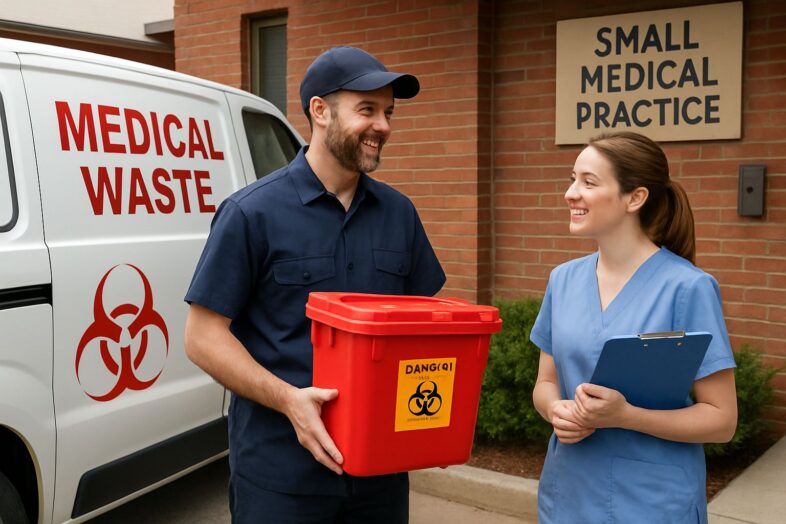
Here are a few key points to consider when choosing between mail-back and scheduled pickup sharps disposal:
- If your practice generates less than 50 lbs of sharps waste per month, you'll likely save money by using a mail-back program.
- Mail-back programs typically cost $80–$300 per year, while scheduled pickup services also charge $10–$30 per container in addition to service fees.
- Both disposal methods must comply with DOT, FDA, and OSHA regulations, but mail-back programs typically handle most of the compliance paperwork for you.
- Medical, dental, veterinary, and home healthcare practices that generate small amounts of sharps waste are usually the best candidates for mail-back programs.
- If you choose the wrong disposal method, your practice could end up paying hundreds of dollars per year in unnecessary fees. Keep reading to find out which method is right for you.
Choosing the wrong sharps disposal method is a common and costly mistake that small medical practices often make.
Regardless if you operate a family clinic, dental practice, or home health care service, the way you discard needles and sharps isn't simply a regulatory requirement — it directly impacts your operating costs, staff safety, and legal compliance. MedPro Disposal is an expert in aiding small clinics in making this exact decision, and the advice below is based on what truly works in actual clinical environments.

“Sharps waste – Wikipedia” from en.wikipedia.org and used with no modifications.
How Do You Know Which Sharps Disposal Method Is Best for Your Practice?
It all boils down to one factor: the amount of sharps waste your practice produces each month.
Small medical practices have two main choices for sharps disposal — mail-back services and scheduled pickup services. Mail-back services send sharps containers that have already been approved to your facility. You just fill them up, seal them, and send them back using prepaid shipping. On the other hand, scheduled pickup services have a licensed waste haulier come to your location on a regular schedule to pick up filled containers.
How the 50 lbs Per Month Rule Determines Your Best Sharps Disposal Option
For practices that generate less than 50 pounds of sharps waste per month, a mail-back program is typically the more affordable and simpler option. This isn’t a random threshold — it’s the point at which the cost of a scheduled pickup becomes more economical in relation to the amount and frequency of waste disposal.
Medical practices that generate 50 lbs or more of sharps waste per month usually have enough volume to warrant the fixed costs of scheduled pickup. These costs include fuel surcharges, service contracts, and the per-container fees associated with that model. If you generate less than that volume, you're often paying for capacity you don't use. For further understanding of waste treatment options, you can explore on-site vs. off-site biomedical waste treatment.
The Reason Small Practices Are Overcharged for Scheduled Pickup Services
Scheduled pickup services charge for frequency, not actual volume. A single practice producing 10 lbs of sharps waste each month pays for the same truck visit as one producing 45 lbs. That inefficiency quickly becomes costly, highlighting the importance of exploring biomedical waste treatment options.
Practices using scheduled pickup often have to buy their own sharps containers, which can cost between $10 and $30 each. This is a cost that is usually included in the package price for mail-back programs. Many small practice administrators overlook this cost when comparing quotes, making scheduled pickup seem less expensive than it really is.
Another thing to consider is the matter of contract lock-in. A lot of scheduled pickup providers necessitate yearly or multi-year service agreements, which doesn't leave practices much wiggle room if their waste volume decreases seasonally or if their patient load fluctuates.

“Sharps waste – Wikipedia” from en.wikipedia.org and used with no modifications.
Understanding Mail-Back Sharps Disposal Programs
Mail-back programs are simple and easy to use, while still ensuring compliance. After enrolling, you will receive a container that has been approved for use. You can fill it up to the indicated line, which is usually at 75% capacity. After sealing it, you can attach the prepaid return shipping label and drop it off at a USPS, UPS, or FedEx location, depending on the provider you are using.
What's Included in a Mail-Back Kit
A typical mail-back sharps disposal kit comes with everything you need to gather, secure, and legally send back your waste. Most kits come with an OSHA-approved sharps container, a prepaid return shipping label, a biohazard outer packaging box, a comprehensive instruction sheet, and a certificate of destruction that you'll receive after processing.
Top-notch providers also include pre-printed compliance labels that meet DOT shipping requirements right out of the box, eliminating the need for staff to source or apply additional regulatory markings. This is important because incorrect labelling on sharps shipments is one of the most common compliance failures during audits.
What's in a mail-back sharps kit:
- OSHA-approved sharps container (pre-labeled)
- Biohazard-rated outer shipping box
- Prepaid return shipping label (DOT-compliant)
- Instruction sheet for proper sealing and shipping
- Certificate of destruction for your compliance records
- Regulatory update notifications (offered by premium providers)
The certificate of destruction is something you shouldn't ignore. It's your evidence that waste was managed by a licensed facility — and it's the first thing an OSHA inspector or state health department auditor will ask for.
Understanding Single, Multi-Pack, and Collection Bin Systems
There are three primary types of mail-back programs. Single-pack systems are designed for low-volume generators, such as solo practitioners or small speciality offices, and include one container per shipment. Multi-pack systems are perfect for practices that have a slightly higher volume and want to lessen the frequency of shipping logistics. These systems bundle two, four, or six containers into one return box. Collection bin systems are larger-format options that are best suited for practices that are nearing the 50 lbs monthly threshold.
Choosing the correct size is crucial because filling a container too much is a violation of the rules, and ordering too little means more frequent shipping interruptions. Most suppliers will assist you in determining the appropriate package size based on your patient volume and the types of procedures you perform during the registration process.
How to Safely and Legally Ship a Full Container
When your container reaches the 75% fill line, close the lid following the manufacturer's instructions — most use a one-way locking mechanism that cannot be reopened. Put the sealed container in the outer biohazard shipping box, attach the prepaid label, and leave it at the designated carrier location. Do not put it in a regular outgoing mail bin or leave it for regular courier pickup unless your provider has specifically authorised that method. For more information on waste management practices, you can explore this guide on waste management.
According to the Department of Transportation regulations under 49 CFR, used sharps are classified as regulated medical waste. The packaging requirements for mail-back kits are specifically designed to meet these standards. The outer packaging must be rigid and leak-resistant, and it must be labelled with the correct biohazard markings. Quality kit providers handle all of these requirements in advance.
Understanding Scheduled Pickup Services
Scheduled pickup services are carried out by a licensed medical waste haulier who will visit your facility at set intervals — weekly, bi-weekly, or monthly — to collect filled sharps containers and take them to a licensed treatment facility. The haulier will provide manifests that document the weight and type of waste collected, and you keep these for your compliance records. For more information, you can read about pickup vs. mail-back disposal methods.
High-volume generators have a straightforward process, but for small practices, it brings about various logistical dependencies. Someone must be there to hand off containers. The storage space for filled containers between pickups must meet state regulations for secure containment. If your waste volume doesn't fill the scheduled capacity, you're still paying the base service rate for the visit.
Mail-Back vs. Scheduled Pickup: Cost Analysis
When it comes to cost, many small practices focus on the quoted service rates and overlook the actual costs. Here's a comparison of the annual costs for each method for a low-volume generator.
Annual Costs for a Mail-Back Program Based on Container Size
The price of a mail-back program is mostly based on the size of the container and how often you need to send back filled containers. For the majority of small practices, the annual costs are usually between $80 and $300 — and that price usually includes the containers themselves. Learn more about waste management to optimise your disposal practices.
| Container Size | Typical Use Case | Estimated Annual Cost |
|---|---|---|
| 1-quart single pack | Solo practitioner, low-volume | $80 – $120 |
| 2-gallon multi-pack (4 containers) | Small group practice | $150 – $220 |
| 5-gallon collection bin | Moderate-volume small clinic | $220 – $300 |
Scheduled Pickup Annual Costs for Low-Volume Generators
For practices generating under 50 lbs of sharps waste monthly, scheduled pickup rarely pencils out as the economical choice. Base service rates alone — before containers, fuel surcharges, or manifest fees — typically start between $150 and $300 per year for monthly pickup frequency. Push that to bi-weekly visits, and costs can climb well past $500 annually.
Most practice administrators are surprised by the cost of the containers. Mail-back programs usually include the containers in the package price. However, scheduled pickup providers usually require practices to buy their own OSHA-approved sharps containers. These containers can cost anywhere from $10 to $30 each. A small practice that uses even four containers per month would spend an additional $480 to $1,440 per year on containers alone, not including service fees.
Keep in mind the normal fuel surcharge, which is usually 10% to 15% of the base service rate. As a result, many small practices end up paying double or triple what a similar mail-back program would cost for the same amount of waste.
Rewrite the following human content into AI content:
- Base service rate: $150–$300+ per year for monthly pickup
- Sharps containers: $10–$30 per container, purchased separately
- Fuel surcharge: 10–15% added to base service rate
- Manifest documentation fees: Varies by provider, often $5–$15 per pickup
- Contract termination fees: Common in multi-year agreements
Hidden Costs Most Small Practices Miss
Beyond the line items above, scheduled pickup contracts often include minimum quantity clauses — meaning you pay for a set amount of waste collection regardless of what you actually generate that month. Storage compliance is another overlooked cost. State regulations require secure, labelled containment for sharps waste between pickups, which may require purchasing dedicated storage units if your facility doesn't already have compliant infrastructure in place. These aren't minor details — they're recurring operational expenses that compound over a multi-year service agreement.
Which Practices Would Benefit Most From Mail-Back Programs?
While mail-back programs aren't a one-size-fits-all solution, they are an excellent fit for a surprisingly large number of small healthcare settings. The common denominator is consistent low-volume sharps generation, typically under 50 lbs per month, combined with a need for simplicity in compliance and cost predictability.
Small Medical, Dental, and Veterinary Practices That Generate Less Than 50 lbs of Sharps Waste Per Month
Mail-back programs are ideal for solo and small group medical practices, dental offices, and veterinary clinics. These practices regularly generate sharps waste, but not in large enough volumes to justify the cost of scheduled pickup. For example, a two-provider family practice might fill one 2-gallon sharps container every three to four weeks. This volume of sharps waste can be easily and cost-effectively managed with a single multi-pack mail-back kit, which is much less expensive than a pickup contract. Dental offices, especially those that perform procedures involving local anaesthetic injections but not higher-volume surgical work, can also benefit from mail-back programs.
Small Laboratories and Home Healthcare Providers
Home healthcare agencies have a unique logistical challenge — sharps waste is generated at patient homes instead of a central facility, which makes scheduled pickup logistically not feasible and often cost-prohibitive. Mail-back programs that are designed for home healthcare settings provide individual patients or caregivers with personal-use containers that can be returned directly, which keeps the compliance burden manageable. Small laboratories that process blood or specimen samples also generate modest but regulated sharps volumes, and mail-back programs provide them with a straightforward disposal path without requiring a dedicated waste management contract.
Regulatory Obligations for Both Disposal Methods
Whether your practice uses mail-back or scheduled pickup, the regulations for sharps waste disposal remain the same. Federal regulations set the minimum requirements, and state regulations — which can differ greatly — can increase those requirements. It's crucial for any practice dealing with regulated medical waste to understand what their responsibilities are under each method.
DOT Shipping Regulations for Mail-Back Programs
Mail-back sharps disposal is regulated by the U.S. Department of Transportation's 49 CFR regulations for regulated medical waste. These rules dictate the integrity of packaging, labelling, and carrier requirements for any sharps container that is shipped through the postal or commercial carrier system. Trustworthy mail-back providers design their kits to be pre-compliant with these standards. This means that the outer packaging, biohazard labelling, and container integrity requirements are already satisfied when you receive your kit. Your responsibility is to fill the container correctly, seal it according to the instructions, and use the designated prepaid shipping label without substituting your own packaging.
What OSHA's Bloodborne Pathogens Standard Means for You
The Occupational Safety and Health Administration's (OSHA) Bloodborne Pathogens Standard (29 CFR 1910.1030) requires any facility where employees could be exposed to blood or other potentially infectious materials to have an Exposure Control Plan. This plan must include procedures for handling and disposing of sharps. It doesn't matter whether you use mail-back or scheduled pickup for disposal — the method of disposal is a separate issue from the standard's main requirements for container placement, labeling, and employee training.
Sharps containers should be closable, puncture-resistant, leak-proof on sides and bottom, and labeled with the biohazard symbol. They should be located as close as feasibly possible to the point of use — meaning a container in a supply closet down the hall doesn't meet the standard if injections are being administered in an exam room. Both mail-back and scheduled pickup providers supply containers that meet these physical specifications, but proper placement and staff training remain the practice's responsibility. Learn more about waste management solutions to ensure compliance and safety.
Proof of Compliance and Destruction Certificates
Both disposal methods provide you with proof of compliance, though in different forms. Scheduled pickup services give you a waste manifest, which is a tracked document that lists the weight, type, and destination of the waste they collect. Mail-back programs give you a certificate of destruction after they’ve processed your returned container at a licensed treatment facility. Either document is your proof that you’ve disposed of your waste compliantly, and you should keep them for at least three years — or longer if your state requires you to keep records for a longer period of time. If you can’t produce these documents during an audit, most regulatory bodies will treat it the same as if you hadn’t disposed of your waste compliantly.
Choosing the Best Mail-Back Sharps Disposal Vendor
Not every mail-back provider operates with the same compliance standards, and the differences are significant. The sharps disposal industry is made up of fully licensed national operators as well as smaller regional providers. It's important to scrutinize the regulatory standing of these providers before you sign up with them. Choosing the wrong vendor can cost you more than just money — it can also expose your practice to liability if the waste isn't processed at a facility with the proper permits.
Firstly, ensure that any potential provider is approved by the respective shipping carrier, be it USPS, UPS, or FedEx, to carry regulated medical waste. For instance, USPS-approved mail-back providers must fulfill certain FDA and DOT stipulations to use the postal system for sharps return shipments. This approval is not automatic and requires formal approval and regular renewal, so it's a valid measure of a provider's compliance framework.
What to Check Before You Commit
Before you sign on the dotted line, there are three important credentials you need to check. The vendor must have a current state permit to operate as a medical waste treatment facility (or a documented contract with a facility that does), authorisation from USPS, UPS, or FedEx to transport regulated medical waste, and proof of EPA compliance for the treatment method used at the destination facility. Don't be shy about asking for copies of these documents. A legitimate provider will have no problem supplying them. If a vendor tries to dodge the question or gives you a vague answer instead of the actual documents, that's a red flag.
It's crucial to understand that treatment facility requirements can differ from state to state. A provider that is licensed to operate in one state might not have the necessary permits to accept waste from practices in a different state. You need to make sure that your vendor's processing facility is permitted to receive waste that originates from your specific state, not just permitted to operate in general. While this might seem like a small difference, it's a legally important one. Regulators often pay close attention to this detail when they're auditing medical waste disposal records.
Container Size Options and Replacement Policies
Your sharps volume will vary. A vendor whose container options force you into a single size or require you to order in large fixed quantities can create an operational issue when your patient load varies. Look for providers that offer a variety of container sizes — from 1-quart personal-use containers to 5-gallon collection bins — and allow you to mix and match configurations within a single order. Also, make sure to check the vendor's policy on damaged or defective containers. A cracked or compromised sharps container cannot be shipped, and you need a straightforward replacement process that doesn't leave your practice stuck with non-compliant waste while waiting for a slow logistics response.
Time-Saving Compliance Support Services
The top mail-back vendors do more than just deliver containers. Look for providers that offer resources for staff training, notifications of regulatory updates when state or federal requirements change, and direct access to compliance support staff who can answer jurisdiction-specific questions. These services reduce the amount of time your practice spends staying up-to-date on a regulatory landscape that changes more frequently than most administrators expect. A vendor that proactively alerts you to a change in labeling or a new state storage requirement is worth more in terms of operations than one that offers a slightly lower price per kit.
Mail-Back Sharps Disposal is the Clear Winner for Small Practices Producing Less Than 50 lbs Per Month
When you take a close look at annual costs, ease of compliance, flexibility in logistics, and contract terms, it’s clear that mail-back programs are the best choice for the majority of small medical practices. The annual cost of $80 to $300, including containers, is simply unbeatable by scheduled pickup. When you consider the cost per container, fuel surcharges, manifest fees, and minimum quantity billing, scheduled pickup just can’t compete. If your practice generates less than 50 lbs of sharps waste per month, the numbers consistently point to mail-back as the most cost-effective solution. Plus, the compliance infrastructure built into quality programs eliminates most of the administrative work that makes medical waste management seem so complex.
Commonly Asked Questions
Are mail-back sharps disposal programs a viable option for home healthcare patients?
Definitely. Mail-back sharps disposal programs are among the most convenient options for home healthcare settings. Providers can give individual patients or caregivers personal-use containers — usually 1-quart size — along with prepaid return labels. This enables sharps waste produced at patient homes to be sent back directly without needing transport through the practice's facility. Some states have specific rules regarding home-generated sharps disposal, so verify that your vendor's program adheres to your state's home healthcare waste requirements before handing out kits to patients.
What happens to sharps waste after it is returned in a mail-back program?
After your sealed container arrives at the processing facility, it is treated using one of several EPA-approved methods — most commonly autoclave sterilisation or incineration, depending on the facility's permits and your state's allowable treatment methods. Once treated, the waste is classified as non-hazardous and disposed of through standard solid waste channels. You receive a certificate of destruction as documentation that the full cycle — from collection through treatment — was completed by a licensed facility. This certificate is your primary compliance record and should be retained for a minimum of three years.
Are sharps containers included in the cost of mail-back sharps disposal programs?
Usually, the answer is yes. The sharps container is often part of the kit price, which is one of the main cost benefits of mail-back programs over scheduled pickup services. When you're comparing quotes from vendors, make sure to ask whether the container is included or if it's billed separately, because pricing structures can vary. Systems that come with multiple containers, like two, four, or six containers per return box, are also usually priced as a single unit. This means the cost per container is even lower than if you were to buy individual containers through a scheduled pickup provider.
When should a medical practice switch to scheduled pickup based on monthly waste volume?
Typically, the industry standard is 50 lbs per month. This is a good rule of thumb as it is around this volume that the cost of mail-back shipments starts to approach the cost of scheduled pickup. This is particularly true when you factor in the staff time needed to manage individual return shipments. For practices that consistently generate 50 lbs or more monthly — usually mid-size group practices, urgent care centers, or surgical suites — scheduled pickup becomes more economically favorable on a per-pound basis. The simplicity of having a single scheduled collection often outweighs the flexibility of mail-back programs.
Do mail-back sharps disposal programs meet federal and state regulations?
Yes, when run by a properly certified vendor, mail-back sharps disposal programs meet all federal regulations including DOT 49 CFR requirements for regulated medical waste transport, FDA oversight of sharps container specifications, and OSHA's Bloodborne Pathogens Standard for container labeling and integrity.
Practices should pay close attention to state compliance. State regulations on medical waste disposal vary greatly. Some states have additional labeling requirements, specific approved treatment methods, or mandatory manifest documentation that exceeds federal minimums. A good mail-back vendor will be familiar with the requirements in every state they serve and will incorporate those specifications into their kits and documentation process.
For small medical practices, choosing the right method for sharps disposal is crucial. Two popular options are mail-back programs and scheduled pickups. Mail-back programs offer convenience, allowing practices to send their waste to a processing facility via mail. On the other hand, scheduled pickups involve a waste management company collecting the sharps directly from the practice. To make an informed decision, it's important to understand the differences between these methods and consider factors such as cost, frequency of disposal, and environmental impact. For more insights on this topic, you can explore the comparison of on-site vs. off-site biomedical waste treatment.