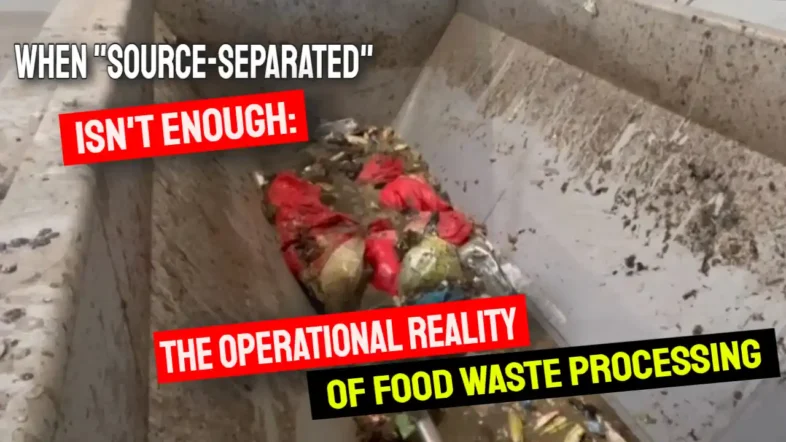
There's a gap in how food waste processing gets discussed. Most of the conversation focuses on diversion rates, composting capacity, and anaerobic digestion infrastructure. What gets less attention is the stretch between when material is discarded and when it actually reaches a processor. That stretch is where a lot of recovery potential gets lost.
Packaging condition, liquid content, contamination from handling, and mismatches between what generators send and what processors can accept all play a role. Understanding where these failures happen matters more than most program-level discussions suggest.
Why The Problem Starts Before Processing
The standard assumption in food waste programs is that source-separated material arrives ready to process. In reality, source separation is a starting point, not a guarantee.
Waste that's correctly classified at the point of discard still arrives with problems. Damaged packaging releases liquid into otherwise dry loads. Non-target materials enter streams at the collection point. Transport conditions that work fine for general waste don't always suit organic material with high moisture content. By the time a load reaches a facility, its condition may be far from what the program design assumed.
Basic information about anaerobic digestion makes clear that AD systems are sensitive to inputs. Contamination levels, packaging residues, and free liquid all affect what a processor can accept. Most of that gets resolved, or doesn't, during pre-treatment. That's the stage where contamination is removed, and organic material is prepared for the processing stream, and it carries far more operational weight than program-level discussions typically acknowledge.
Packaging format is another variable that program designs tend to underestimate. The same organic content inside a flexible pouch, a glass bottle, a shrink-wrapped tray, or a rigid container creates different handling requirements at every stage. Classification decisions made upstream directly shape what's possible downstream.
The Depackaging Problem Is More Complex Than It Sounds
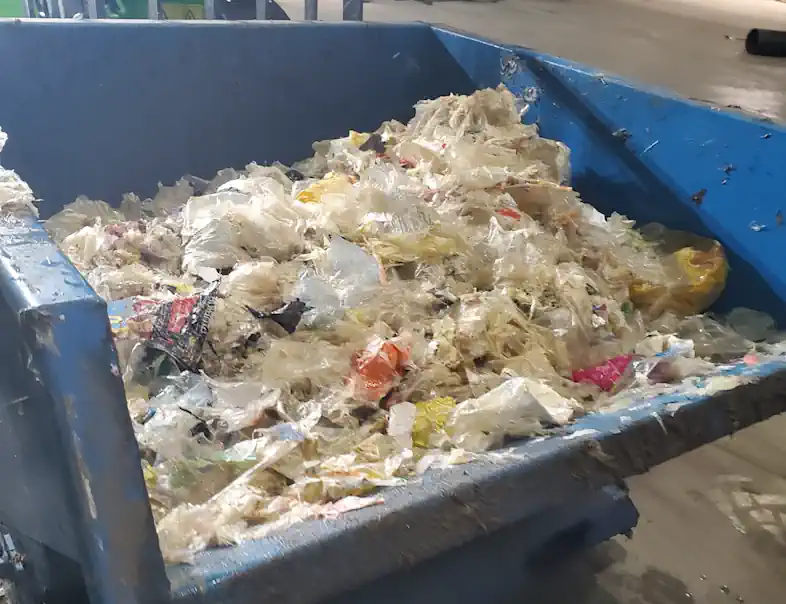
What depackaging actually involves depends heavily on what arrives. Full intact containers behave differently from damaged ones. Pouches and multi-layer formats create different separation challenges than mono-material packaging. Shrink-wrapped units, mixed loads, and glass all introduce their own complications.
Extracting organic content is not the same as producing a clean, processor-acceptable stream. A depackaging run can remove the bulk of packaging material and still leave the resulting organic fraction with residue levels, moisture content, or physical contaminants that put it outside what the destination facility will accept. The output quality depends as much on what came in as it does on the equipment doing the work.
Material condition at intake is probably the biggest variable. Degraded or heavily damaged packaging changes separation efficiency in ways that are hard to predict and harder to control. A load of intact retail units runs very differently from a load of damaged warehouse returns, even if they carry the same product.
Destination requirements add another constraint. Processor thresholds vary considerably. What one facility accepts, another won't. That gap between what a generator assumes is acceptable and what a processor actually requires is where a lot of material gets rejected or downgraded despite having gone through depackaging correctly.
Why Liquids Create Disproportionate Operational Challenges
Beverage waste and food products with high liquid content deserve separate treatment in any honest discussion of food waste processing. They do not behave like solid organic waste, and handling programs that treat them as equivalent tend to run into problems.
Liquids Migrate And Contaminate
The core issue is that liquids migrate. A single compromised container in a mixed load can cross-contaminate dry material, change the handling characteristics of the whole batch, and create secondary problems at processing. Transport is a particular pressure point. Loads that look manageable on pickup can arrive in a significantly different state.
Storage And Handling Complications
Storage compounds this. Liquid waste generates odour quickly, requires appropriate containment, and creates compliance considerations depending on the material type. Beverage products with alcohol content, dairy-based products, and certain sauces or condiments each carry different handling requirements that a standard organic waste stream is not always set up for.
Liquids Change The Calculation
Transport costs, handling requirements, and processor compatibility all look different when liquid waste is involved. Beverage waste management carries considerations that can change the feasibility calculation for what would otherwise seem like a straightforward diversion. Liquid waste often does not fit neatly into the assumptions built into standard food waste recycling programs.
For operators, this means beverage and high-liquid streams frequently need to be evaluated and routed separately rather than absorbed into a general organics stream.
What Operators Look At Before Deciding A Stream Is Recoverable
Not every waste stream that could theoretically be diverted is worth diverting in practice. Operators working in this space make that call based on a set of factors that rarely feature in program-level conversations.
Packaging Composition And Contamination Profile
Packaging composition is usually the first consideration. Is it separable, and what residue does it leave in the organic fraction? A stream with complex multi-material packaging creates a different recovery proposition than one with straightforward mono-material formats. Contamination profile follows. Streams that look clean at generation often carry contamination by the time they reach processing.
Moisture Content And Stream Consistency
High-moisture content and free liquid change handling requirements and processor compatibility before anything else gets considered. A stream with variable moisture levels is harder to place than one with predictable characteristics. Processors care about a reliable supply, not just a clean supply. Irregular or inconsistent streams create planning problems that affect acceptance decisions independently of contamination.
Processor Capability And Transport Distance
Local processor capability shapes what's actually possible regardless of how well a stream is managed upstream. A generator operating outside the catchment area of a facility equipped to handle its material faces constraints that no amount of good source separation resolves. Transport distance changes the economics of recovery, particularly for lower-value or high-moisture streams where haulage costs can make diversion financially unworkable.
On-Site Handling And Compliance Considerations
For some streams, on-site or near-site processing models make more sense than routing material to a distant facility. This is particularly relevant for high-volume generators, sensitive material types, or streams where transport creates contamination or compliance risks. Beverage waste with alcohol content, dairy streams, and certain food manufacturing byproducts all carry handling and chain-of-custody considerations that affect routing decisions independently of processing capability.
What This Means For Better Waste System Design
Most program failures trace back to the same root cause: design decisions made around assumptions rather than actual downstream capability. Fixing that requires a different starting point.
A few things that matter in practice:
- Design around processor reality, not program intent. What a facility can accept, at what contamination threshold, and at what volume shapes what's actually recoverable. That information needs to be built into program design from the start, not discovered after rejections begin.
- Evaluate packaging and product formats early. Packaging complexity affects depackaging outcomes, contamination risk, and processor compatibility. Identifying difficult formats upstream is cheaper than managing the consequences downstream.
- Separate operationally difficult streams before they compromise wider loads. High-liquid content, complex packaging, and variable contamination profiles all create problems when absorbed into general organics streams. Routing them separately protects the integrity of the broader load.
- Treat logistics as part of recoverability. Transport distance, handling conditions, and transit time all affect what arrives at processing. A stream that's clean at collection can become a problem load by the time it reaches the facility.
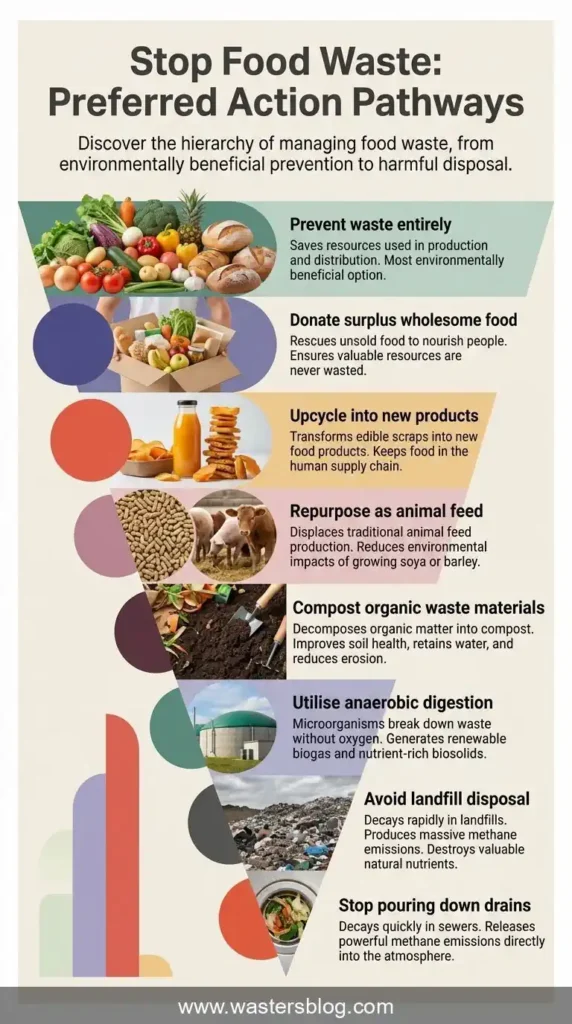
EPA's Wasted Food Scale provides a useful hierarchy for thinking about preferred outcomes across different material types. But the hierarchy only delivers value when infrastructure and operational conditions support it. Real diversion performance depends on contamination control, processor capability, and infrastructure fit working together.
The Operational Reality of Food Waste Processing – The Bottom Line
If the goal is to improve organics diversion, the conversation has to move beyond program design and deal with what actually happens between discard and processing.
Contamination, packaging complexity, liquid handling, and infrastructure mismatches are not edge cases.
They are routine. And they are where most of the real system losses occur.