
ArrowBio was one of the more original waste-treatment technologies to emerge during the early growth of mechanical biological treatment and anaerobic digestion for municipal solid waste. Its developers took an unusual approach: instead of trying to keep water out of mixed municipal waste processing, they deliberately put water at the heart of the separation process.
The ArrowBio system used hydromechanical separation to recover recyclable materials and convert the biodegradable fraction of mixed municipal solid waste into a pumpable organic slurry. That slurry was then treated by anaerobic digestion to produce methane-rich biogas.
At a time when much biodegradable municipal waste was still being sent directly to landfill, this was an ambitious idea. ArrowBio sought to recover recyclable materials, generate renewable energy and greatly reduce the residual fraction requiring disposal within one integrated treatment system.
The technology did not go on to become the dominant approach to municipal waste management. Modern waste policy increasingly favours separating food waste and other recyclables at source rather than attempting to recover them after they have all been mixed together.
Nevertheless, it would be wrong to judge ArrowBio only by today's waste-management philosophy. The technology was genuinely innovative for its time and deserves recognition as one of the early systems that demonstrated how anaerobic digestion could become part of the solution for treating municipal solid waste.
2026 Update: What Happened to ArrowBio?
This article was originally published when plans were being developed for an ArrowBio facility at Avondale near Falkirk in Scotland. It was subsequently updated in 2019 and has now been substantially revised again in August 2026.
The proposed Scottish ArrowBio plant was not eventually constructed. However, the technology itself was much more than a paper proposal. A commercial-scale ArrowBio installation operated at the Hiriya waste site near Tel Aviv, Israel, and another plant was constructed at Jack's Gully near Sydney, Australia.
The ArrowBio name also remains in use. The current Arrow Ecology website continues to describe and promote the ArrowBio hydromechanical separation and anaerobic digestion technology.
Corporate history is less straightforward. Arrow Ecology & Engineering Overseas (1999) Ltd developed the technology in Israel, while Oaktech Environmental represented and developed ArrowBio projects in the UK. A company called Arrow Green Ecology International Limited also exists on the UK Companies House register, although its recent accounts record it as dormant.
It is therefore safer to describe ArrowBio today as an established waste-treatment technology and intellectual-property lineage rather than assume that the organisations now associated with the name are identical to those developing projects almost two decades ago.
Why ArrowBio Was Such an Interesting Idea
The fundamental problem ArrowBio tried to solve remains familiar to waste engineers.
Mixed municipal solid waste contains food, paper, plastics, metals, glass, textiles, grit and numerous other materials. The wet biodegradable fraction contaminates otherwise recyclable materials and can make conventional mechanical separation difficult.
Most material recovery facilities therefore try to keep incoming recyclables relatively dry.
ArrowBio turned that principle around.
Instead of treating water as a nuisance, its developers used water as the principal separation and transport medium.
This was the distinctive feature of the ArrowBio process.
Different waste materials behave differently in water according to their density and physical properties. Heavy materials such as glass and metals sink. Many plastics float. Biodegradable materials including food and paper absorb water and can be broken down into an organic suspension.
The system could therefore use water simultaneously for:
- hydromechanical separation of mixed waste;
- transporting materials through the process;
- cleaning recovered recyclable materials;
- breaking down biodegradable material;
- recovering the organic fraction into a pumpable slurry; and
- preparing that organic material for anaerobic digestion.
It was an elegant concept and very different from most dry MBT systems being proposed at the time.
How the ArrowBio Process Worked
The ArrowBio system essentially consisted of two closely integrated sections: a hydromechanical materials recovery system followed by biological treatment using anaerobic digestion.
The YouTube video embedded below provides a useful historical guide to the process:

1. Waste Reception and Initial Sorting
Mixed municipal solid waste was received without requiring householders or businesses to separate every biodegradable component beforehand.
Oversized and unsuitable objects could first be removed before the remaining material passed through equipment designed to open bags and prepare the waste for wet separation.
2. Hydromechanical Separation
The prepared waste entered a water-filled separation system.
Dense materials such as metals, glass and other heavy objects sank and could be removed by underwater conveyors. Ferrous and non-ferrous metals could then be separated using conventional magnets and eddy-current equipment.
Lighter plastics tended to remain nearer the surface and could be removed and further classified.
The use of water also helped wash contamination from some recovered materials.
3. Recovery of the Organic Fraction
The most interesting part of the process was what happened to the biodegradable fraction.
Food waste, paper and other biodegradable materials became saturated and were progressively broken down in water. Mechanical action and water jets helped turn this material into a liquid organic suspension.
Grit, glass fragments and other remaining contaminants could then be removed before the organic-rich liquid was pumped to the biological treatment section.
In effect, ArrowBio transformed the biodegradable content of mixed refuse into something much more closely resembling a wastewater-treatment feed than conventional solid municipal waste.
4. Two-Stage Anaerobic Digestion
ArrowBio then applied anaerobic biological treatment to the recovered organic liquid.
The system used a two-stage approach involving acidogenic treatment followed by methanogenic digestion.
In the first biological stage, complex organic materials were converted into simpler organic compounds and organic acids.
The resulting liquid then entered the methanogenic stage, where anaerobic microorganisms converted biodegradable material into biogas.
ArrowBio used Upflow Anaerobic Sludge Blanket, or UASB, technology. This was particularly interesting because UASB digestion was already well established in wastewater treatment. ArrowBio effectively adapted established liquid-phase anaerobic treatment principles to the organic fraction recovered from municipal refuse.
5. Renewable Energy Production
The resulting methane-rich biogas could be used in gas engines to generate electricity and heat.
Contemporary descriptions of the ArrowBio process reported biogas containing around 70% to 80% methane under favourable operating conditions.
Electricity could first meet the parasitic power requirements of the treatment plant, with surplus generation potentially exported.
The Tel Aviv ArrowBio Plant
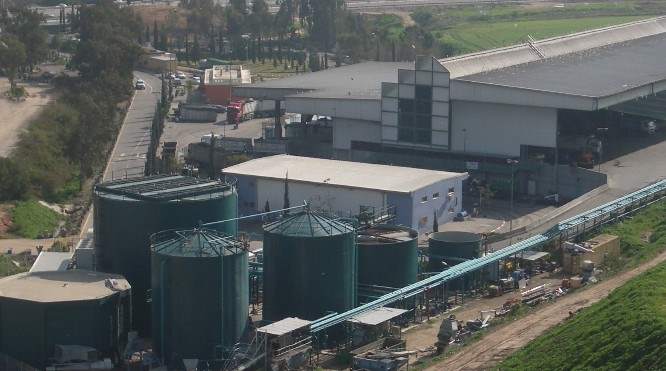
The most important reference installation was constructed at the Hiriya waste complex serving the Tel Aviv metropolitan area in Israel.
A full-scale ArrowBio module was reported as coming online in December 2002, with commercial operation becoming widely documented from 2003 onwards.
The plant was important because it showed that the concept was not confined to laboratory experiments or design drawings. Mixed municipal waste was actually being subjected to water-based separation followed by anaerobic digestion at commercial scale.
The Hiriya installation became an international reference plant. It appeared in technical papers, waste-industry publications and government guidance examining emerging alternatives to landfill.
For engineers and local authorities assessing waste technologies in the early and mid-2000s, ArrowBio provided evidence that anaerobic digestion could be integrated into a system receiving mixed municipal waste.
ArrowBio Was Trail-Blazing for Anaerobic Digestion
It is easy today to forget how different the anaerobic digestion industry looked during the period when ArrowBio was being developed.
Anaerobic digestion itself was certainly not new. Sewage sludge digestion had been used for many decades and industrial anaerobic wastewater processes were already well established.
What was far less established was the large-scale use of AD as a mainstream municipal solid waste treatment technology.
ArrowBio was one of a group of technologies that helped change that perception.
It demonstrated a particularly imaginative answer to a difficult question:
How can the biodegradable fraction be recovered from a mixed refuse stream in a form suitable for efficient anaerobic digestion?
ArrowBio's answer was to use water to separate, clean, transport and liquefy the organic fraction before digestion.
That approach was genuinely innovative.
Although later developments in waste collection and recycling policy have favoured a different route, ArrowBio was part of the pioneering period during which AD moved from being thought of principally as a sewage-sludge and industrial-effluent process toward being considered a serious technology for recovering renewable energy from municipal organic wastes.
The modern biogas industry therefore has good reason to remember systems such as ArrowBio. Not every pioneering process becomes the eventual industry standard. Innovation often consists of demonstrating possibilities from which later technologies, policies and operating practices evolve.
The Proposed ArrowBio Plant at Avondale, Falkirk
The original version of this WastersBlog article reported one of ArrowBio's most interesting proposed UK projects.
In July 2007, Oaktech Environmental entered into an agreement with Avondale Environmental Ltd to undertake design development for an ArrowBio facility at the Avondale waste-management site near Polmont in Falkirk, Scotland.
Contemporary reports described an approximately £18 million mechanical biological treatment plant designed to process around 70,000 tonnes of waste per year.
The proposed facility was intended to receive mixed household and commercial waste rather than depend on one specific local-authority waste contract.
At the time, Avondale already handled residual waste from authorities in central Scotland.
The ArrowBio development was expected to:
- divert biodegradable waste from landfill;
- recover metals, plastics, glass and other recyclable materials;
- convert the recovered biodegradable fraction into biogas;
- generate approximately 2 MW of renewable electricity; and
- produce a treated organic residual material potentially suitable for appropriate beneficial use or landfill restoration, subject to regulatory requirements.
Construction was reported as potentially taking about 16 months once design and consenting requirements had been completed.
At the time this was a serious commercial proposal rather than simply a conceptual technology study.
So What Happened to the Falkirk ArrowBio Plant?
After researching the historical record again in 2026, we have found no evidence that the proposed ArrowBio anaerobic digestion plant at Avondale was ever constructed.
There is also no reliable source located during this review that provides a simple statement saying that the project was formally cancelled on a particular date for one particular reason.
That distinction matters.
The available evidence shows that the project was under active development in 2007. It was still being cited in a 2008 South London Waste Partnership waste-options appraisal as a 75,000 tonnes-per-year ArrowBio merchant proposal for Avondale Environmental.
But the development subsequently disappears from the available record as a constructed ArrowBio facility.
What happened next at Avondale is instructive.
Avondale Subsequently Built a Different Recycling Facility
By 2011, Avondale Environmental had secured a £17 million funding package for a very different recycling development at Falkirk.
That facility was designed to process around 200,000 tonnes of household and commercial waste per year.
It was a materials recycling facility rather than the proposed ArrowBio hydromechanical separation and anaerobic digestion plant.
The facility opened but subsequently ceased operating in May 2013. Contemporary reporting attributed the closure to increasing operating costs combined with reductions in both the volume and market value of recyclable materials.
Years later the MRF was acquired by Levenseat, which announced a major refurbishment and modernisation programme in 2022.
We therefore know that the ArrowBio project proposed for the site in 2007 did not become the plant ultimately constructed there.
However, without documentary evidence it would be speculation to attribute the abandonment of ArrowBio to one specific technical, financial, planning or commercial cause.
Why Did the Waste Industry Move Away From This Type of Mixed-Waste AD?
The waste industry in Britain has changed considerably since the ArrowBio proposals of the early 2000s.
One of the principal attractions of ArrowBio was that householders did not have to separate the biodegradable fraction before collection. The plant itself was intended to recover useful materials from mixed residual waste.
Modern policy increasingly works from the opposite direction.
Food waste, paper, card, metals, glass and plastics are increasingly expected to be separated before they enter the residual waste stream. In particular, separately collected food waste provides anaerobic digestion plants with a much cleaner and more predictable feedstock than an organic fraction extracted from mixed refuse.
This has several advantages.
Source-segregated food waste reduces the potential for contamination by fragments of glass, plastics, metals and other unwanted materials. It also makes the quality of digestate easier to manage and provides greater confidence that nutrients and organic matter can be recycled beneficially.
This change in waste-management philosophy reduces one of the original attractions of sophisticated mixed-waste separation systems.
If food waste can be collected separately in the first place, there is less reason to mix it with residual refuse and then invest considerable effort separating it again.
That Does Not Mean ArrowBio Was a Bad Idea
Technology should be judged in the context in which it was developed.
During the late 1990s and early 2000s enormous quantities of biodegradable municipal waste were still being landfilled. Governments and local authorities were searching for technologies capable of achieving large reductions in landfill disposal without requiring completely new collection systems to be introduced overnight.
MBT consequently attracted substantial attention.
Against that background, ArrowBio offered an ingenious proposition: continue accepting mixed municipal waste, recover recyclable materials from it, extract the biodegradable fraction using water, digest that material anaerobically and use the resulting methane as renewable energy.
The concept addressed several waste-management problems simultaneously.
That is why ArrowBio attracted interest in Europe, Australia, Israel and elsewhere and why the technology appeared repeatedly in professional waste-management assessments during that period.
The Importance of ArrowBio's Wet MRF Concept
Perhaps ArrowBio's most enduring technical contribution was its willingness to challenge the assumption that municipal waste separation should necessarily be a dry process.
Conventional dry MRFs have always faced difficulties when handling wet and sticky organic waste. Food residues can adhere to paper, plastics and containers, reducing recyclate quality and making machinery dirty and difficult to operate.
ArrowBio effectively said: if the waste is already wet, why fight it?
Water became part of the process.
The liquid medium provided density separation, washing, organic-material recovery and transport while simultaneously preparing the biodegradable fraction for wet anaerobic treatment.
This integration of mechanical separation with biological treatment made ArrowBio technically distinctive.
ArrowBio and Today's Circular Economy
Some aspects of the original ArrowBio philosophy remain surprisingly modern.
The developers were seeking to treat waste as a collection of recoverable resources rather than material simply requiring disposal.
The process attempted to recover metals, plastics and other useful materials while capturing energy from the biodegradable fraction.
That resource-recovery philosophy sits comfortably with today's circular-economy objectives, even though current thinking places much greater emphasis on preventing materials from becoming mixed and contaminated in the first place.
The difference is therefore less about the objective than about where separation should occur.
ArrowBio attempted sophisticated separation after collection.
Modern systems increasingly seek separation before or during collection.
Does ArrowBio Still Exist?
There has been considerable confusion online about the status of ArrowBio and the companies associated with it.
The original technology was developed by Arrow Ecology & Engineering Overseas (1999) Ltd in Israel and was marketed internationally through partners including Oaktech Environmental in the UK.
The current Arrow Ecology website remains online and continues to describe the ArrowBio process, including its patented separation system for recovering organic matter from mixed MSW for anaerobic digestion.
A UK company named Arrow Green Ecology International Limited also remains on the Companies House register, although recent filings describe that UK company as dormant.
For that reason, readers investigating a new project should establish the identity and corporate status of the organisation currently offering any ArrowBio-related technology rather than relying upon contact details contained in historical articles from the 2000s.
Do Not Confuse Historical ArrowBio With Every Modern “Arrow Bio” Project
The words “Arrow Bio” also appear in the names of newer waste developments and this can cause confusion in internet searches.
For example, a proposed facility in Deeside, Wales, has been described by Natural Resources Wales as the Arrow Bio Waste Recycling Facility. That proposal concerns a large source-segregated food-waste anaerobic digestion facility operated by Deeside SPV Limited.
Readers should not assume merely from the similarity of the names that such projects use the historical ArrowBio hydromechanical mixed-MSW treatment process.
The Legacy of ArrowBio
ArrowBio deserves to be remembered as one of the more imaginative technologies from a formative period in modern waste management.
It combined several ideas that were individually established but were unusual when brought together in this way:
- mixed municipal solid waste treatment;
- materials recovery;
- wet density separation;
- organic slurry preparation;
- two-stage biological treatment;
- UASB anaerobic digestion; and
- renewable biogas production.
The Falkirk plant did not materialise, and source segregation has subsequently changed the direction taken by much of the UK anaerobic digestion industry.
Nevertheless, that should not obscure ArrowBio's historical significance.
The technology was developed at a time when the waste industry badly needed alternatives to simply burying biodegradable municipal waste in landfill. It helped demonstrate that the organic fraction of MSW could be regarded as an energy resource and that anaerobic digestion could form part of an integrated municipal waste-treatment plant.
Some pioneering technologies become the dominant systems of the future. Others demonstrate possibilities, stimulate investment, provide operating experience and help establish an industry that later develops in another direction.
ArrowBio belongs in that second category.
The modern anaerobic digestion and biogas industry has benefited from those early innovators who were willing to design, finance and operate systems before the technology became mainstream.
Whatever ultimately happened to individual ArrowBio projects, the process remains an important and fascinating chapter in the development of mechanical biological treatment, anaerobic digestion and energy recovery from municipal waste.
Sources and Further Reading
The following sources were consulted when preparing this 2026 revision:
- LetsRecycle: £18m MBT plant set for Scotland, July 2007 – contemporary account of the proposed Avondale ArrowBio development.
- Waste Management World: The ArrowBio System – A Solution for MSW – detailed technical description of hydromechanical separation, UASB digestion and the Australian development.
- Arrow Ecology: ArrowBio Technology – current description of the ArrowBio process.
- Arrow Ecology: About the Company – company history and international activities.
- Israel National News: A Source of Green Energy – contemporary 2003 report on the first full-scale Tel Aviv ArrowBio plant.
- Hiriya Recycling Park: The Story of Hiriya – information on the development of the Tel Aviv waste-treatment site.
- UK Companies House: Arrow Green Ecology International Limited – current UK corporate filings.
- Levenseat: Falkirk MRF Acquisition and Modernisation – subsequent history of the materials recycling facility at the Avondale site.
- SEPA: Avondale Quarry Landfill – information on continuing waste-management operations at Avondale.
[Article substantially updated August 2026. The original version of this article reported the proposed Falkirk ArrowBio development in 2007 and was updated in 2019. This revision preserves that historical record while adding subsequent information about the project, technology and its significance to the development of anaerobic digestion for municipal solid waste.]




Contact me please.
I am in Paraguay.
Thanks.
Guillermo. I emailed you but I didn’t see a reply.
I need to contact Arrowbio Ecology, can someone reply and send email ?
John
i need ARROWBIO CONTACT IT IS URGENT for waste to energy project