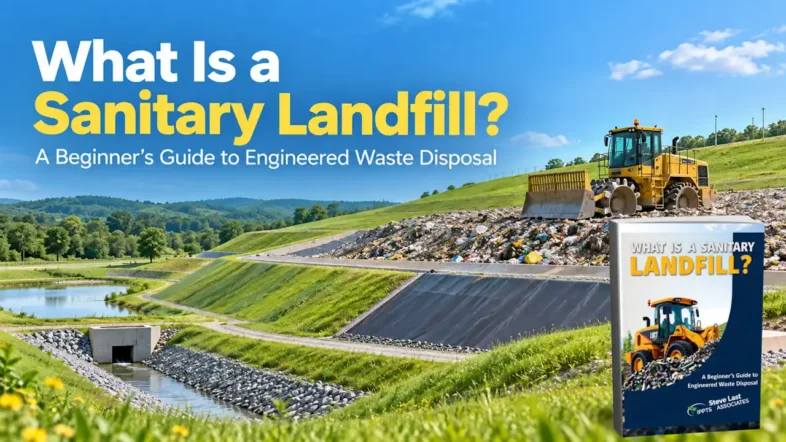
Looking for a clear introduction to how modern landfills are designed and managed? What Is a Sanitary Landfill? A Beginner’s Guide to Engineered Waste Disposal is an educational guide for students, junior designers, and people new to waste management. It tackles a subject that can seem simple from the outside—burying waste—but involves a much wider set of engineering and environmental controls.
This review is based on the supplied guide and product materials. It is not a claim of field testing, and the guide itself says it is educational information, not project-specific engineering, legal, regulatory, or safety advice.
In brief: this guide aims to explain the landfill lifecycle, from site selection and waste acceptance through liners, leachate, gas management, closure, and aftercare. Its strongest appeal is the breadth of subjects it brings together for beginners. Its important limitation is that it is an introduction, not a substitute for current regulations, specialist training, or qualified professional advice.View the guide on Gumroad
What the Guide Claims to Do
The guide presents itself as a modern beginner’s introduction to engineered waste disposal. Its central message is that a sanitary landfill is not simply an open dump with waste covered over. It describes a modern landfill as a facility intended to contain residual waste and manage environmental risks across the site’s life.
The topics listed in the supplied contents include:
- How sanitary landfills have evolved and why they still have a role in waste management.
- Site selection, waste classification, and waste acceptance.
- Landfill capacity, airspace, cell development, and operational phasing.
- Base liners, geological barriers, leachate collection, and water management.
- Landfill gas, methane, collection systems, and explosion-risk considerations.
- Daily cover, final capping, restoration, monitoring, and aftercare.
- Examples of how approaches in the United States, United Kingdom, Germany, the Netherlands, and Japan differ.
- A practical checklist for students and junior designers.

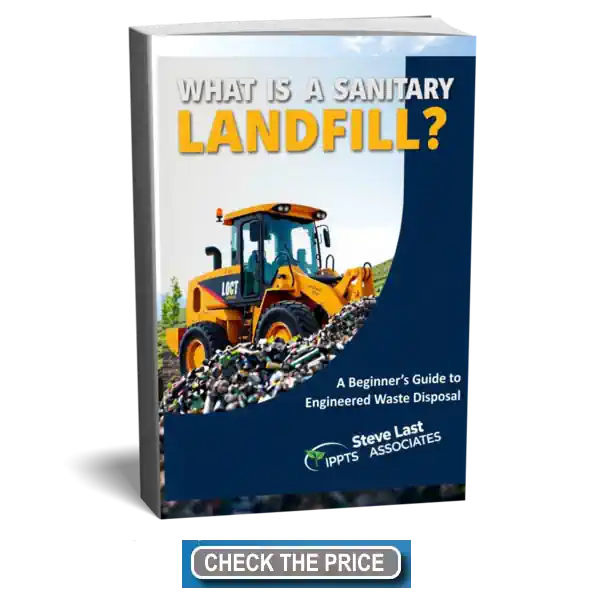
The guide’s cover, featuring the title and landfill equipment.
What’s Inside: A Content-Based Review
I reviewed the supplied guide contents rather than testing the material in a live landfill project. Based on that review, the guide’s clearest strength is its lifecycle perspective. It does not stop at waste placement: it connects containment and operations with monitoring, closure, restoration, and long-term aftercare.
The guide also makes a useful distinction between the role of a well-engineered landfill and the broader goal of reducing reliance on landfill. It presents landfill as a final destination for residual waste where better options are not suitable—not as the preferred destination for material that could reasonably be prevented, reused, recycled, or treated.
For someone just starting out, that framing is valuable. It helps explain why landfill engineering involves more than machinery and daily cover, and why decisions about accepted waste, water, gas, stability, and aftercare are connected.
At the same time, the document covers technical and regulatory topics that vary by country and site. The guide itself cautions readers not to use it as a replacement for current rules, site investigations, risk assessments, or qualified advice. That caveat matters: this is best treated as a learning and orientation resource, not a design manual to follow independently.
How the Guide Works as a Learning Resource
The guide’s approach can be understood as a progression through the main stages and systems of a landfill:
- Understand the purpose. It introduces the modern landfill as part of an integrated waste-management system and explains why residual waste may still require controlled disposal.
- Consider the site and the waste. It outlines factors such as geology, groundwater, flood risk, waste type, classification, and acceptance procedures.
- Follow the engineering systems. It describes the functions of containment layers, leachate drainage, gas management, cover, and surface-water controls.
- Connect design with operation. It discusses phasing, working-face control, compaction, access, equipment, and the importance of limiting exposed areas.
- Look beyond active filling. It covers monitoring, final capping, restoration, and aftercare after waste placement ends.
This structure gives beginners a mental map of the subject. It does not, on its own, provide a complete design process or establish what requirements apply at a particular site.
Features Translated Into Practical Benefits
- Broad lifecycle coverage: The contents extend from site selection to aftercare, helping readers see that landfill responsibility continues after filling stops.
- Clear attention to leachate and gas: These topics are treated as core engineering concerns, not minor operational details.
- International examples: The country-focused sections offer context for how policy and engineering approaches can differ. They are useful for orientation, but readers still need to check local requirements.
- Operational topics: Sections on cells, working faces, compaction, roads, and equipment connect facility design with the practical realities of running a site.
- Beginner checklist: The questions for students and junior designers can help organize further study and flag subjects that need specialist input.
- Safety and limitations are acknowledged: The guide includes cautions around hazardous waste and landfill-gas explosion risk, and states that it is not professional advice.
Pros and Cons
Pros
- Explains the subject as an engineered system rather than simply a disposal practice.
- Covers a wide range of beginner-level topics in one guide.
- Includes operational, environmental, and aftercare considerations.
- Places landfill within the wider waste hierarchy and discusses reducing reliance on landfill.
- Offers a practical checklist that can help readers guide their next steps in learning.
- Includes an explicit educational-use disclaimer and cautions readers to seek qualified advice.
Cons
- Its breadth means readers should not assume that every topic is covered in enough depth for professional design work.
- Regulations and technical requirements vary by jurisdiction and can change; readers must verify current local sources.
- The guide is not a substitute for formal engineering education, site-specific investigation, or specialist review.
- The supplied product materials do not establish a current price, refund policy, or whether additional products are offered at checkout.
Who Is This Guide For?
It may suit:
- Students beginning to study waste management or landfill engineering.
- Junior designers who want an introductory overview to support further learning.
- Waste-management beginners who want to understand the main systems and terminology.
- Readers who want a broad overview before consulting specialist references or local guidance.
It is not the right stand-alone resource for:
- Anyone seeking site-specific design instructions or calculations to use without qualified review.
- Readers who need authoritative, current regulatory requirements for a particular country or project.
- Anyone responsible for hazardous-waste acceptance, landfill-gas safety, permitting, or compliance who has not consulted the relevant experts and regulations.
How It Compares With Alternatives
This guide sits between informal introductory reading and detailed professional references. It may be a convenient starting point for readers who want a single overview, while official regulations, regulator guidance, technical standards, and specialist textbooks remain essential for authoritative or advanced work.
| Resource type | Main advantage | Main limitation | Best use |
|---|---|---|---|
| This beginner’s guide | Brings many core topics together in an introductory format. | Not a substitute for current rules or project-specific professional advice. | Orientation and structured beginner learning. |
| Official regulator guidance | Provides jurisdiction-specific requirements and expectations. | May be technical, detailed, or difficult for a complete beginner to navigate. | Checking applicable requirements and regulatory processes. |
| Engineering textbooks and standards | Can provide deeper technical treatment and formal methods. | May require prior knowledge and may focus on a narrower subject. | Advanced study and professional reference, alongside current standards. |
| Free introductory articles and videos | Easy to sample and often quick to consume. | Coverage and accuracy can vary, and information may be fragmented. | Initial exploration or reviewing a specific basic concept. |
Pricing, Availability, and Possible Upsells
The supplied promotional banner describes the guide as “Free,” but the materials provided here do not confirm the current Gumroad listing price, checkout terms, refund policy, or whether any optional upgrades or related products are offered. Check the product page and checkout screen for the current details before purchasing or downloading.
Check the current listing on Gumroad
Is It Worth Getting?
The guide’s value depends on what you need from it. If you want a structured introduction that connects site choice, waste acceptance, liners, leachate, gas, operations, closure, and aftercare, the subject coverage may make it a useful starting point. The contents suggest it is designed to help beginners understand how the pieces fit together, rather than focus on a single narrow technical issue.
It is less suitable if you expect a complete professional design reference, guaranteed current regulatory advice, or a substitute for specialist guidance. For those purposes, use the relevant regulator materials, technical standards, site-specific studies, and qualified professional advice.
Final Verdict
“What Is a Sanitary Landfill? A Beginner’s Guide to Engineered Waste Disposal “looks like a practical introductory resource for readers who want a broad overview of modern landfill engineering and management. Its best feature is its lifecycle perspective: landfill design is presented as a combination of waste selection, containment, water and gas controls, operations, monitoring, closure, and aftercare.
The key qualification is also clear: this is educational material, not a design or compliance manual. Read it as a starting point and verify technical and regulatory decisions against current, local sources and qualified advice.
Rating: 4 out of 5 stars for beginner orientation. A promising overview for students and newcomers; not a replacement for professional references or site-specific expertise.
Explore the Sanitary Landfill Beginner’s Guide on Gumroad
Review note: This review is based on the supplied guide content and promotional materials. No claim is made here of personal use in a landfill project. The guide states that it is for general educational and informational purposes and should not replace qualified professional advice.