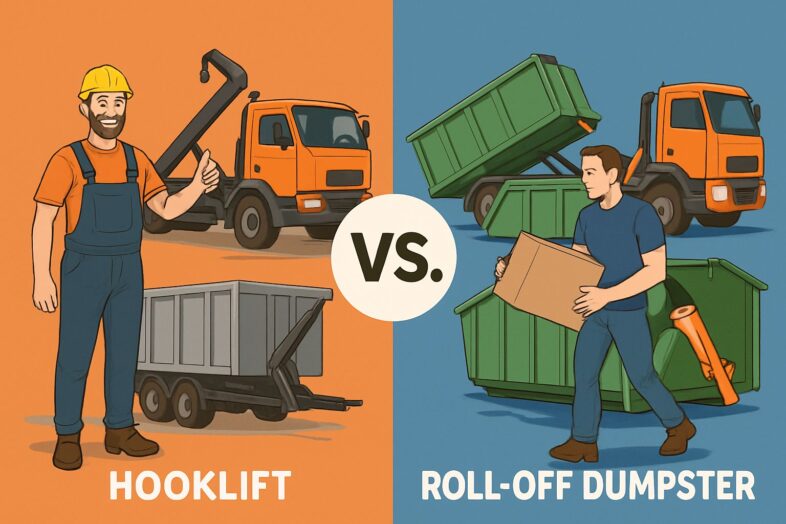
The big difference between roll-off and hook-lift containers is their operational mechanism: traditional roll-off systems attach a pair of cables and winch up containers along ground rollers, while hook-lift systems use a hydraulic L-shaped arm to hoist containers directly onto the truck bed.
Roll-Off vs. Hook-Lift Container – Article-at-a-Glance
- Roll-off containers are the go-to for high-volume demolition and heavy construction debris, while hook-lift containers shine in tight spaces and recurring waste removal scenarios.
- The single biggest difference between these two systems comes down to how the driver connects to the container — and that one detail changes everything about efficiency, safety, and cost.
- One container type can actually service commercial compactors on a job site, and the other simply cannot — knowing which one matters before you book.
- Hook-lift trucks can run flatbeds, dump bodies, storage units, and dumpsters all on one vehicle — a flexibility that roll-off cable trucks can't match.
- Triad Recycling & Container Services offers both hook-lift and roll-off solutions to fit the specific demands of your project.
The Container Choice That Can Make or Break Your Job Site
Pick the wrong container system and you're looking at delayed pickups, wasted space, and a crew standing around waiting — none of which you can afford.
Construction debris doesn't wait. Whether you're tearing down walls, stripping a roof, or clearing out an entire building, waste management is one of those logistics decisions that quietly determines how smoothly everything else runs. The choice between a roll-off container and a hook-lift container isn't just about which one looks right parked on your site — it's about matching the system to the specific demands of your job. Triad Recycling & Container Services works with both systems daily and has seen firsthand how the wrong call here can slow down an otherwise well-run project.
Most people assume these two container types are basically the same thing in different packaging. They're not. The mechanics are different, the best-use cases are different, and in some situations, only one of them will actually do the job.
How Roll-Off Containers Work on a Construction Site
Roll-off containers are the large, open-top dumpsters you see most often on construction sites, demolition projects, roofing tear-offs, and major property cleanouts. They're delivered on specialized roll-off trucks and literally rolled onto your property using a cable hoist system — hence the name.
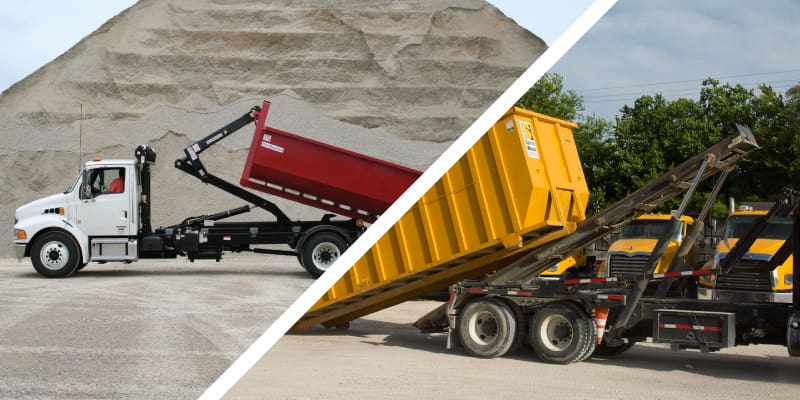
Roll-Off vs. Hook-Lift Container: “Hooklift vs. Roll-Off Cable Hoist: Which is Right for You?” from www.stellarindustries.com and used with no modifications.
The Cable Hoist System Explained
How a Roll-Off Cable System Works: The driver pulls up to the drop location, exits the cab, and manually connects a steel cable from the truck's winch to the container. The winch then reels the cable in, dragging the container up the truck's inclined frame on wheeled rollers. Delivery reverses the process — the container slides down and rolls into position. The driver handles the cable connection by hand at every single stop.
That manual connection step is the defining characteristic of roll-off cable systems. It adds time per stop and puts the driver outside the cab, which increases physical exposure compared to hook-lift operations. However, the cable system is purpose-built for dumpster and roll-off container hauling — including extremely heavy loads of construction debris and demolition waste — and it handles those high-volume demands exceptionally well. For more information on managing construction waste, check out these construction waste recycling methods.
Note: Some sources say that roll-off trucks are also the only system compatible with commercial compactor units. When you are considering choosing between roll-off and hook-lift containers always check if your waste management plan includes compactor servicing, because it may be that roll-off cable trucks are the only tool that works for your revenue stream and hook-lifts are not compatible.
Standard Roll-Off Sizes for Construction Debris
Roll-off containers come in a range of sizes to handle everything from a single-room renovation to a full-scale commercial demolition. The most common sizes you'll encounter on construction sites are 10-yard, 20-yard, 30-yard, and 40-yard containers.
| Container Size | Best For | Approximate Load Capacity |
|---|---|---|
| 10 Yard | Small cleanouts, single-room demo | 3–4 pickup truck loads |
| 20 Yard | Roofing tear-offs, mid-size renovations | 6–8 pickup truck loads |
| 30 Yard | New construction, large remodels | 9–11 pickup truck loads |
| 40 Yard | Commercial demolition, major construction | 12–14 pickup truck loads |
Because of their larger capacities, roll-off containers are the standard choice when you're dealing with high volumes of bulky material that needs to move fast and in large quantities.
For effective waste management, consider exploring construction waste recycling methods to further optimize the process.
Best Construction Applications for Roll-Off Containers
Roll-off containers handle the heaviest, most demanding construction debris scenarios without breaking a sweat. If your job generates serious volume, this is typically your system.
- New construction site waste
- Full building demolition projects
- Roofing tear-offs with heavy shingle loads
- Home and commercial renovations
- Large residential and commercial cleanouts
- Heavy debris disposal including concrete, drywall, and lumber
- Any project requiring compactor servicing
The roll-off system is the industry norm for these applications, which also means most waste management companies and municipal accounts are already spec'd for cable roll-off trucks — making logistics simpler when you're coordinating with third-party haulers.
How Hook-Lift Containers Work on a Construction Site
Hook-lift containers use a hydraulic hook arm mounted on the truck — instead of a cable — to pick up and place containers. The driver stays in the cab the entire time, operating the hydraulic system to engage a bar on the front of the container, lift it, and load it onto the truck frame. No manual cable connection, no stepping out onto the street or job site to hook up.
The Hydraulic Hook System Explained
The hook arm extends, catches the container's hook bar, and the hydraulics do the rest. This precision control means the driver can place containers in tighter spots with far less maneuvering than a standard roll-off truck requires. The result is faster turnaround per stop and significantly lower physical risk to the driver — they never leave the cab to make the connection.

“Hydraulic hooklift hoist – Wikipedia” from en.wikipedia.org and used with no modifications.
Hook-Lift Container Sizes Available
Hook-lift containers are generally available in smaller to mid-range sizes compared to roll-off units, making them particularly well-suited for commercial facilities, recurring service routes, and sites with space limitations. Common sizes include 10-yard, 15-yard, and 20-yard configurations, depending on the provider.
Best Construction Applications for Hook-Lift Containers
Hook-lift systems really earn their place on job sites where access is limited, swaps need to happen quickly, or the same truck needs to serve multiple different functions across a workweek.
One of the most underappreciated advantages of hook-lift trucks is their versatility. The same vehicle can run dumpsters in the morning and switch to a flatbed, dump body, or even a storage unit configuration in the afternoon — all without a second truck. For contractors managing multiple job types or locations, that operational flexibility is a genuine cost saver.
- Commercial and industrial facilities with recurring waste removal needs
- Sites with restricted access or narrow delivery zones
- Residential streets where maneuvering space is tight
- Operations that need frequent, fast container exchanges
- Companies running mixed-body truck configurations
Hook-lift containers are also the smarter call when you need predictable, scheduled service rather than one-time heavy hauling — think active job sites with ongoing debris generation rather than a single large dump event when making roll-off vs. hook-lift container comparisons..
Roll-Off vs. Hook-Lift: Head-to-Head Comparison
Both systems move construction debris — but they do it differently enough that choosing the wrong one creates real operational friction. Here's how they stack up across the factors that actually matter on a job site.
The fundamental difference between these two systems comes down to one thing: how the driver connects to the container. Everything else — efficiency, safety, training time, operational cost — flows directly from that single mechanical difference.
Space Requirements on a Tight Job Site
Roll-off trucks need a straight, clear run of roughly 60 to 80 feet to slide a container off the back. On an open commercial construction site, that's rarely a problem. On a residential street, a narrow urban lot, or a facility with overhead obstacles, that space requirement becomes a genuine constraint that can force you into workarounds — or the wrong container entirely.
Hook-lift trucks operate with significantly more placement precision. The hydraulic arm gives the driver direct control over exactly where the container lands, and the system generally requires less linear clearance to operate. If your site has tight access, a hook-lift isn't just more convenient — it may be the only system that physically works.
Speed of Delivery and Pickup
Hook-lift trucks complete container exchanges faster per stop because the driver never leaves the cab. There's no cable to connect, no manual steps outside the vehicle, and no time spent managing the hook-up process by hand.
Roll-off cable systems add time at every single stop due to the manual cable connection — not a dealbreaker on low-frequency hauls, but a real efficiency gap when you're running multiple swaps across a busy project schedule.
For more information on different dumpster systems, check out this comparison of front-load vs. rear-load dumpsters.
Driver Safety at Each Stop
This one isn't close. Hook-lift systems keep the driver inside the cab for the entire container exchange — no exposure to traffic, no cable handling, no physical exertion at the connection point.
Roll-off cable systems require the driver to exit the cab, handle steel cable on the street or job site, and manage the physical connection process at every stop. Most operators find hook-lift systems significantly easier to train on for exactly this reason. Additionally, understanding construction waste recycling methods can further enhance safety and efficiency on site.
Cost Differences Between the Two Systems
Roll-off containers are typically more widely available and often carry competitive rental pricing due to the sheer volume of operators running cable systems.
Hook-lift rentals may carry slightly different pricing structures depending on your region and provider, but the operational efficiency gains — faster swaps, less driver time per stop, multi-body truck versatility — can offset cost differences quickly on active job sites running frequent exchanges.

“Roll-off (dumpster) – Wikipedia” from en.wikipedia.org and used with no modifications.
When Roll-Off Containers Are the Clear Winner
High-volume, heavy-debris jobs with open site access and one-time or low-frequency haul needs are where roll-off containers consistently outperform. If you're dealing with serious tonnage and need the largest available container capacities, the roll-off cable system is built for exactly that.
High-Volume Demolition and Heavy Debris
Full building demolitions, commercial strip-outs, and large-scale roofing tear-offs generate the kind of bulk and weight that roll-off containers handle best.
The 30-yard and 40-yard container sizes available in roll-off configurations simply don't have a direct hook-lift equivalent — when you need to move maximum volume in minimum trips, roll-off is the answer. Concrete, heavy lumber, drywall, and mixed construction debris load easily into open-top roll-off containers without the capacity concerns you'd face with smaller hook-lift units.
Compactor Servicing Routes
If any part of your project or waste management operation involves commercial compactor units, roll-off cable trucks are the only compatible system. Hook-lift trucks cannot service compactors — the mechanics simply don't work. This is a non-negotiable distinction. Any waste management plan that includes compactor servicing must spec roll-off cable trucks from the start.
When Hook-Lift Containers Are the Smarter Call
Hook-lift systems earn their place when the job demands flexibility, frequent service, or precise placement in restricted spaces — scenarios that roll-off cable trucks handle poorly or not at all. On those occasions the roll-off vs. hook-lift container choice is an easy decision.
Recurring Waste Removal on Active Job Sites
Active construction projects don't generate debris on a single day — they produce a steady stream of waste across weeks or months. A site running ongoing framing, drywalling, or finishing work needs a container system that can swap in and out quickly and reliably without disrupting crew workflow. Hook-lift containers deliver exactly that.

“Hydraulic hooklift hoist – Wikipedia” from en.wikipedia.org and used with no modifications.
Because hook-lift exchanges happen faster per stop and require less maneuvering space, scheduling regular pickups on an active job site becomes significantly less disruptive. Your crew isn't waiting around for the truck to sort out a cable connection or navigate a tight approach — the container is swapped and gone before it becomes anyone's problem.
- Faster container exchanges mean less downtime for your crew
- Precise hydraulic placement works in confined site layouts
- Scheduled recurring service keeps debris from accumulating between hauls
- Smaller container footprint fits tighter staging areas
- Same truck can return with a different body type if site needs change
For project managers running multi-phase builds where debris type and volume shift over time, the hook-lift system's adaptability is a genuine operational advantage — not just a nice-to-have.
Restricted Access Areas and Residential Streets
Residential streets and tight urban job sites are where roll-off trucks routinely run into trouble. A cable roll-off truck needs a clean, straight path of 60 to 80 feet to slide a container off the back — and on a residential street lined with parked cars, overhead utilities, or narrow driveways, that clearance simply doesn't exist.
Hook-lift trucks solve this problem by design. The hydraulic arm gives the driver precise control over where the container lands, and the system requires far less linear clearance to operate. A hook-lift driver can place a container in a driveway, a side yard, or a narrow staging area that a roll-off truck couldn't approach without creating a logistics headache.
This isn't just a convenience distinction — on some job sites, it's the difference between getting a container placed and not getting one placed at all. Contractors working in dense urban neighborhoods, historic districts with access restrictions, or residential lots with shared driveways need a system that works within those real-world constraints.
If you're managing a renovation or addition project on a residential street, the hook-lift container is almost always the smarter starting point. It places faster, fits tighter, and causes far less disruption to neighbors and traffic than a large roll-off truck maneuvering through a confined space.
Real-World Roll-Off vs. Hook-Lift Container Scenario: A contractor renovating a row of houses in a dense urban neighborhood needs debris removed from a 12-foot-wide driveway with a 6-foot clearance fence on one side. A roll-off truck cannot access the space. A hook-lift truck places a 10-yard container precisely in the driveway in under three minutes without the driver leaving the cab — project stays on schedule, neighbors stay unbothered.
Running Multiple Body Types on One Truck
- Dumpsters and open-top containers for general construction debris
- Flatbed bodies for equipment or material transport
- Dump truck bodies for loose fill, gravel, or bulk material removal
- Storage units for on-site secure material storage
- Specialty demountable bodies configured for specific job requirements
The hook-lift truck's most underutilized advantage is its ability to run completely different body types on the same vehicle across a single workday. One hook-lift truck can deliver a dumpster in the morning, swap to a flatbed for an afternoon material run, and return to container service by end of day — all without a second truck leaving the yard.
For contractors managing multiple job types, phases, or locations simultaneously, this versatility translates directly into reduced equipment costs. Instead of maintaining separate trucks for different functions, a well-configured hook-lift operation can consolidate several roles into one vehicle. Roll-off cable trucks don't offer this — they're purpose-built for cable-connected roll-off containers and nothing else.
If your operation involves varied hauling needs across a week — not just debris removal but also material delivery, equipment transport, or storage solutions — a hook-lift system isn't just a debris container. It's a multi-function logistics tool that earns its keep across the entire job. For more information on different container systems, check out this comparison of front-load vs. rear-load dumpsters.
How to Choose the Right Container for Your Project
The decision comes down to three questions: How much debris are you moving? How often do you need it hauled? And what does your site access actually look like? High-volume, one-time heavy hauls on open sites with compactor service needs point clearly to roll-off. Recurring removal, tight access, mixed truck use, or residential locations point just as clearly to hook-lift. Match the system to the job — not the other way around.
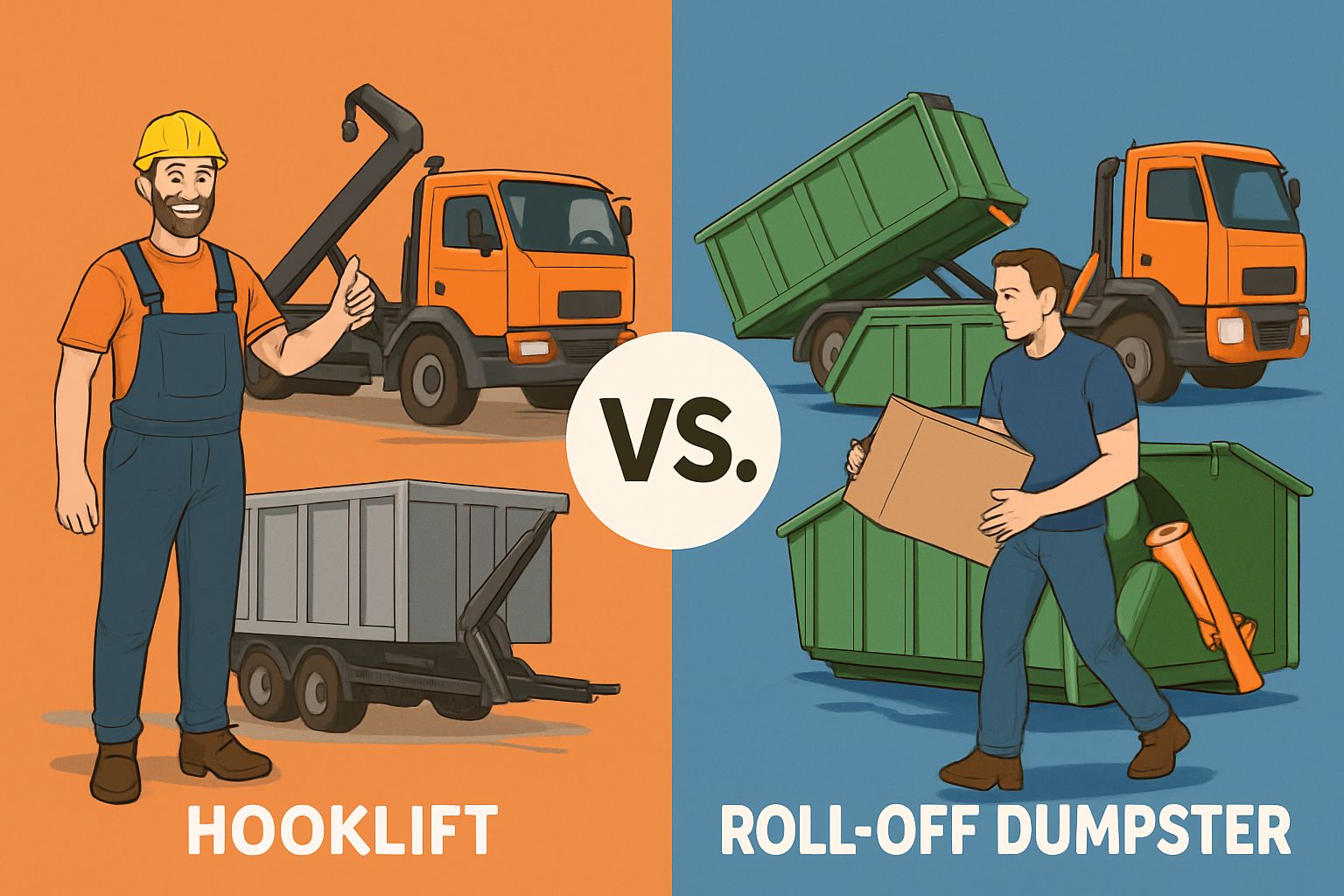
Frequently Asked Questions – For Roll-off and Hook-lift Containers
Still weighing your options? These are the questions that come up most often when contractors and project managers are deciding between roll-off and hook-lift containers for construction site debris removal.
Can a Hook-Lift Truck Service Commercial Compactors on a Construction Site?
No. Hook-lift trucks are not compatible with commercial compactor units. The hydraulic hook arm system and compactor connection mechanics are fundamentally incompatible — the hook simply cannot engage a compactor the way a roll-off cable system does. If your debris management plan includes commercial compactor servicing at any point in the project, you must use roll-off cable trucks. This is a hard constraint, not a preference.
Which Container Type Handles Heavier Construction Debris Better?
Roll-off containers handle heavier construction debris loads more effectively, primarily because of their larger size options. A 40-yard roll-off container can carry the equivalent of 12 to 14 pickup truck loads of material — concrete chunks, heavy lumber, roofing shingles, mixed demolition debris — in a single haul. Hook-lift containers typically max out at smaller capacities, which makes them less efficient when you're moving serious tonnage in large quantities.
That said, for moderate debris loads — framing scraps, drywall, light demolition waste — a 15-yard or 20-yard hook-lift container handles the job without issue. The container type matters less for moderate volumes; it's the high-end heavy loads where roll-off clearly wins on sheer capacity.
Are Hook-Lift Containers More Expensive to Rent Than Roll-Off Containers?
Pricing varies by region and provider, but roll-off containers are generally more widely available and often competitively priced because of the high volume of operators running cable systems. Hook-lift rentals may carry slightly different pricing depending on your market. However, on active job sites running frequent container exchanges, the operational time savings from faster hook-lift swaps can offset any price difference — fewer driver hours per stop adds up quickly across a multi-week project schedule.
How Much Space Does a Roll-Off Container Need for Delivery?
A roll-off truck typically requires 60 to 80 feet of clear, straight access to slide a container off the back of the vehicle. The area also needs to be free of overhead obstructions — low-hanging utility lines, tree branches, or structural overhangs can make delivery impossible regardless of ground clearance. Width clearance for the truck itself is also a factor on narrow streets or confined job sites.
Which System Is Faster When You Need Same-Day Container Swaps?
Hook-lift containers are faster for same-day swaps — and it's not particularly close. Because the driver never exits the cab to connect to the container, the entire exchange happens in minutes with no manual cable handling involved. The hydraulic arm engages, lifts, and loads the container in a single fluid sequence.
Roll-off cable systems require the driver to exit the cab, walk to the container, manually connect the steel cable to the winch, and manage the hook-up process before the container can be loaded. That adds meaningful time per stop — which multiplies across every swap you need in a single day. For a comparison of different dumpster systems, you can explore front-load vs. rear-load dumpsters as well.
On a job site running one or two container hauls over a multi-week period, the speed difference is minor. On an active site needing multiple same-day exchanges to keep a demolition or renovation crew moving, hook-lift is the clear operational winner.
Project managers coordinating debris removal alongside active crew schedules need waste logistics that don't create bottlenecks. A slow container swap during peak work hours doesn't just delay the haul — it disrupts the entire worksite rhythm. Hook-lift systems are simply better engineered for high-frequency, time-sensitive service scenarios.