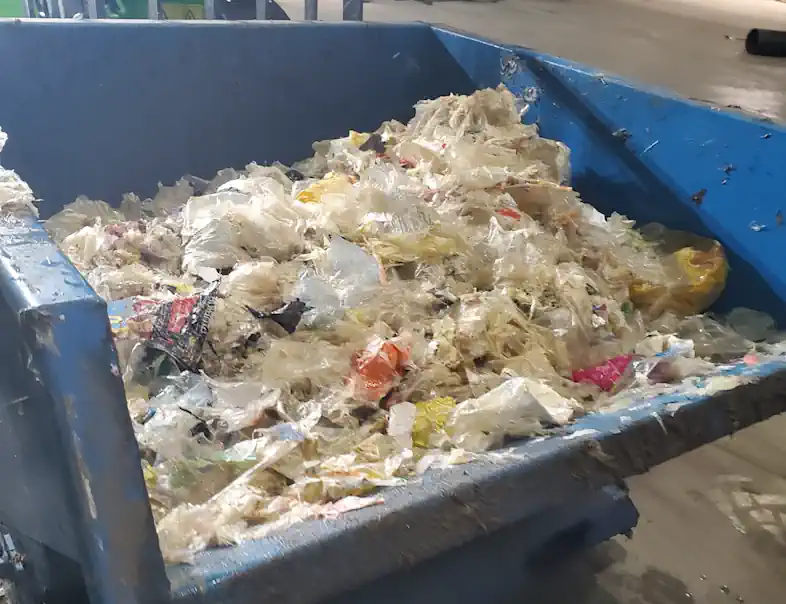
Paper mill pulp rejects are the undesirable waste products that are collected from recycled paper during the screening and pulping process. Plastics, metals, glass, sand, and tangled fibre ropes known as pulper rags make up the majority of these wet, mixed wastes.
Article-At-A-Glance: Why the Drycake Twister Changes the Game for Paper Mill Pulp Rejects
- Paper mill pulp rejects are a complex, wet mixed-material stream containing recoverable fibre and plastics that most facilities currently treat as a disposal cost rather than a resource.
- Traditional processing methods like hydrocyclones and thermal dryers are either water-intensive, energy-expensive, or require multiple processing stages before usable outputs are achieved.
- The Drycake Twister uses aerodynamic vortex separation to process wet rejects in a single continuous pass, producing a plastic-rich fraction dry enough for SRF qualification or direct recycling.
- In real-world trials, the Twister processed feed material at 61–75% moisture and achieved output dryness of 72–74% — without dedicated thermal drying equipment.
- Keep reading to find out how waste heat from your own dryer hoods could be powering this process right now, and what that means for your operating costs.
Most paper mills are sitting on a resource they are currently paying to throw away.
Pulp rejects have historically been one of the most stubborn waste streams in paper manufacturing — wet, mixed, and difficult to process economically.
That is changing. Drycake, the developer behind the Twister vertical separation system, has engineered a solution specifically designed to handle these complex wet streams without the energy penalties or multi-stage complexity of conventional approaches.
Paper Mill Pulp Rejects Are a Hidden Resource, Not Just Waste
Every paper mill running a recycled fibre furnish generates pulper rejects. These are the materials that survive the pulping process without breaking down into usable fibre — and in most facilities, they are baled, hauled, and landfilled or incinerated at significant cost.
What Pulp Rejects Actually Contain
The composition of pulper rejects is more valuable than their disposal route suggests. A typical reject stream from a recycled paper mill contains a mixture of plastic films, rigid plastics, staples, wire, foam, and — critically — a substantial proportion of recoverable cellulose fibre. The fibre content alone represents lost raw material that was paid for in the incoming recovered paper bale. The plastics fraction, once dried, carries meaningful calorific value that qualifies for Solid Recovered Fuel (SRF) classification or, in cleaner streams, direct polymer recycling.
The problem has never been what the material contains. It has been the moisture. Pulper rejects typically exit the pulper at 50–75% moisture content, which makes them heavy, expensive to transport, and unsuitable for most downstream recovery processes without significant pre-treatment. For more information on handling paper mill waste, visit Twister Paper Mill Waste Management.
Why Wet Reject Streams Are Traditionally Treated as a Cost
When a material arrives at 60% moisture and needs to reach 25% or lower before it becomes a useful fuel or recyclable feedstock, the processing chain gets expensive fast. Traditional approaches require shredding, mechanical pressing, thermal drying, and screening — each stage adding capital cost, energy demand, and operational complexity. For most mills, the economics have never justified the investment, so the material gets classified as residual waste and the cost gets buried in operational budgets.
The Shift from Disposal Liability to Recoverable Resource
The framing is shifting. Gate fees for reject disposal are rising across Europe, landfill tax escalators are squeezing margins, and Extended Producer Responsibility (EPR) frameworks are pushing more accountability onto fibre users and paper producers. These pressures are forcing mills to reconsider streams they have historically written off. The Drycake Twister enters this context not as a speculative future technology, but as an operational system with documented trial results in paper mill environments.

“Pulp mill – Wikipedia” from en.wikipedia.org and used with no modifications.
Why Traditional Pulp Reject Processing Methods Fall Short
Understanding what makes the Twister different requires an honest look at why existing methods have failed to make wet pulp reject reprocessing economically viable at scale.
The Problem with Water-Heavy Hydrocyclone Systems
Hydrocyclone systems are a standard tool in paper mill screening rooms, but they are designed for fibre recovery in dilute suspension — not for cleaning and drying a complex mixed-material reject stream. Using water-based separation on a stream that is already too wet simply relocates the moisture problem rather than solving it. The output still requires dewatering and drying, and the added water volume increases effluent treatment load. For reject streams specifically, hydrocyclones add process steps without delivering a ready-to-use output.
Why Thermal Drying Is an Economic Non-Starter
Dedicated thermal dryers can absolutely reduce moisture in reject streams — but the energy cost is prohibitive when processing low-value residual material. Conventional rotary or belt dryers require high-grade heat input, purpose-built infrastructure, and significant capital expenditure. The economics only work when the output material commands a price high enough to offset the drying cost, which pulp rejects, as a mixed and contaminated fraction, historically do not.
There is also the operational reality of running a thermal dryer on a stream containing plastics at varying moisture levels. Inconsistent feed characteristics create process instability, fire risk, and maintenance headaches that push mills back toward the simpler option of skipping treatment entirely and paying the gate fee.
How the Drycake Twister Works
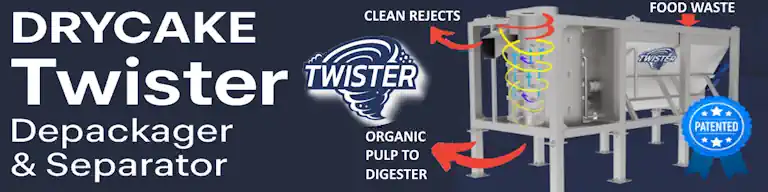
The Drycake Twister is a vertical dry separation system. It does not add water, does not rely on screens that can blind or block, and does not require the material to be pre-dried before entering the machine. These three characteristics alone separate it from every conventional approach to pulp reject treatment.
At its core, the Twister uses a proprietary aerodynamic vortex separation process. Material is fed into the vertical chamber where controlled airflow and mechanical action simultaneously break apart the reject mass, liberate mechanically-held water, and separate fractions by density and aerodynamic behaviour. The result is a continuous output of separated, drier fractions — achieved in a single pass.
Aerodynamic Vortex Separation Without Added Water
The vortex separation process works by exploiting the different aerodynamic profiles of the materials present in a pulp reject stream. Plastic films, rigid fragments, and fibre-rich organics behave differently in a controlled airstream. The Twister's vertical chamber geometry creates the conditions for these materials to separate by aerodynamic class rather than by size through a screen aperture. This is significant because it eliminates the screen blinding and blockage problems that make wet mixed-material processing so unreliable in conventional systems.
Mechanical Water Liberation and Airflow Integration
Water in a pulp reject stream is not all chemically bound — a large proportion is mechanically held within the matrix of fibre and plastic. The Twister targets this mechanically-held water directly. The combination of mechanical agitation and directed airflow physically extracts moisture from the material mass without needing to raise it to evaporation temperatures. This is what enables the Twister to achieve meaningful dryness improvements without a dedicated thermal dryer upstream or downstream. Discover more about ways to recycle plastics and their impact on waste management.
- Mechanically-held moisture is removed through agitation and airflow during the separation pass
- Feed material can enter the Twister at 61–75% moisture content without pre-treatment
- Output dryness of 72–74% has been documented in real mill trials
- No screens means no blinding, no blockages, and no screen change downtime
- Continuous operation is maintained across variable feed compositions
What this means in practice is that a mill can feed raw, wet pulper rejects directly into the Twister and receive separated, substantially drier output fractions ready for the next stage of recovery or energy use. The reduction in moisture also means a direct reduction in transport weight, which has immediate and measurable impact on haulage costs for mills that currently send rejects offsite for disposal.
The screenless design deserves particular attention. Conventional separation systems processing wet mixed material are notoriously prone to blinding, wrapping, and blockage — especially when plastic films and fibrous materials are present together. The Twister's aerodynamic approach sidesteps this entirely, which has significant implications for uptime, maintenance burden, and overall throughput reliability.
This single-pass capability also simplifies the process layout considerably. Where a conventional reject treatment line might require a shredder, a screw press, a thermal dryer, and a screening stage in sequence, the Twister consolidates the separation and drying function into one continuous unit operation. Fewer machines means fewer failure points, lower maintenance costs, and a smaller footprint within the mill. For more insights on sustainable practices, explore sustainable waste management services.
Waste Heat Integration from Mill Dryer Hoods
One of the most practically significant design features of the Twister is its ability to integrate directly with low-grade waste heat sources that most paper mills already have in abundance. Paper machine dryer hoods exhaust warm, humid air — typically in the range of 60–85°C — that is normally vented or managed as a thermal waste stream. The Twister is designed to use this exhaust air as its drying medium, feeding it directly into the separation chamber to enhance moisture removal without any additional energy input beyond what the mill is already generating. For a mill with an existing dryer hood exhaust loop, this integration can make the Twister's operating energy cost remarkably low relative to the processing work it performs. This aligns with the principles of the circular economy, promoting efficient resource use and sustainability.
Key Advantages of the Drycake Twister for Paper Mills
The Twister does not offer a single marginal improvement over existing reject treatment methods — it changes the economics of the entire process. These five advantages explain why paper mills that have trialled the system are treating it as a structural solution rather than a temporary fix.
1. Fibre Recovery and Return to the Pulping Process
Every tonne of recovered paper bale that enters a mill carries a cost. When fibre trapped in reject streams is landfilled rather than returned to the pulping process, that cost is written off completely. The Twister's separation capability allows mills to isolate the fibre-rich organic fraction from the plastic and reject mass, creating a stream that can be recirculated back into the pulper as a supplementary feedstock.
The financial case for fibre recovery compounds quickly. Reduced raw material loss means lower incoming fibre purchasing costs, lower reject disposal tonnage, and an improvement in the overall yield from each tonne of recovered paper processed. For high-volume mills running continuous operations, even a modest improvement in fibre recovery rate translates into a measurable reduction in annual operating cost.
2. Significant Reduction in Sludge and Reject Volumes
Wet pulper rejects are expensive to handle primarily because of their weight. A reject stream at 65% moisture is more than half water by mass, and every tonne of that material costs money to collect, contain, transport, and dispose of. By mechanically liberating moisture during the separation process, the Twister directly reduces the tonnage that exits the mill as residual waste.
This volume reduction has a cascading effect across the entire reject management chain. Fewer collection containers are required. Fewer haulage movements are needed. Gate fees at the receiving facility are calculated on tonnage, so a lighter output stream means a lower disposal invoice — even before any recovered material value is counted. For mills managing hundreds of tonnes of rejects per week, this weight reduction alone can justify a significant portion of the capital investment. Learn more about Twister paper mill waste management.
Sludge volumes from the broader mill process are also affected. When fibre is recovered from the reject stream and returned to the pulper rather than passing through to the effluent treatment plant, the organic loading on the sludge management system decreases. This reduces sludge dewatering costs and the volume of bio-solids requiring final disposal.
3. Dry Plastic-Rich Fraction Suitable for Recycling or SRF
The plastic-rich output fraction from the Twister is where the most immediate revenue opportunity lies. Once separated and dried to the moisture levels documented in field trials, this fraction meets the technical requirements for two distinct recovery routes:
- Solid Recovered Fuel (SRF): The dried plastic fraction carries sufficient calorific value for use as SRF in cement kilns or waste-to-energy facilities, with documented output dryness of 72–74% supporting autothermal combustion without supplementary fuel
- Direct polymer recycling: Cleaner plastic streams separated from lower-contamination reject batches may be suitable for mechanical recycling back into secondary polymer markets
- Co-processing: The dried fraction can serve as a supplementary fuel in industrial co-processing applications where mixed plastic fractions are accepted
The key distinction here is dryness. A wet plastic fraction from a conventional reject press is a marginal fuel at best — its moisture content suppresses its effective calorific value and may disqualify it from SRF specifications. The Twister's ability to reach 72–74% output dryness in a single pass moves the material from a borderline fuel to a compliant one, aligning with recycling standards.
This matters commercially because SRF offtake agreements are typically conditional on consistent quality specifications. A processing system that reliably delivers material within those specifications enables mills to negotiate stable long-term contracts for their plastic-rich fraction rather than selling at spot price to whichever facility will accept wet mixed material at short notice.
4. Continuous High-Throughput Processing with Minimal Downtime
Industrial reject streams do not pause for maintenance windows. A processing system that requires frequent screen changes, de-ragging interventions, or blockage clearances creates operational gaps that accumulate into real throughput losses over a production year. The Twister's screenless design directly addresses this. Without apertures to blind or wires to wrap, the machine maintains continuous operation across the variable feed compositions that are inherent to pulp reject streams.
The vertical chamber design also contributes to throughput consistency. Material moves through the separation zone under controlled conditions without the bridging or channelling that affects horizontal processing systems handling mixed wet material. The result is a system that processing teams can run as a background continuous operation rather than a supervised batch process requiring regular intervention. Learn more about the Twister paper mill waste management system.
5. Direct Financial Payback by Turning Waste Streams into Revenue
When you combine fibre recovery, weight-reduced disposal tonnage, and a plastic-rich fraction with a defined offtake route, the Twister converts what was a pure cost centre into a stream with measurable financial return. The disposal cost avoidance alone — gate fees, haulage, and landfill tax — represents a calculable saving that can be set against capital and operating costs to produce a payback timeline without relying on optimistic revenue projections.
Real-World Performance: What the Numbers Show
Documented field performance is what separates a genuinely useful piece of processing equipment from a promising concept. The Twister has been trialled in operational paper mill environments, and the results provide a concrete basis for evaluating its performance against conventional alternatives.
Mpact Limited Trial Results: 72–74% Output Dryness Achieved
Trials conducted at Mpact Limited, a major paper and packaging producer, demonstrated that the Twister consistently achieved output dryness of 72–74% when processing paper mill pulper rejects. This figure is significant because it places the output material within the range required for SRF qualification and autothermal combustion — meaning the plastic fraction can sustain its own combustion without supplementary fuel input once it enters the energy recovery process.
Reaching this output dryness in a single continuous pass, without upstream thermal drying, is the result that challenges the industry assumption that reject treatment requires multi-stage processing infrastructure. The Mpact trial data gives procurement and engineering teams a verified reference point rather than a manufacturer specification to evaluate against. For more information on this innovative approach, you can read about Twister paper mill waste management.
Feed Moisture Levels of 61–75% Successfully Processed in One Pass
The feed material processed during trials entered the Twister at moisture levels between 61% and 75% — which is representative of the actual condition in which pulper rejects leave the pulper in a typical recycled fibre mill. The Twister did not require the feed to be pre-pressed, pre-shredded, or pre-dried before processing. This is operationally important because it eliminates the capital and energy cost of an upstream dewatering stage that conventional systems require before meaningful separation can begin.
Plastic Fraction Dry Enough for Autothermal Combustion
Autothermal combustion — where a material sustains its own combustion without additional fuel — is a key threshold for SRF acceptance at cement kilns and waste-to-energy facilities. The plastic-rich fraction produced by the Twister during the Mpact trials crossed this threshold. In practical terms, this means the separated plastic fraction is not simply a lower-cost disposal option — it is an energy product with a defined and documentable specification that offtake facilities can contract against.
Environmental and Circular Economy Benefits
The environmental case for investing in reject reprocessing is increasingly inseparable from the financial one. As disposal costs rise and regulatory frameworks tighten, the mills that have already built recovery infrastructure for their reject streams will carry a structural cost advantage over those still paying full gate fees on wet, unprocessed residual waste.
Reduced Haulage Costs and Disposal Tonnage
Moisture removal is, at its most direct level, a logistics intervention. When the Twister reduces a reject stream from 65% moisture to 27% moisture, the remaining material is substantially lighter. Fewer truck movements are required to clear the same volume of processed material compared to wet, untreated rejects. Each avoided haulage movement reduces fuel consumption, vehicle emissions, and road wear — and it reduces the direct cost line on the mill's waste management budget without requiring any change to the disposal route itself. For a mill generating significant reject tonnage weekly, the haulage saving alone can be a material figure in annual operating cost calculations. To explore more about sustainable practices, you can read about sustainable waste management services.
Lower Energy Demand Compared to Conventional Thermal Drying
Conventional thermal dryers processing reject streams consume significant quantities of high-grade heat energy to evaporate moisture from a material that, in most cases, is generating no revenue to offset that energy cost. The Twister's approach inverts this equation by using mechanical water liberation and low-grade waste heat — specifically the 60–85°C exhaust air already leaving the paper machine dryer hoods — to achieve drying performance that would otherwise require purpose-built thermal infrastructure running on premium energy inputs.
The practical effect is that a mill integrating the Twister into its dryer hood exhaust loop is not purchasing additional drying energy. It is redirecting energy that was already being generated and discarded. This changes the operating cost calculation fundamentally. The energy component of reject treatment, which is the primary reason thermal drying has historically been uneconomic for low-value residual streams, becomes a near-zero marginal cost when the heat source is already available on site. This aligns with the principles of the circular economy, where waste is minimized and resources are reused efficiently.
Industries Beyond Paper Mills That Benefit from the Twister
The aerodynamic vortex separation principles at the core of the Twister are not specific to paper mill chemistry or paper mill operating conditions. They are designed to handle wet, mixed-material streams where conventional separation technology struggles — and those streams exist across multiple industrial sectors beyond paper manufacturing.
The common thread is moisture and material complexity. Any process that generates a residual stream containing mixed fractions at high moisture content, where the goal is to separate and dry those fractions for recovery or energy use, is a candidate for the same core technology. The Twister's screenless, continuous-operation design makes it particularly suited to streams where material variability would cause conventional systems to block, blind, or require constant operator intervention.
Two sectors where the application is most directly analogous to the paper mill use case are wet plastic film processing after washing lines and biogas substrate preparation in organic waste treatment facilities.
Wet Plastic Film and Flake Processing After Washing Lines
Plastic film and rigid flake material exiting a washing and float-sink separation line carries substantial residual moisture that must be removed before the material can be pelletised or sold as a secondary polymer feedstock. Conventional centrifugal dryers and thermal friction dryers are the standard tools, but both have limitations when processing thin films or highly mixed fractions. The Twister's combination of mechanical agitation and directed airflow offers a lower-energy route to achieving the moisture targets that downstream pelletising equipment requires, without the heat stress on sensitive film fractions that friction dryers can cause.
Biogas Substrate Preparation for Food Waste Plants
Food waste processing facilities receiving source-segregated organic material must separate packaging contamination — plastic bags, film wrapping, rigid containers — from the organic fraction before the organics can be fed into anaerobic digestion. The Twister's depackaging and separation capability allows the organic fraction to be liberated from its packaging and passed to the digester while the dry packaging fraction is diverted to energy recovery. This is the same fibre-from-plastic separation logic that applies in the paper mill context, applied to a food waste feedstock where the value being recovered is biogas yield rather than fibre recirculation.
The Drycake Twister Is a Practical Step Toward Sustainable Waste Recovery
Paper mill pulp reject reprocessing has been a problem without a commercially viable solution for most of the industry's history. The Twister does not solve it theoretically — it solves it with documented trial data, a single-pass process that eliminates the multi-stage complexity of conventional approaches, and a waste heat integration pathway that makes the operating energy cost manageable for mills of varying sizes.
The shift from treating pulper rejects as an unavoidable disposal cost to treating them as a separable, dryable, and partially recoverable resource stream is a structural improvement in how a mill accounts for its residual material flows. The fibre that goes back to the pulper, the plastic fraction that qualifies for SRF offtake, the haulage movements that no longer happen, and the gate fees that are no longer invoiced all represent real financial outcomes that compound over the operating life of the system.
Frequently Asked Questions
The following questions address the most common points of evaluation for engineers, operations managers, and sustainability teams considering the Twister for paper mill reject treatment.
What are paper mill pulp rejects made of?
Paper mill pulp rejects are the materials that survive the pulping process without breaking down into usable fibre. They typically contain a mixture of plastic films, rigid plastic fragments, foam, wire, staples, and a significant proportion of recoverable cellulose fibre. The exact composition varies depending on the quality and source of the incoming recovered paper furnish, but moisture content at the reject stage commonly falls between 50% and 75% by mass.
How does the Drycake Twister differ from a thermal dryer?
A thermal dryer removes moisture by applying heat energy to raise the material to evaporation temperatures, which requires a high-grade heat source, purpose-built containment infrastructure, and significant energy input per tonne of material processed.
The Drycake Twister removes mechanically-held moisture through aerodynamic vortex separation and directed airflow, using low-grade waste heat from existing mill exhaust loops rather than a dedicated energy source.
The Twister also performs material separation simultaneously with drying — something a thermal dryer does not do — making it a combined unit operation rather than a single-function drying stage.
Can the plastic fraction from the Twister be used as SRF?
Yes. The plastic-rich output fraction from the Twister has been documented at 72–74% dryness in trials conducted at Mpact Limited, which places it within the moisture range required for Solid Recovered Fuel qualification. At this dryness level, the material supports autothermal combustion, meaning it sustains its own combustion in an energy recovery facility without requiring supplementary fuel input.
SRF offtake agreements at cement kilns and waste-to-energy facilities are conditional on consistent quality specifications, including moisture content thresholds. The Twister's ability to deliver a consistently dry plastic-rich fraction enables mills to negotiate stable SRF contracts rather than relying on ad hoc disposal arrangements for wet mixed-plastic rejects.
What moisture levels can the Drycake Twister handle at the feed stage?
The Drycake Twister has been trialled processing feed material at moisture levels between 61% and 75%, which is representative of the actual condition of pulper rejects as they leave a typical recycled fibre paper mill. The machine does not require the feed material to be pre-pressed, pre-shredded, or pre-dried before entering the separation chamber.
This feed flexibility is operationally significant because it eliminates the capital and energy cost of an upstream dewatering stage. Mills can connect the Twister directly to their reject stream without building a pre-treatment line, which simplifies the installation scope and reduces the overall project cost of implementing reject reprocessing capability.
Is the Drycake Twister only suitable for paper mills?
No. While paper mill pulp reject treatment is a well-documented application for the Twister, the underlying aerodynamic vortex separation technology is applicable to any industrial process generating wet mixed-material residual streams where the goal is separation, drying, and fraction recovery.
Documented adjacent applications include wet plastic film and flake processing after washing lines in plastic recycling facilities, and biogas substrate preparation in food waste anaerobic digestion plants. In both cases, the same core challenge applies: separating mixed fractions at high moisture content without the energy cost of thermal drying or the operational unreliability of screen-based separation on wet mixed material.