
Recycling facilities depend on increasingly sophisticated equipment to separate valuable materials from mixed waste streams. Conveyors, screens, optical sorters, magnets, air separators, balers, artificial-intelligence systems and process controls may all form part of a modern material recovery facility.
This updated directory introduces companies that supply recycling systems, machinery and related services in the United States. It includes complete material recovery facility integrators as well as specialist manufacturers whose equipment may form an important part of a larger processing line.
A material recovery facility—normally abbreviated to MRF and pronounced “murf”—receives recyclable or mixed material, separates it into marketable grades and prepares those materials for sale or further processing.
Some companies in this directory can design and install an entire turnkey MRF. Others concentrate on particular operations, such as optical sorting, screening, conveying, glass processing, baling or plant automation. Buyers should therefore distinguish between a system integrator and a specialist equipment supplier before requesting proposals.
This article updates our original list, which was compiled from exhibitors at WasteExpo 2018. Company names, ownership arrangements and product ranges have been checked again for this edition.
Key Takeaways for this Update of our 15 Recycling System and MRF Equipment Suppliers List
- Most of the recycling equipment suppliers in the original 2018 directory remain active.
- The companies do not all provide the same service. Some deliver complete turnkey recycling plants, while others supply individual machines, controls, installation or maintenance.
- Bulk Handling Systems, CP Group, Machinex, Sparta, STADLER and Van Dyk are among the companies offering extensive system-design or integration capabilities.
- NRT remains an important optical-sorting brand, but it is now presented as part of the BHS group rather than as a separate system supplier.
- TOMRA specializes in sensor-based sorting and supplies technology used in many MRFs, plastics plants and metal-recovery operations.
- Himes Service Company, Hustler Conveyor, Mayfran, Pinnacle/Alpine and SPALECK provide more specialized equipment or services.
- Plexus Recycling Technologies has been removed because its continued operation as an independent supplier could not be confirmed.
- “Serving the United States” is more accurate than calling every entry a US company. Several major suppliers have overseas headquarters but established North American operations.
- Facility owners should obtain references for plants processing a comparable material stream and verify performance, after-sales support and total lifecycle cost.
How to Select a Recycling System Supplier
A credible proposal should start with the material, not the machinery. Before approaching suppliers, define:
- The material streams the plant will receive
- Expected tonnes or tons per hour
- Seasonal and daily variations in volume
- Incoming material composition and contamination
- Required recovery and purity targets
- Available building dimensions and site constraints
- Staffing assumptions and automation objectives
- Markets available for recovered commodities
- Capital budget and expected operating cost
- Requirements for maintenance, spare parts and remote support
Prospective buyers should ask suppliers to substantiate performance claims using comparable facilities. Headline throughput alone does not establish whether a system will produce material of the required quality.
Energy use, staffing, cleaning time, wear components, planned downtime and access for maintenance can all affect the system’s lifetime cost. The least expensive tender is not necessarily the least costly plant to operate.
Recycling System and MRF Equipment Suppliers List
The following companies are listed alphabetically. Inclusion is for information and does not constitute an endorsement.
1. Bulk Handling Systems
Bulk Handling Systems, commonly known as BHS, designs and supplies integrated material recovery facilities and recycling equipment from its base in Eugene, Oregon.
Its systems cover applications including single-stream recycling, municipal solid waste, plastics, construction and demolition waste, compost and organics. The BHS group also includes Nihot air-separation equipment, NRT optical sorting and Max-AI detection and robotic sorting technology.
BHS is best classified as a full MRF system supplier and integrator, rather than simply an individual equipment manufacturer.
Relevant capabilities: turnkey MRFs, conveyors, screens, air separation, optical sorting, AI-powered recognition and robotic sorting.
2. CP Group
CP Group designs, manufactures and installs recycling systems for single-stream recyclables, commercial and industrial material, municipal solid waste, plastics, construction and demolition waste, and organics.
The group grew from CP Manufacturing and incorporates equipment and expertise associated with MSS optical sorting and other CP technologies. Its services include new plants, retrofits and modernisation projects.
CP Group is a suitable candidate for operators seeking an integrated MRF supplier with in-house manufacturing and optical-sorting capabilities.
Relevant capabilities: turnkey systems, MRF upgrades, screens, conveyors, optical sorters and plant engineering.
3. Himes Service Company
Himes Service Company is a Texas-based recycling and scrap-equipment supplier and service business.
It buys, sells and services equipment including balers, conveyors, compactors, magnets, screens, shears and wire-tying systems. The company also undertakes installations, equipment relocations, rebuilds, preventive maintenance and MRF retrofits.
Himes is best described as an equipment and lifecycle-service provider rather than a manufacturer of proprietary, full-scale MRF systems.
Relevant capabilities: new and used equipment, installation, relocation, repair, rebuilding, parts and preventive maintenance.
4. Hustler Conveyor Company and American Pulverizer
Hustler Conveyor Company manufactures material-handling equipment for recycling, scrap and solid-waste applications. Its range includes conveyors, screens, trommels, drum feeders, bale breakers, sorting stations and storage bins.
Its associated company, American Pulverizer, manufactures shredders, hammermills, crushers and other size-reduction equipment. American Pulverizer describes Hustler Conveyor as its wholly owned subsidiary, enabling the businesses to offer combined shredding and conveying systems.
These companies are most relevant where robust conveying, feeding or size-reduction machinery is required.
Relevant capabilities: conveyors, trommels, screens, feeders, shredders, crushers and complete shredding lines.
5. KRS Recycling Systems
KRS Recycling Systems specialises in glass-processing and separation technology.
Its equipment has been associated with container-glass and flat-glass processing, including crushing, drying, screening, conveying and the removal of contaminants. KRS is therefore more specialised than the large suppliers of mixed-recyclables MRFs.
Operators should contact the company directly to confirm the current scope of its US sales, engineering and after-sales services.
Relevant capabilities: glass recycling plants, crushers, dryers, screens, conveyors and glass-cleaning equipment.
6. Machinex
Machinex is a Canadian-headquartered recycling-system manufacturer and integrator with extensive experience in the United States.
The company engineers, manufactures and installs turnkey sorting systems for single-stream recycling, mixed waste, construction and demolition material, plastics, glass, scrap metal, organics and other applications.
Its equipment includes MACH Hyspec optical sorters, SamurAI sorting robots, ballistic separators, disc screens, balers and conveyors. Machinex also supplies plant controls and data tools intended to connect and monitor MRF operations.
Relevant capabilities: complete MRFs, plant upgrades, optical sorting, AI, robotics, screening, conveying and baling.
7. Mayfran International
Mayfran International supplies engineered material-handling systems for recycling, solid waste, scrap processing, waste-to-energy and industrial applications.
Its solid-waste range includes conveyors and systems for feeding balers, compactors and shredders, as well as equipment for ash handling, transfer stations, electronic waste and construction and demolition material.
Mayfran is principally a material-handling and conveyor specialist, although it can provide integrated solutions for particular processing applications.
Relevant capabilities: steel-belt conveyors, waste and scrap handling, shredder feeds, baler feeds and ash handling.
8. National Recovery Technologies
National Recovery Technologies—usually known as NRT—develops optical sorting equipment for material recovery and recycling applications.
NRT technologies use sensors such as near-infrared and colour cameras to identify and separate commodities moving on a conveyor. Its equipment can be applied to plastics, paper and other recoverable materials.
NRT should no longer be counted as a separate turnkey-system company in this directory because it operates within the BHS family. It remains listed separately here because facility operators frequently search for the NRT brand when researching optical sorters.
Relevant capabilities: sensor-based identification, optical sorting and automated quality control.
9. Pinnacle Engineering, now associated with Alpine Industrial Services
The former Pinnacle Engineering recycling-controls operation is now represented online through Alpine Industrial Services.
Its specialist systems include shredder controls, power-management equipment, water-injection controls, plant monitoring and operational reporting. These technologies are particularly relevant to metal shredding and downstream recovery systems.
This entry should not be described as a complete MRF supplier. Its role is the design and integration of automation and electrical controls within a wider recycling plant.
Relevant capabilities: shredder automation, electrical controls, power management, water systems, monitoring and reporting.
10. Revolution Systems
Revolution Systems supplies compact sorting systems intended to make local processing practical for smaller communities and lower-volume operations.
Its Mini-MRF approach uses a purpose-built revolving sort table and integrated controls. The modular concept can suit authorities, hauliers and landfill operators that cannot justify a conventional high-capacity MRF or want to avoid transporting unsorted material over long distances.
Potential buyers should compare its throughput and labour model with the volume, composition and marketing requirements of their local recycling programme.
Relevant capabilities: compact MRFs, manual sorting systems, conveyors, controls and localized recycling solutions.
11. SPALECK USA
SPALECK USA manufactures screening and feeding equipment for recycling and other material-processing industries.
Its recycling range includes waste screens, flip-flow screens, 3D combination screens, mobile screening plants and vibratory feeders. These machines can classify material by size before downstream magnetic, eddy-current, air or sensor-based separation.
SPALECK is a specialist equipment manufacturer rather than a complete MRF integrator.
Relevant capabilities: recycling screens, flip-flow screens, vibrating feeders, mobile screens and material classification.
12. Sparta Manufacturing
Sparta Manufacturing designs, builds and integrates custom recycling systems.
The company works in applications including construction and demolition waste, single-stream recycling, municipal solid waste, organics and wood waste. It supplies new facilities as well as equipment upgrades and system optimization.
Sparta is appropriately classified as a recycling-system manufacturer and integrator capable of delivering turnkey projects.
Relevant capabilities: system design, turnkey plants, C&D processing, single-stream systems, organics processing and plant upgrades.
13. STADLER America
STADLER America is the North American operation of the German recycling-system manufacturer STADLER.
The company designs, manufactures and assembles automated sorting plants and individual components. Its portfolio covers applications such as household packaging, mixed waste, plastics, paper, construction and demolition material, electronic waste and refuse-derived fuel.
STADLER maintains a dedicated US operation in North Carolina and is a potential supplier for major turnkey sorting projects as well as plant components.
Relevant capabilities: turnkey sorting plants, ballistic separators, trommel screens, conveyors, bunkers and plant modernization.
14. TOMRA Recycling
TOMRA Recycling supplies sensor-based sorting equipment for waste and metal-recovery facilities.
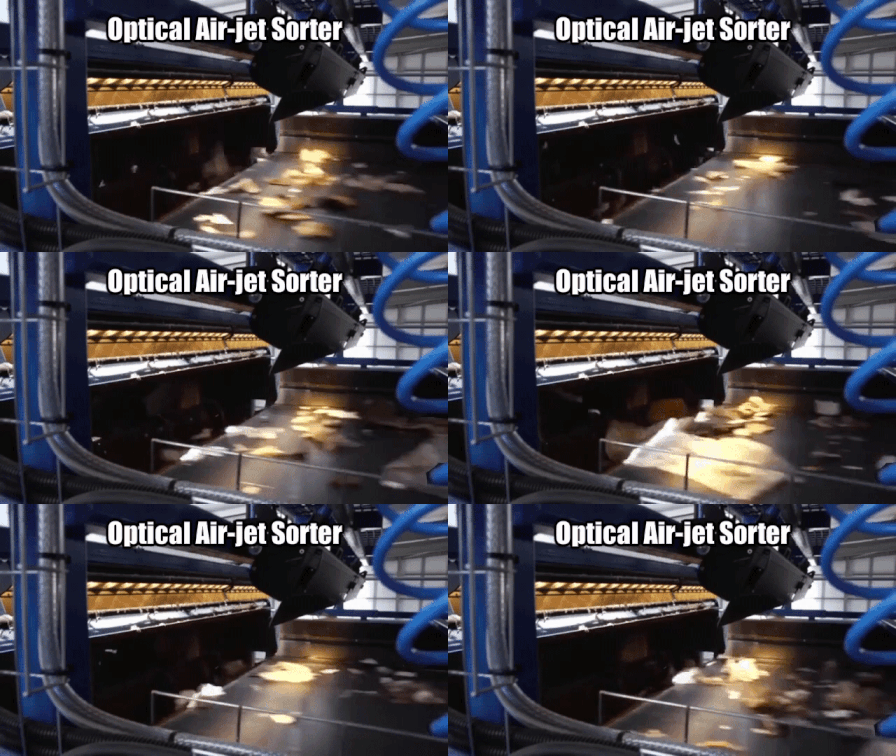
Its systems can identify and separate plastics, metals, paper, wood, electronic waste and other materials using combinations of near-infrared, visual, electromagnetic and X-ray sensors. TOMRA equipment is often integrated into MRFs designed by other companies.
TOMRA has substantial operations in the United States, although its parent company is headquartered in Norway. It should be described as a technology and equipment supplier rather than a US-owned turnkey MRF company.
Relevant capabilities: optical sorting, sensor-based separation, plastics sorting, metals recovery and material-stream analysis.
15. Van Dyk Recycling Solutions
Van Dyk Recycling Solutions supplies and integrates recycling systems throughout North America.
The company is the North American distributor for Bollegraaf equipment and supplies systems incorporating balers, screens, optical sorting, air systems and other separation technologies. Bollegraaf identifies Van Dyk as its exclusive distributor with a strong North American presence.
Van Dyk reports hundreds of MRF and sorting-system installations, making it one of the established suppliers for complete plants, retrofits and equipment upgrades in the US market.
Relevant capabilities: turnkey MRFs, Bollegraaf balers, TOMRA optical sorting, screens, air separation, system installation and lifecycle support.
16. Remcon Equipment, Inc.
Remcon Equipment is a Washington-based conveyor specialist that designs and builds material-handling equipment for recycling facilities from its headquarters in Airway Heights, near Spokane.
Originally established in 1977 as a division of a structural steel fabricator before becoming an independent business in 1991, the company focuses specifically on conveying systems, support platforms, hoppers, and chutes. Its primary product range centers on slider bed, drag chain belt, and roller chain belt conveyors, as well as high-speed optical sorting feed conveyors. While Remcon integrates components such as disc screens and walking floors from other manufacturers into its lines, it does not manufacture balers or optical sorters itself.
Like Hustler Conveyor and Mayfran, Remcon is best categorized as a specialist conveyor and material-handling equipment manufacturer rather than a turnkey MRF integrator.
Relevant capabilities: slider bed conveyors, drag chain and roller chain belt conveyors, optical sorting feed conveyors, support structures, hoppers, chutes, and custom conveyor line integration.
Questions to Ask Before Buying a MRF System
Before awarding a contract, consider asking each shortlisted supplier:
- How many comparable systems has the company commissioned?
- Can it provide recent customer references?
- What material composition was used to calculate the performance guarantee?
- Are recovery, purity and throughput guaranteed simultaneously?
- Which parts of the plant are manufactured in-house?
- Who is responsible for integrating equipment supplied by third parties?
- What utilities, civil works and building modifications are excluded?
- How many operators and quality-control staff are assumed?
- How long will routine cleaning and maintenance take?
- Where are critical replacement parts held?
- What remote and on-site technical support is available?
- What happens if the completed plant fails its acceptance tests?
A well-defined specification and acceptance-testing procedure can be just as important as the choice of machinery.
Frequently Asked Questions
What is a material recovery facility?
A material recovery facility is a plant that receives recyclable or mixed material, separates it into different grades and prepares the recovered commodities for sale or further processing. The abbreviation MRF is generally pronounced “murf.”
What is the difference between a clean MRF and a mixed-waste MRF?
A clean MRF primarily processes material collected through a recycling programme, such as mixed paper, cardboard, cans and plastic containers. A mixed-waste MRF processes a broader residual-waste stream and attempts to recover recyclable or otherwise useful materials from it.
The equipment may look similar, but the material composition, contamination, operating conditions and achievable product quality can differ substantially.
What equipment is normally used in a MRF?
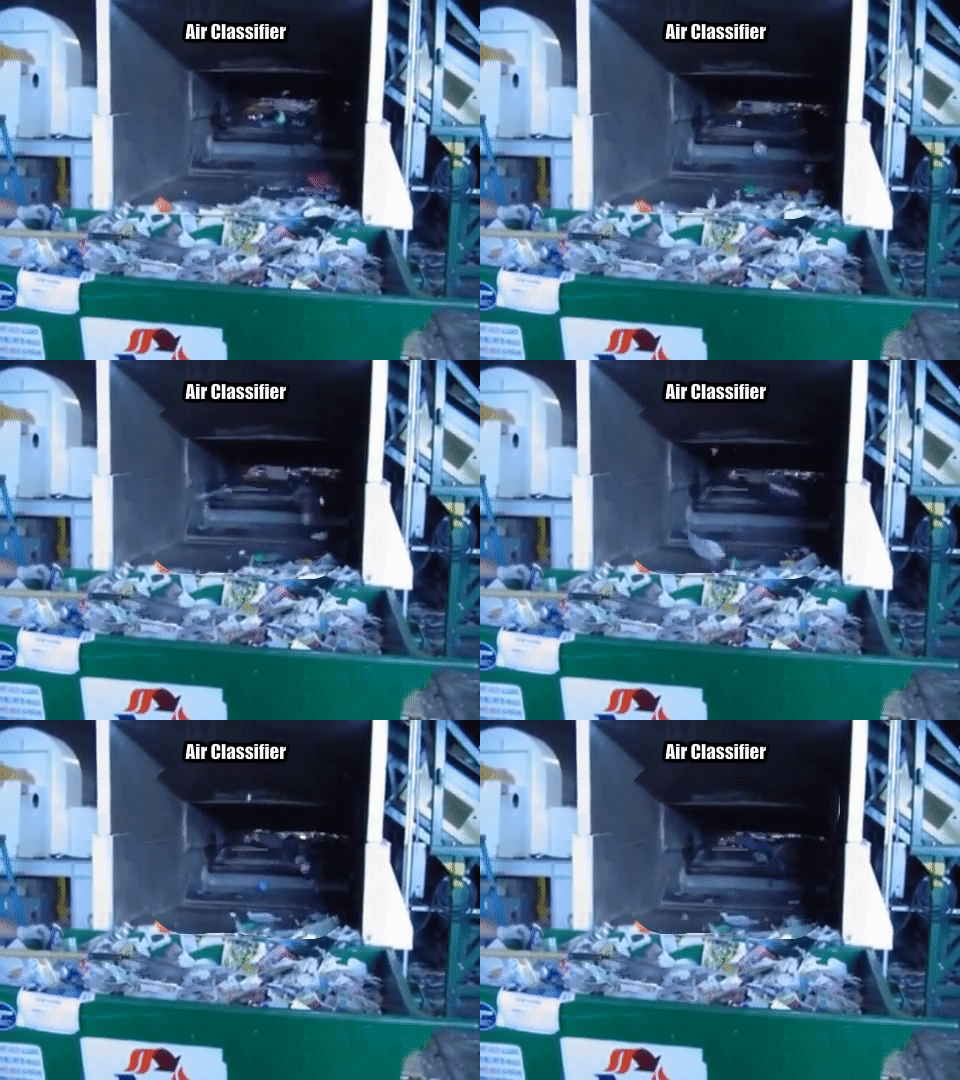
A MRF may contain bag openers, conveyors, trommels, disc or ballistic screens, magnets, eddy-current separators, air classifiers, optical sorters, robots, manual quality-control stations, bunkers and balers.
The exact arrangement depends on the incoming material and the products the facility is intended to recover.
What is a turnkey recycling system?
A turnkey system is normally designed, supplied, installed and commissioned under the responsibility of a principal contractor or integrator. The precise meaning depends on the contract, so purchasers must confirm whether civil works, electrical infrastructure, permits, buildings, fire protection and ancillary equipment are included.
Are all the companies in this list based in the United States?
No. The directory covers suppliers serving the US market. Several companies have international headquarters but maintain North American offices, representatives, installations or distribution arrangements.
Which companies supply complete MRFs?
Companies in this directory with extensive system-integration capabilities include BHS, CP Group, Machinex, Sparta, STADLER and Van Dyk. The appropriate shortlist will depend on the waste stream, project size and required technology.
Which companies specialise in optical sorting?
BHS/NRT, CP Group/MSS, Machinex and TOMRA all supply optical or sensor-based sorting technologies. Optical sorters are also incorporated into systems delivered by integrators such as Van Dyk and STADLER.
Can an existing MRF be upgraded without replacing the entire plant?
Often, yes. Screens, optical sorters, robots, controls, conveyors and balers can frequently be retrofitted into an existing facility. Before ordering equipment, an engineering assessment should identify current bottlenecks and confirm that upstream and downstream machinery can accommodate the proposed change.
How much does a recycling sorting system cost?
Costs vary enormously. A compact manual system for a small community is not comparable with a highly automated regional MRF containing multiple optical sorters and robots.
Building work, utilities, fire protection, controls, installation, commissioning and contingency should be included when comparing total project costs.
Does greater automation always produce a better MRF?
Not necessarily. Automation can improve consistency, reduce exposure to dangerous sorting tasks and address labour shortages. However, its value depends on feed preparation, equipment utilization, maintenance capability and access to technical support.
A poorly designed automated plant can simply move a bottleneck to another part of the process.
How often should a supplier directory like this be updated?
It should be reviewed at least annually. Ownership, distribution agreements, product lines and regional support arrangements can change quickly. Buyers should always confirm current information directly with a manufacturer before including it in a tender.
Editor’s note: This directory is intended as a starting point for market research, not as an endorsement or a substitute for technical, commercial or legal due diligence. Company capabilities and commercial arrangements should be confirmed directly before procurement.
[Published 3 May 2018. Rewritten and updated July 2026. October 2026 company No. 16 added by request.]




MRF and ERF are acronyms and very little know what they mean. You will never get a plain-speaking award through using these in a title. Learn how to write good titles for your articles which inform and do not confuse.
Join the plain-speaking community and campaign for higher standards in journalism now.
I’m very pleased to discover this great site. I need to to thank you for your time for this fantastic read!! I definitely liked every bit of it and I have you saved as a favorite to look at new things in your blog.
Your posts have a way of hitting home with readers while offering unique insights. I’d love to see you address how these suppliers might influence evolving industry technology. Your ability to clarify complex topics is unmatched. Thanks for consistently delivering such engaging content—looking forward to your next post!