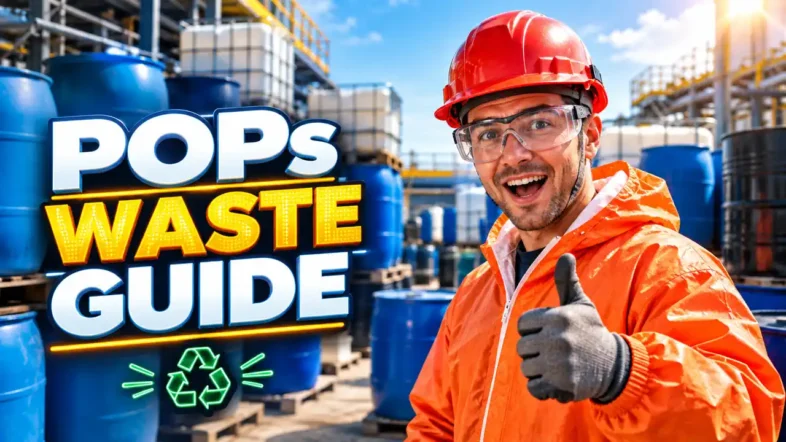
Persistent organic pollutants (POPs) are some of the most troublesome chemicals encountered in waste management. They can remain in the environment for many years, accumulate in living organisms and travel considerable distances from their original source.
Although many POPs were once widely used in pesticides, electrical equipment, plastics, insulation, furniture and industrial processes, their harmful properties have led to international restrictions and prohibitions.
For waste producers, recyclers and disposal contractors, the problem is that these chemicals may still be present in products manufactured decades ago.
This guide explains what persistent organic pollutants are, provides examples of POPs chemicals, identifies their sources and environmental effects, and examines the regulations governing POPs waste in the UK.
What Are Persistent Organic Pollutants (POPs)?
Persistent organic pollutants are carbon-containing chemical substances that resist environmental degradation, can accumulate in organisms and may cause serious harm to human health or the environment.
POPs are commonly associated with four characteristics:
- Persistence: They resist breakdown through chemical, biological or environmental processes.
- Bioaccumulation: Many accumulate in living organisms, sometimes reaching higher concentrations through food chains.
- Long-range transport: They may travel through air, water or migrating organisms far beyond their original source.
- Adverse effects: They can cause toxic effects in humans, wildlife or ecosystems.
These characteristics form the basis of the international assessment process under the Stockholm Convention on Persistent Organic Pollutants.
Not every chemical described as persistent is legally classified as a POP. The formal designation depends upon international and national regulatory processes.
Examples of Persistent Organic Pollutants
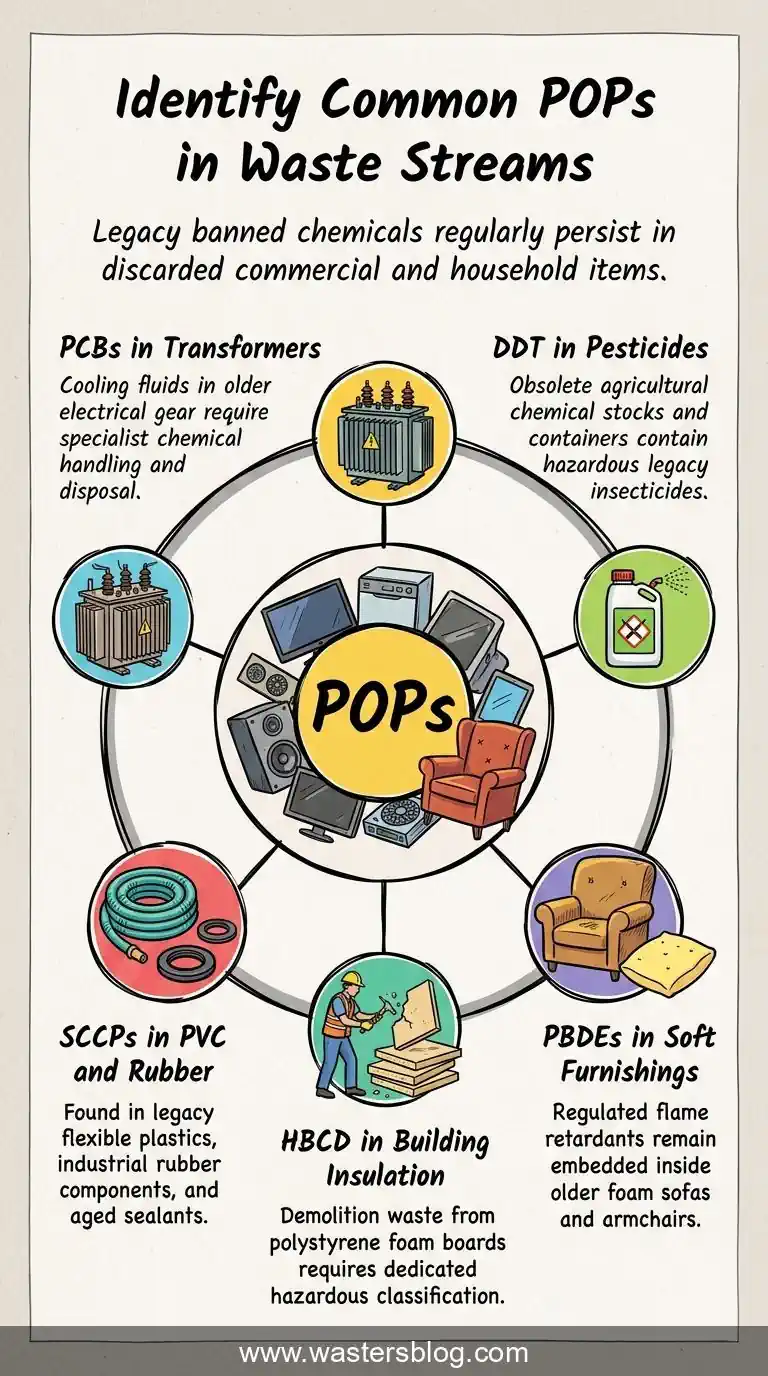
Examples of persistent organic pollutants include DDT, polychlorinated biphenyls (PCBs), dioxins, furans, certain brominated flame retardants, short-chain chlorinated paraffins and specified PFAS chemicals.
The following table provides practical examples and identifies where they may be encountered.
| POP chemical or group | Historical use or source | Possible waste materials |
|---|---|---|
| DDT | Insecticide and disease-vector control | Obsolete pesticide stocks and contaminated soils |
| Polychlorinated biphenyls (PCBs) | Electrical insulating fluids and industrial applications | Old transformers, capacitors and contaminated equipment |
| Dioxins (PCDDs) | Unintentional formation in certain thermal and industrial processes | Contaminated residues, ashes and soils |
| Furans (PCDFs) | Unintentional industrial and combustion by-products | Some thermal-process residues and contaminated materials |
| PBDEs | Flame retardants in plastics and furnishings | Waste electrical equipment, furniture foams and certain insulation products |
| HBCD (HBCDD) | Flame retardant used in insulation and other applications | Some older EPS and XPS insulation products |
| Short-chain chlorinated paraffins (SCCPs) | Plasticisers, flame retardants and industrial additives | Some PVC products, rubber, sealants and industrial wastes |
| PFOA and related compounds | Fluoropolymer manufacture and other industrial uses | Selected industrial wastes and contaminated materials |
| PFOS and related substances | Firefighting foams and various industrial applications | Some legacy firefighting foams and contaminated equipment or land |
| Hexachlorobenzene (HCB) | Former pesticide use and unintended industrial formation | Obsolete chemicals and contaminated residues |
| Aldrin and dieldrin | Historical insecticides | Obsolete pesticide stocks and contaminated land |
| Medium-chain chlorinated paraffins (MCCPs) | Plasticisers and additives in polymers, sealants and other products | Some PVC, expanding fillers and industrial polymer wastes |
Important: These examples do not imply that every product in the listed category contains POPs. Composition depends on manufacture, age, formulation and use. The Stockholm Convention's chemical listings are also updated periodically.
See the official Stockholm Convention list of POPs for the internationally listed substances.
What Were the Original 12 Persistent Organic Pollutants?
The Stockholm Convention initially targeted 12 POPs, sometimes called the Dirty Dozen.
They were:
- Aldrin
- Chlordane
- DDT
- Dieldrin
- Endrin
- Heptachlor
- Hexachlorobenzene
- Mirex
- Toxaphene
- Polychlorinated biphenyls (PCBs)
- Polychlorinated dibenzo-p-dioxins (PCDDs)
- Polychlorinated dibenzofurans (PCDFs)
These included nine pesticides, PCBs and two groups of unintentionally produced pollutants, although some chemicals had more than one source or use.
Since the Convention was adopted in 2001, further chemicals have been added.
It is therefore incorrect to assume that the original 12 represent the complete current list of persistent organic pollutants.
Where Do Persistent Organic Pollutants Come From?
POPs originate from several major sources.
1. Agricultural pesticides
Some of the earliest recognised POPs were insecticides used in agriculture and public health.
Examples include DDT, aldrin, dieldrin and chlordane.
Although many of these substances have been prohibited or severely restricted, residues may persist in contaminated soils, sediments and obsolete pesticide stocks.
2. Electrical equipment
PCBs were historically valued for their chemical stability and electrical insulating properties.
They were used in transformers, capacitors and certain other electrical and industrial products.
Old equipment can therefore present waste-management problems even after many years of service.
3. Plastics, furniture and insulation
Certain brominated flame retardants were added to plastics, upholstered furniture, electrical housings and insulation materials.
These substances can remain in the material throughout its useful life and become a problem when the product is discarded.
This is one reason why some waste upholstered seating, electrical equipment and insulation materials require particular attention.
4. Industrial and thermal processes
Dioxins and furans can be formed unintentionally during certain combustion and industrial processes, particularly where suitable precursor chemicals and operating conditions are present.
Modern industrial emissions controls are intended to minimise these releases.
However, historical contamination and residues from poorly controlled processes may remain significant.
5. Firefighting foams and fluorinated chemicals
Some legacy aqueous film-forming firefighting foams contained PFOS, PFOA-related substances or other fluorinated compounds.
Not all PFAS are legally designated POPs, but specified PFAS substances are regulated under the Stockholm Convention and domestic legislation.
Why Are Persistent Organic Pollutants Dangerous?
The environmental significance of POPs arises from their persistence, potential toxicity and capacity for movement through ecosystems.
Depending upon the particular substance and exposure, adverse effects may include:
- Damage to reproductive and developmental processes;
- Disruption of endocrine or hormonal systems;
- Effects on immune function;
- Neurological and developmental harm;
- Increased cancer risk associated with certain substances;
- Long-term contamination of soils, sediments and food chains.
These are not universal effects of every POP. Toxicity, exposure pathways and health outcomes vary considerably between chemicals.
For waste management, the important point is that preventing environmental release is generally preferable to attempting to recover dispersed pollutants after contamination has occurred.
How Do POPs Accumulate in the Food Chain?
Many POPs are resistant to degradation and can accumulate in organisms over time.
Some are strongly associated with fats and other organic materials.
When contaminated organisms are eaten, pollutants may transfer to predators.
In some circumstances, concentrations increase at successive levels of the food chain. This is known as biomagnification.
For example, a pollutant entering an aquatic ecosystem may be taken up by small organisms, transferred to fish and subsequently reach fish-eating birds or mammals.
Not every POP behaves identically, but persistence and bioaccumulation are central reasons why international controls are necessary.
What Is POPs Waste?
POPs waste is waste containing specified persistent organic pollutants at or above the applicable regulatory concentration limits.
In England, the Environment Agency publishes concentration limits used to determine when waste must be managed under POPs destruction or irreversible-transformation requirements.
Waste containing POPs below those limits may still require assessment under other waste and hazardous-substance rules.
Examples of waste streams that may contain POPs include:
- Waste upholstered domestic seating containing certain flame retardants;
- Some waste electrical and electronic equipment (WEEE);
- Old electrical equipment containing PCBs;
- Some insulation foams and construction products;
- Obsolete pesticide stocks;
- Selected industrial residues and contaminated soils;
- Certain firefighting foams and related wastes.
Not all materials in these categories are automatically POPs waste. Identification and classification must follow the relevant guidance.
Is POPs Waste Always Hazardous Waste?
No. POPs waste and hazardous waste are related but legally distinct concepts.
Hazardous-waste classification considers the waste code, composition and hazardous properties under the applicable waste-classification system.
POPs waste controls concern the presence of specified persistent organic pollutants and the relevant concentration thresholds.
Consequently, a waste may be subject to POPs destruction requirements even where its hazardous-waste classification needs to be considered separately.
Conversely, waste containing hazardous substances below POPs concentration limits may still be classified as hazardous.
The distinction matters because the required treatment and disposal arrangements may differ.
For further information, see the Environment Agency's guidance on identifying and classifying POPs waste.
POPs Waste Concentration Limits: Examples
The following examples are drawn from the Environment Agency's published concentration-limit guidance for England.
| Persistent organic pollutant | Published concentration limit |
|---|---|
| Aldrin | 50 mg/kg |
| Chlordane | 50 mg/kg |
| DDT | 50 mg/kg |
| Polychlorinated biphenyls (PCBs) | 50 mg/kg |
| Short-chain chlorinated paraffins (SCCPs) | 10,000 mg/kg |
| Specified PBDE congeners, combined | 500 mg/kg |
| HBCD | 1,000 mg/kg |
| PCDDs and PCDFs | 15 micrograms/kg, using the prescribed toxic-equivalency calculation |
Regulatory caution: This is a simplified selection, not the complete legal concentration-limit table. Some entries apply to sums of specified substances, have special calculation rules or distinguish between chemical salts and related compounds. Requirements may change as legislation is amended.
Before classifying any waste, consult the current Environment Agency concentration-limit table and the relevant legislation.
How Do You Identify POPs in Waste?
Identification usually begins with knowledge of the material and its origin.
Useful evidence may include:
- Product age and manufacturing records;
- Original use and likely chemical additives;
- Safety data sheets, where relevant and available;
- Supplier or manufacturer information;
- Existing waste-classification guidance;
- Appropriate chemical screening and laboratory analysis.
For some waste streams, the Environment Agency provides specific instructions or assumptions to assist classification.
For other materials, laboratory analysis may be necessary where there is insufficient evidence to establish whether regulated POPs are present above relevant limits.
Can X-ray fluorescence identify POPs?
X-ray fluorescence (XRF) can be a useful screening technique for elements such as bromine and chlorine.
However, it does not generally identify the precise organic chemical compound responsible for an elemental signal.
For example, detecting bromine in a plastic product may indicate the presence of a brominated flame retardant, but it does not establish which flame retardant is present or whether it exceeds a specific POPs threshold.
Confirmatory laboratory analysis may therefore be needed.
How Must POPs Waste Be Stored and Segregated?
The Environment Agency requires waste holders to take reasonable steps to prevent POPs waste from being mixed with other waste.
This includes appropriate segregation during collection, storage and treatment.
If POPs waste is mixed with other waste, the resulting mixture may have to be managed as POPs waste even where the measured concentration has been reduced through dilution.
Diluting POPs waste is not an acceptable way to avoid the regulatory requirements.
For operators, practical controls may include:
- Separate storage areas or containers;
- Clear waste identification and labelling;
- Suitable staff training;
- Documented waste acceptance procedures;
- Appropriate record keeping and traceability;
- Checks on the authorisations held by receiving facilities.
How Is POPs Waste Treated or Disposed Of?
Where the applicable concentration limit is met or exceeded, the general requirement is for the POP to be destroyed or irreversibly transformed, subject to the relevant legal provisions.
The purpose is to prevent persistent chemicals from re-entering the environment or being circulated into new products.
Depending upon the waste and the facility's authorisation, appropriate treatment may include high-temperature thermal destruction or other approved processes capable of achieving the required outcome.
Not every incinerator is authorised or technically suitable to accept every POPs waste stream.
Waste holders should confirm that the chosen facility is appropriately permitted and that its treatment process satisfies the applicable requirements.
Landfilling untreated POPs waste is not generally an acceptable alternative to required POP destruction. Limited exceptions and special provisions may apply to certain wastes and circumstances under the legislation.
See the Environment Agency's guidance on managing waste containing POPs.
Can Waste Containing POPs Be Recycled?
Recycling is possible only where the relevant legal requirements are satisfied.
Where a waste contains POPs at or above the applicable limit, conventional recycling that retains those pollutants in a new product will generally not meet the destruction or irreversible-transformation requirement.
However, separating contaminated components from uncontaminated material may allow the clean fraction to be recycled, provided the separation is lawful, effective and appropriately authorised.
For example, a mixed waste stream containing identifiable POPs-bearing components may be suitable for controlled separation, with the affected fraction sent for appropriate treatment.
The important distinction is between recovering useful materials safely and merely transferring persistent chemicals into another product.
POPs in Construction and Demolition Waste: A Recent UK Study
New research commissioned by the Environment Agency provides a useful example of the practical challenges.
WRc investigated POPs and other hazardous substances in more than 1,000 construction and demolition waste products, including insulation, flooring, window frames and polymer-based materials.
Following initial XRF screening and selected chemical analyses, the researchers identified POPs above relevant thresholds in 13 samples.
Findings included:
- Seven insulation samples with PBDE concentrations exceeding 500 mg/kg;
- One insulation sample with HBCD above 1,000 mg/kg;
- One expanding-filler sample with SCCPs above 10,000 mg/kg;
- Twenty samples containing MCCPs above 10,000 mg/kg.
These figures describe the tested samples and must not be interpreted as nationally representative contamination rates.
The research also highlights the importance of distinguishing current waste controls from evolving international chemical listings.
MCCPs were added to Annex A of the Stockholm Convention in 2025. However, implementation of individual requirements and waste concentration limits under UK legislation must be checked separately.
The study illustrates how materials that appear physically suitable for recycling can contain chemical additives that affect their classification and permitted management routes.
Read the WRc research summary and associated Environment Agency reports.
What Is the Stockholm Convention on Persistent Organic Pollutants?
The Stockholm Convention is an international treaty designed to protect human health and the environment from persistent organic pollutants.
It was adopted in 2001 and entered into force in 2004.
The Convention establishes controls for listed chemicals under three principal annexes:
- Annex A: Chemicals subject to elimination measures, with any specified exemptions.
- Annex B: Chemicals subject to restrictions, with any permitted purposes or exemptions.
- Annex C: Chemicals for which releases from unintentional production must be reduced or eliminated where feasible.
The list has expanded significantly since the original Dirty Dozen.
In 2025, the Conference of the Parties agreed additional listings including chlorpyrifos, medium-chain chlorinated paraffins and long-chain perfluorocarboxylic acids and related substances.
These international decisions inform national regulatory measures, but waste operators must check the requirements currently in force in their own jurisdiction.
What Are the UK POPs Regulations?
The UK regulates persistent organic pollutants through domestic legislation implementing its international obligations.
For Great Britain, the relevant framework includes the assimilated POPs Regulation, derived from Regulation (EU) 2019/1021, as amended.
Northern Ireland operates under arrangements that may involve continuing application of relevant EU rules.
Waste-management guidance and regulatory administration also differ between England, Scotland, Wales and Northern Ireland.
For England, the Environment Agency publishes guidance on:
- Identifying and classifying POPs waste;
- POPs concentration limits;
- Segregation and storage;
- Waste treatment and destruction;
- Specific affected waste streams.
Operators working across the UK should check the requirements of the relevant national regulator rather than assuming that all guidance documents apply identically throughout the country.
Are All PFAS Persistent Organic Pollutants?
No. PFAS is a broad family of chemicals, and not every PFAS substance is legally listed as a POP.
However, specified PFAS substances and groups are covered by international POPs controls.
Examples include PFOS, PFOA and PFHxS, together with certain salts and related compounds as defined in the relevant listings.
Some PFAS are highly persistent, but their bioaccumulation, mobility and toxicity characteristics vary.
Waste holders must therefore identify the actual substances present rather than assuming that all PFAS are regulated identically.
Frequently Asked Questions About Persistent Organic Pollutants
What are persistent organic pollutants in simple terms?
POPs are chemicals that resist breakdown in the environment and can cause long-term harm. Many can accumulate in organisms and travel far from their original source.
What are two examples of persistent organic pollutants?
DDT and polychlorinated biphenyls (PCBs) are two well-known examples. DDT was widely used as an insecticide, while PCBs were used in electrical and industrial equipment.
Is DDT a persistent organic pollutant?
Yes. DDT is one of the original 12 POPs listed under the Stockholm Convention. Its production and use are subject to international restrictions, with limited provisions relating to disease-vector control.
Are dioxins persistent organic pollutants?
Yes. Specified polychlorinated dibenzo-p-dioxins are POPs. They may be formed unintentionally during certain combustion and industrial processes.
Are PCBs still found in waste?
Yes. PCBs may remain in older electrical equipment and contaminated materials despite long-standing restrictions on their use.
Is mercury a persistent organic pollutant?
No. Mercury is a hazardous element, not an organic compound, and is not classified as a POP under the Stockholm Convention. It is subject to other international controls, notably the Minamata Convention on Mercury.
Are microplastics persistent organic pollutants?
Microplastics are particles of plastic rather than a single chemical substance. They are not collectively classified as POPs, although they may contain, carry or release certain POP chemicals.
Are all pesticides POPs?
No. Some historical pesticides are internationally listed POPs, but most pesticides are not classified as POPs. Their regulatory status depends upon the particular chemical.
Can persistent organic pollutants enter drinking water?
Some POPs can contaminate water sources, although their mobility varies. Certain substances strongly associate with sediments or organic matter, while others are more mobile in water.
Can POPs be removed by normal wastewater treatment?
Conventional wastewater treatment does not necessarily destroy POPs. Some substances may transfer into sewage sludge or other treatment residues. Effective removal or destruction depends upon the chemical and treatment technology.
Can anaerobic digestion destroy POPs?
Anaerobic digestion is not generally an authorised or reliable method for destroying regulated POPs. Some persistent chemicals resist biological degradation, and their transfer into digestate may create further management concerns.
Waste containing regulated POPs must be assessed against the applicable waste rules before any biological treatment is considered.
Does a POP always make waste hazardous?
Not automatically. POPs waste status and hazardous-waste classification involve different legal tests. Both assessments may be necessary.
Can POPs waste be sent to landfill?
Waste above applicable POPs concentration limits normally requires destruction or irreversible transformation. Landfill disposal without such treatment is not generally permitted, although specific statutory exceptions may apply.
How can a waste operator tell whether material contains POPs?
Evidence may include product history, manufacturer information, waste-stream guidance, screening tests and appropriate laboratory analysis.
Why are POPs still a problem if they have been banned?
Many POPs remain in old products, contaminated soils, sediments and obsolete equipment. Their persistence means that restrictions on new manufacture do not immediately eliminate historical contamination.
What is the difference between persistence and bioaccumulation?
Persistence describes resistance to degradation. Bioaccumulation describes the build-up of a substance within an organism over time. A substance can be persistent without exhibiting the same bioaccumulation behaviour as other POPs.
Conclusion: Why POPs Matter to the Circular Economy
Persistent organic pollutants present a difficult challenge for modern waste management.
Many were originally used because they provided valuable properties such as chemical stability, flame resistance or effective pest control.
Unfortunately, some of those same properties have contributed to long-term environmental contamination.
As older products enter waste streams, recycling businesses increasingly encounter materials containing additives that may now be restricted or prohibited.
The solution is not to abandon recycling.
It is to improve identification, segregation, classification and treatment so that useful materials can be recovered without allowing persistent hazardous substances to circulate indefinitely.
A successful circular economy must consider not only how much material is recovered, but also the chemical quality and safety of the materials returned to use.
References and Further Reading
- Stockholm Convention on Persistent Organic Pollutants.
- Stockholm Convention: Complete List of POPs.
- Environment Agency: Identify and Classify Waste Containing POPs.
- Environment Agency: Manage Waste Containing POPs.
- WRc: POPs and Hazardous Substances in Construction and Demolition Waste.
- UK Government: 2026 POPs Regulation Consultation Response.
Written by Steve Last, MICE, MCIWM, CEnv, Chartered Civil & Environmental Engineer, Chartered Waste Manager and Chartered Environmentalist, IPPTS Associates.
Regulatory note: This article is intended for general technical information. Chemical listings, concentration limits and waste-management requirements can change. Operators must check current legislation and regulator guidance before making waste classification or treatment decisions.