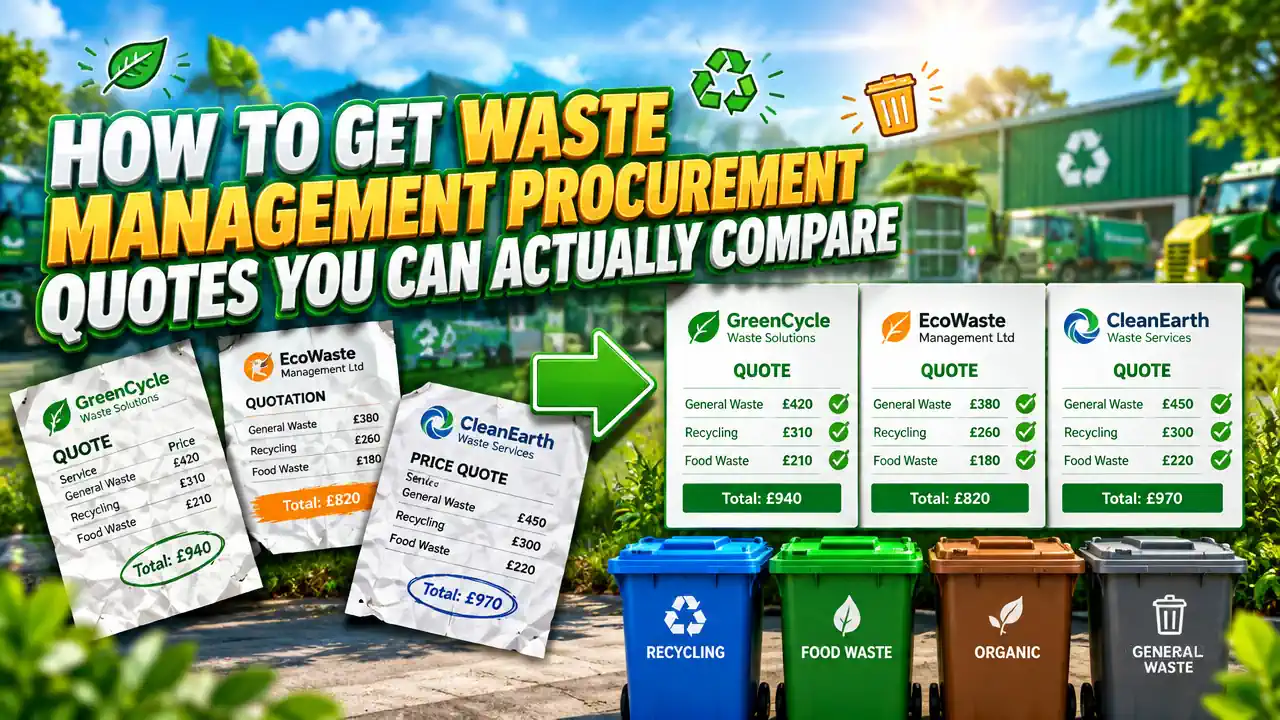
If you're searching for a waste collection tender template, you probably want one thing: quotes from different contractors that you can put side by side and judge fairly.
Here's the short answer. A good tender document does three jobs. It names every waste stream you need collected. It makes the contractor price every cost the service could create, not just the bin lift. And it gives each of your sites its own requirements and price lines. If any of those is missing, the quotes come back in different shapes, and the comparison becomes guesswork.
This guide explains how to build a tender that does all three for a business in England, and shows what to include at each step.
Key Takeaways – Waste Collection Tender Template
- Quotes rarely match because most quote requests are vague, so each contractor decides what's included and what's extra.
- Price every waste stream separately: residual, food, paper and card, mixed dry recyclables and garden waste, each by container size.
- Turn every specification cost into a priced line, marked as nil charge, priced or capped.
- Give each site its own table, then total them into one annual price.
- Tell contractors to enter £0.00 or “Nil”, never to leave a box blank.
- Paper and card stays separate unless the contractor supplies a written co-collection assessment.
- Plastic film is optional until mandatory collection starts on 1 April 2030, so ask for it as a separate priced line.
- Micro-firms (fewer than 10 FTE employees) have until 31 March 2027 to comply.
- Check pass/fail requirements (waste carrier registration, permits, insurance) before you score on price and quality.
Why waste collection quotes rarely match
Most quote requests are short. They say something like “weekly general waste, fortnightly recycling, three sites.” Each contractor then fills the gaps in their own way.
One bundles the bin rental into the lift price. Another quotes the lift cheaply and charges rental separately. A third includes reporting, and a fourth doesn't mention it. None of them is wrong. They've simply answered different questions.
The result is that the cheapest quote isn't necessarily the cheapest service. The difference often shows up later, as an extra charge for a missed lift, a lockable bin or a one-off clearance.
The fix is to ask the same detailed question of every contractor and give them identical boxes to fill in. That's what a tender does.
What Simpler Recycling changes for your tender
Simpler Recycling is the set of rules that decides which waste streams a workplace in England has to separate. Since 31 March 2025, businesses and other non-household premises with 10 or more full-time-equivalent (FTE) employees have had to arrange separate collections. Micro-firms, meaning those with fewer than 10 FTE employees, have until 31 March 2027.
For most workplaces that means arranging collections for these streams:
- Residual waste: general waste that can't be recycled
- Food waste: needed where your site produces it
- Paper and card: kept separate from other dry recyclables unless your collector has completed an assessment to justify mixing them
- Mixed dry recyclables: glass, metal and plastic, often with food and drink cartons depending on the collector
- Garden waste: only where you generate it, and it must be recycled or composted where that gives the best environmental outcome
Plastic film is a separate case. Mandatory collection from workplaces and households has been deferred by Defra to 1 April 2030. Until then it's optional, so many businesses ask contractors to price it separately and decide later whether to start sooner.
This matters because every stream is a separate service with its own container, frequency and cost. A tender that treats “recycling” as one item can't tell you what you're paying for each stream.
The three things a good tender must do
1. Price every waste stream separately
Ask contractors for a separate rate for each stream and each container size, not one blended rate. A useful rate table gives contractors boxes for:
- container rental or supply, per container per week
- collection charge, per lift
- treatment or disposal, per tonne
- minimum charge, per lift
When food waste has its own price table and paper and card has its own price table, you can see where your money goes. You can also see which stream is cheap to collect and which isn't, and decide whether to change container sizes or frequencies.
Tip: One small instruction makes a big difference: tell contractors to enter £0.00 or “Nil” rather than leaving a box blank. A blank box could mean “included”, “forgot” or “not offered.” A zero means the contractor has made a decision.
2. Make the contractor price every cost your specification creates
This is the part most quote requests skip. Your service specification sets out what you expect, and many of those expectations carry a cost. Each one needs a line in the pricing.
Think through the items a specification usually covers:
- Missed collections. A common standard is that a missed collection is put right by the end of the next working day at no extra cost, including any additional bags produced as a result.
- Overweight containers. You can't know a bin is overweight until it's lifted. A fair process is to tell the customer first, monitor for three months, offer advice or a one-off clearance, and only then apply an excess weight charge per kilo, capped at a figure you set.
- Contamination. Slightly contaminated loads stay the contractor's responsibility. A load where no effort was made can be treated as residual waste, with the charge for that and the recycling that would have been provided.
- Containers. Standard wheeled bins on loan should be included in the rates. Lockable bins, replacement of customer-damaged bins and mid-contract exchanges are separate items.
- Ad-hoc and emergency collections. Ask for a rate and a response time.
- Reporting and paperwork. Waste transfer notes, monthly weight reports, contamination reports and destination reports should each be priced or confirmed as included.
- Mobilisation and handover. Site visits, initial container delivery and collection of containers at the end of the contract.
For each item, state the basis you expect: nil charge, priced, or capped. Then leave a box for the contractor's rate. If a contractor wants to add a charge you haven't listed, give them a labelled place to do it. That way it's visible and can be scored, instead of appearing on an invoice later.
3. Give each site its own requirements and price
If you have a head office and several smaller sites, they won't need the same service. One may need a food waste caddy and a small paper and card bin. Another may need a 1,100 litre residual bin and a weekly collection.
Build a requirements table for each site that records:
- which streams are required (mark “N” for any you don't generate)
- container type and size
- number of containers
- collection frequency and day
- estimated weight per year
Then build a matching pricing table for each site, so the contractor can enter rates against those quantities and calculate an annual cost. A summary page can add the site totals into one annual price, and a figure over the initial contract term, so the evaluation is straightforward.
Simpler Recycling doesn't require weekly collections except for food waste. Workplaces can choose container sizes and frequencies for other waste types. So you may want to to suit the frequency to the volume they produce, so it's worth thinking about this per site rather than copying one pattern across all of them.
A quick checklist before you issue a tender
Use this to check your draft:
- – Have you listed every stream each site generates, and marked those it doesn't?
- – Is paper and card kept separate, unless you're prepared to accept a contractor's written co-collection assessment?
- – Is plastic film shown as an optional priced line, given the 1 April 2030 date?
- – Does every cost in your specification have a matching line to price?
- – Have you told contractors to enter £0.00 or “Nil” instead of leaving boxes blank?
- – Have you set a cap on any excess weight charge?
- – Do you have a site-by-site pricing table and a summary page?
- – Have you asked for the contractor's waste carrier registration, permits and insurance?
- – Have you provided a space for the treatment facility and permit number for each stream?
- – Have you set out how the price can change after the first year, if inflation rises?
If you can answer yes to all ten, your quotes should come back in a form you can compare.
Don't forget the pass/fail checks
Price isn't the only thing to compare. Before scoring a quote, check that the contractor passes some basic requirements:
- They're registered as a waste carrier on the Public Register of Waste Carriers, Brokers and Dealers.
- The facilities they'll use hold the right environmental permits.
- The manner in which they will keep consignment records in a satisfactory manner and their implementation of the new electronic transfer note system will match your needs.
- They hold the insurance levels you've specified.
- They can provide the separate collections you've asked for from the contract start date.
A yes/no table with a column for evidence makes this quick to check. A contractor who can't tick every box can be set aside before you spend time on the pricing.
Scoring quality as well as price
Two quotes at the same price can be very different services. A short set of scored questions helps you see the difference. Useful topics include:
- how the contractor will run the collections at each site
- the containers, vehicles and emissions standard they'll use
- how they'll mobilise the contract and communicate with your staff
- how they'll monitor and reduce contamination
- what reporting they'll give you, and in what format
- how they'll handle breakdowns, facility closures and bad weather
- who your account manager will be and who covers when they're away
Decide on your weightings before you issue the tender. A common approach is to give price the largest share and split the rest between quality and sustainability or social value, but the right balance depends on your priorities.
Common mistakes to avoid
- Leaving the specification vague. If the document doesn't say what happens on a missed collection or an overweight bin, you can't hold anyone to a standard, and you can't compare how contractors have priced it.
- Accepting blended rates. A single recycling rate hides what each stream costs.
- Forgetting the paperwork. Waste transfer notes and records are part of the duty of care. Make sure they're covered in the price.
- Ignoring access. Gates, height limits, reversing and pedestrian areas all affect which vehicles can serve a site. Record them in your site details so contractors can price realistically.
- Using out-of-date legislation lists. Older example specifications often cite regulations that have since been replaced or revoked. Have a legal adviser check the list before you issue.
- Not setting out the price review. Say whether rates are fixed for the first year, how they can change after that and by how much.
From checklist to finished document
You could assemble all of this yourself. You'd need to draft a service specification, design the stream and site tables, work out every ancillary cost, write the questionnaire and build a summary page. That's a lot of structure to get right before you've asked a single contractor for a price.
That's why we built the Waste and Recycling Collection Services Tender, from IPPTS Associates. It's a complete Word tender pack for businesses in England, and it's built around the three things above.
- A separate rate for every waste stream. Each stream has its own pricing table with boxes for each container size.
- A price against every cost the specification creates. About 40 ancillary charges are tied back to the specification, each with the basis you expect, so nothing is left for contractors to quietly leave out.
- Site-by-site pricing you can total. There's a requirements table and a pricing table for your headquarters and three further sites, with a summary that carries the totals through to one annual price.
It also includes a 20-section service specification, instructions to tenderers, a pass/fail checklist, twelve scored questions, a form of tender and a set of appendices with defined terms and guidance sources.
You complete the yellow fields with your details and requirements. Contractors complete the blue fields with their prices and answers. Because everyone answers the same questions in the same boxes, the quotes line up.
It's a template, not legal advice. Have your legal adviser review your contract terms before you issue it, and check the current GOV.UK guidance on dates before you send it out.
If you're about to ask for waste collection quotes, download our Waste and Recycling Collection Services Tender Template and send contractors a document that makes their answers comparable.
Get Your Free Download (MSWord .docx) HereThe takeaway
Comparable quotes don't come from chasing contractors for clarification. They come from asking a clear, complete question at the start.
Name every stream. Price every cost. Give each site its own table. Do those three things and the quotes you receive will be easier to compare, so you can choose the contractor who's the right fit for your business.
Waste Collection Tender Template – Frequently Asked Questions
What should a waste collection tender include?
A good tender includes customer and site details, a service specification, site-by-site collection requirements, a Bill of Quantities with a separate rate for each waste stream, a priced list of ancillary charges, pass/fail checks, scored questions and a form of tender for the contractor to sign.
Which waste streams do businesses in England need to separate under Simpler Recycling?
Most workplaces need to arrange separate collections of residual waste, food waste (where produced), paper and card, and mixed dry recyclables such as glass, metal and plastic. Garden waste applies only where you generate it.
When do micro-firms have to comply with Simpler Recycling?
Businesses with 10 or more full-time-equivalent employees have had to comply since 31 March 2025. Micro-firms, with fewer than 10 FTE employees, have until 31 March 2027.
Is plastic film collection mandatory yet?
No. Defra has deferred mandatory plastic film collection from workplaces and households to 1 April 2030. Until then it's optional, so it's sensible to ask contractors to price it as a separate line.
Do I need weekly waste collections?
No. Simpler Recycling doesn't require weekly collections. Workplaces can choose container sizes and collection frequencies to suit the volume of waste they produce, site by site.
Why should I ask contractors to price each waste stream separately?
A blended rate hides what each stream costs. Separate rates show you where your money goes, make quotes comparable line by line, and help you decide whether to change container sizes or collection frequencies.
What should I check before scoring contractors' quotes?
Check that each contractor is registered as a waste carrier, that the facilities they'll use hold the right environmental permits, that they hold the insurance levels you've specified, and that they can provide the separate collections you've asked for from the start date.
Is the Waste and Recycling Collection Services Tender legal advice?
No. It's a template. Have a legal adviser review your contract terms before you issue it, and check the current GOV.UK guidance on dates.