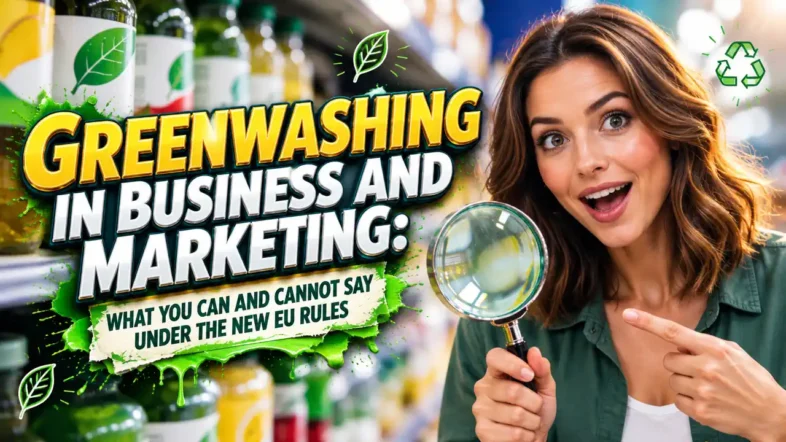
Spend five minutes in any supermarket aisle, and you will see them: leaves, globes, green ticks and promises of “planet-friendly” packaging. For years, almost anyone could print these claims on a product with little more than a good design team. That has now changed. Since 27 September 2026, new European Union rules on misleading environmental claims, widely known as the greenwashing rules, apply across the EU. If you sell to EU customers, or simply want to know whether to trust what you read on a label, here is what has changed.
Introduction: Why the EU Is Cracking Down on Greenwashing
Greenwashing is the practice of making a product, service, or company look more environmentally responsible than it really is. It can be blatant, such as a false claim, or subtle, such as a flattering word or a reassuring image that gives a misleading impression.
The legal tool is the Empowering Consumers for the Green Transition Directive (Directive (EU) 2024/825), sometimes called the Empowering Consumer Protection Directive. It was approved in 2024 and has applied since 27 September 2026. In simple terms, it says that environmental claims must be backed by evidence, and that businesses can no longer rely on vague green language to win customers.
There is one important twist. A companion proposal, the Green Claims Directive, would have gone much further. It would have set out detailed rules for third-party verification of claims and for national approval of green labelling schemes. The European Commission announced in June 2025 that it was withdrawing it. So the principles are now in force, but the detailed rulebook on how every claim must be checked has not been delivered. That leaves businesses with clear red lines but some grey areas, and gives regulators, courts and consumer groups plenty of room to interpret them.
What Businesses Must Not Say Any More
1. Vague, generic claims with nothing behind them
Words such as “eco-friendly”, “green”, “climate friendly” or “good for the planet” sound harmless, but they are exactly the kind of broad claims the rules target. Under the Directive, a generic environmental claim must be supported by relevant evidence. If a business cannot show that its product or service really performs well environmentally, it should not make the claim.
2. Telling only one part of the story
A product cannot be presented as green on the strength of just one aspect of its environmental performance. A bottle made from recycled plastic is a good example. It may sound impressive, but if the product's manufacturing or transport has a heavy footprint, a bold headline about the bottle alone can mislead. The claim has to reflect the bigger picture.
3. Made-up or self-awarded sustainability labels
Sustainability labels must have independent certification. A logo a company designed itself, with no outside check behind it, will no longer be acceptable. The days of an in-house “eco seal” that looks official but is really just marketing are numbered.
4. “Climate neutral” claims based on carbon offsetting
This is one of the most talked-about changes. Businesses cannot claim that a product is “climate neutral”, or has a reduced or positive climate impact, simply because the emissions have been offset by buying carbon credits somewhere else. Offsetting can still be part of a company's wider climate efforts, but it can no longer be the basis for a headline promise to customers.
5. Big promises about the future with no plan
Claims such as “net zero by 2030” are popular, and easy to make. Under the new rules, future environmental claims must be supported by implementation plans. In other words, a company needs to show how it intends to get there, rather than simply stating an ambition and hoping nobody asks questions.
What Businesses Can Still Say
The rules are not a gag order on honest environmental marketing. Companies are still free to talk about their genuine progress. The key is to be specific, accurate and able to prove it. For example:
- Specific claims with evidence: “This packaging contains 80% recycled material” is far safer than “eco-friendly packaging”, provided the figure is true and documented.
- Independently certified labels: A recognised, third-party-certified scheme can be displayed with confidence.
- Ambitious targets with a plan: Future goals are still allowed if there is a credible plan to deliver them.
- Honest offsetting: Companies can still invest in offset projects and talk about them, as long as they do not use them to claim that the product itself is climate neutral.
The Missing Piece: The Withdrawn Green Claims Directive
Many in the business world expected the Green Claims Directive to make the new regime easier to follow. It would have introduced a formal system for verifying claims before they were used, and rules for how national authorities approve green labelling schemes. With that proposal withdrawn, there is no EU-wide checklist or pre-approval process. Companies must make their own judgement calls on whether their evidence stands up, and they do so knowing that national authorities, competitors and consumer organisations can challenge them.
The practical message: do not wait for further rules. The existing Directive is already in force, and the safest approach is to treat any green claim as something you may one day have to defend in front of a regulator or a judge.
What This Means for Shoppers
For consumers, the changes should mean fewer meaningless buzzwords and more reliable information. If you see a sustainability label, there should be an independent body behind it. If a company says it will be climate neutral in the future, you can reasonably expect there to be a plan. And if a product is called “climate neutral” purely because of offsets, that claim should disappear from EU shelves. It is still wise to stay curious. Look for specifics, such as percentages, named certifications and clear timelines, rather than feel-good language.
For readers in the UK, note that these rules apply when selling into EU markets, so many UK exporters are affected, even though the UK has its own separate framework for misleading environmental claims.
Greenwashing: EU rules – Key Takeaways
- The EU's new greenwashing rules (Directive (EU) 2024/825) have applied since 27 September 2026.
- Generic environmental claims must be supported by relevant evidence.
- A product cannot be marketed as green on the basis of only one aspect of its environmental performance.
- Sustainability labels must have independent certification.
- Climate neutrality claims cannot rely on carbon offsetting alone.
- Future claims such as “by 2030” must be backed by implementation plans.
- The proposed Green Claims Directive was withdrawn (announced June 2025), so detailed rules on third-party verification and on approving labelling schemes will not follow from that route.
Businesses should audit their marketing now: be specific, keep the evidence on file, and drop the vague buzzwords.
Greenwashing: EU rules – Frequently Asked Questions (FAQs)
What is greenwashing?
Greenwashing is when a business gives a misleading impression that its products, services or operations are more environmentally friendly than they really are. It can involve false statements, vague wording, selective facts or imagery that suggests more than the evidence supports.
When do the new EU greenwashing rules apply?
The Empowering Consumer Protection Directive (2024/825) applies from 27 September 2026, so the rules are now live for businesses selling to consumers in the EU.
Can a company still say its product is “eco-friendly”?
Only if it can back the claim with relevant evidence. A generic term with nothing to support it is exactly what the rules aim to stop. Specific, provable statements are a much safer option.
Can a product still be sold as “carbon neutral” or “climate neutral”?
Not if the claim rests solely on carbon offsetting. Offsets cannot be the basis of a claim that a product is climate neutral.
Do sustainability logos and labels need to be certified?
Yes. Sustainability labels must have independent certification. A label that a company invents and awards to itself will not meet the standard.
Can a company promise “net zero by 2030”?
It can make a future-looking claim, but it must be supported by an implementation plan showing how the goal will be achieved.
What happened to the Green Claims Directive?
It was a separate proposal that would have added rules on third-party verification of environmental claims and on national approval of green labelling schemes. The European Commission announced its withdrawal in June 2025, so those extra requirements will not arrive through that route.
Does this affect businesses outside the EU, including in the UK?
Any business marketing to consumers in the EU needs to comply, wherever it is based. The UK has its own rules on misleading environmental claims, so UK businesses selling into both markets should check that their claims satisfy each regime.
How can shoppers spot greenwashing?
Be cautious about vague words, unexplained symbols and big promises without detail. Look for specific facts, named independent certifications and clear, dated plans.
This article is general information, not legal advice. Businesses should take professional advice on specific claims.