A Tidal Wave of Change Is Heading for Britain’s Sorting Plants: Report Reveals Likely Consequences of UK MRFs Packaging Reform
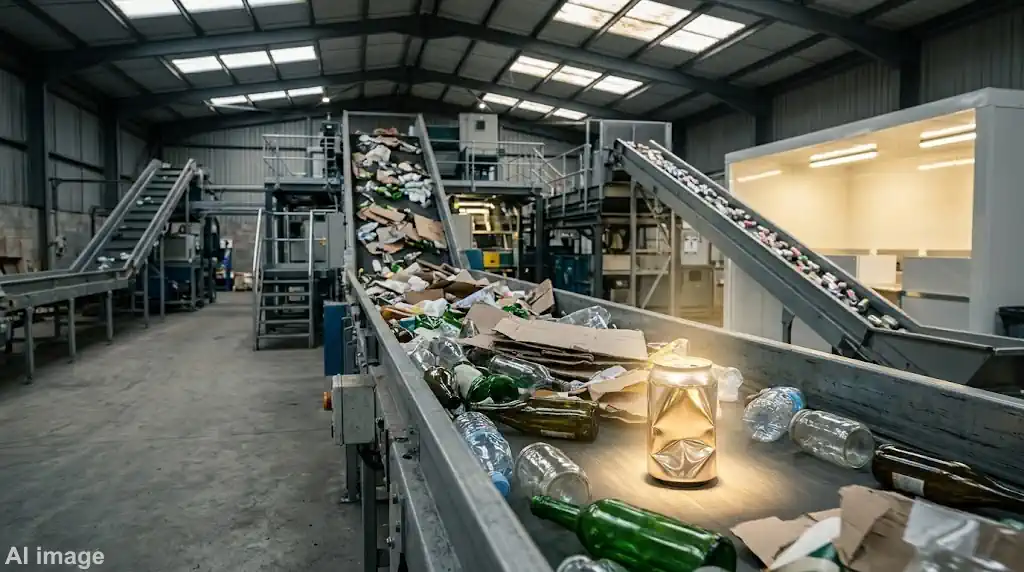
Picture a conveyor belt carrying the contents of thousands of recycling bins: crushed cans, soggy cardboard, clinking glass, squashed plastic bottles. Now picture about a hundred people and a lot of clever machinery sorting it all into tidy, saleable bales. That is a Materials Recovery Facility, or MRF (pronounced “murf”), and it is where your recycling goes after the bin lorry drives off.
Those sorting plants are about to meet the biggest shake-up in a generation. A new report from the Chartered Institution of Wastes Management (CIWM) Specialist Expert Group, published in October 2026, asks a blunt question: can UK MRFs survive packaging reform? The short answer is yes, but not unchanged.
Key Takeaways
- MRFs are where your recycling is sorted, and they are about to face several major reforms in quick succession: the Deposit Return Scheme, packaging EPR, Simpler Recycling, separate paper and card collections and possible carbon pricing for waste incineration.
- Weight is not value. Aluminium and PET plastic bottles make up around 12% of a typical tonne of mixed recycling but roughly 39% of the sales income, and the Deposit Return Scheme (from 1 October 2027) targets exactly those materials.
- Income could fall faster than tonnage. If 80% of these materials were diverted, the report estimates tonnage could drop by almost 10% while material income falls by more than 30%.
- The “MRF Gap” is unresolved. No tested national system yet shows how deposit containers that still end up in kerbside recycling will be identified, counted and paid for.
- Aerosols are a hidden risk. With drinks cans diverted, aerosols could rise from about 2% to about 9% of a plant’s aluminium output, and regulators have yet to say how that stream will be classified.
- Plastic film collections are delayed. Mandatory household and business collection is now intended from 1 April 2030 in England and Northern Ireland, giving a three-year window to prepare.
- Survival means adaptation. The CIWM expert group expects a gradual squeeze rather than a sudden collapse, and calls for joined-up impact assessments, fairer contracts, clear regulation and recognition of MRFs as critical environmental infrastructure.
- The numbers in this article are illustrative. They come from anonymised operator data and sensitivity scenarios, not national averages or forecasts.
What is actually in your recycling bin?
The report builds its analysis on anonymised data from a representative commingled MRF, the type that takes your paper, cans, glass and plastics all mixed together. By weight, the picture is surprising:
- Cardboard and paper: 47.4%
- Glass: 35.7%
- Plastic bottles: 10.6%
- Steel cans: 3.1%
- Aluminium: just 1.7%
- Other plastics: 1.5%
Paper and glass together make up more than 83% of what arrives. Yet the weight on the scales tells you very little about the money in the bales.
The tiny can with the big price tag
This is the heart of the report’s argument, and it is a neat one. The authors call it income density: how much commodity income a plant earns for every tonne it processes.
Take a round 1,000 tonnes of mixed recycling. On the report’s deliberately simple, illustrative prices, 17 tonnes of aluminium earns roughly £17,000, while 357 tonnes of glass earns next to nothing. A thin sliver of cans pays as much as a mountain of bottles and jars. Together, valuable plastic (PET) bottles and aluminium make up only around 12% of the weight but roughly 39% of the sales income.
Now add the Deposit Return Scheme (DRS), due to start on 1 October 2027. Drinks containers will carry a deposit and head into a separate return system, with government expecting returns above 90% by year three. That is great news for clean, closed-loop recycling. It is awkward news for the sorting plants, because it pulls out exactly the high-value items. The report estimates that if 80% of those materials were diverted, the tonnage reaching a MRF would fall by almost 10%, but sales income could drop by more than 30%.
Think of it as a thimble of gold hidden in a bucket of sand. Remove the gold, and the bucket still looks nearly full, but it is worth far less.
Five reforms, one building
The DRS is only one of several changes landing on the same sheds in quick succession:
- Deposit Return Scheme: high-value drinks containers leave the mixed stream from October 2027.
- Extended Producer Responsibility (EPR): packaging producers pay more towards the cost of dealing with their waste, with fees linked to recyclability. Lighter, redesigned packaging may not be any easier to sort, and the report notes there is not yet clear evidence that EPR has reduced the work MRFs do.
- Simpler Recycling: standardised collections in England, in force from 31 March 2026.
- Separate paper and card collections: now the default in England, which could move bulk fibre away from some MRFs.
- Carbon pricing for waste incineration (UK ETS): expansion will not go ahead in 2028 as planned, but a replacement date and design are still unconfirmed, leaving a cost risk hanging over residual waste.
Each has a sensible environmental purpose. The worry is the cumulative effect. When DRS removes the valuable containers and separate collections divert the bulky paper, a MRF can lose value and volume at the same time. The report’s illustrative scenarios suggest the gross tonnage change could range from about 10% to 30% of a plant’s mixed stream. These are not forecasts, but they show why the combined impact needs proper modelling.
Meet the “MRF Gap”
Even a very successful deposit scheme will not catch every container. Some will still end up in kerbside bins, commercial collections, litter or general waste. The report coins the term “MRF Gap” for the unresolved question of how those stray containers will be identified, counted and paid for, once the scheme treats them as deposit material while the sorting plant is the one handling them.
Put simply: if a deposit can ends up in your recycling bin, who pays for the lorry, the sorting and the baling? At the time of writing, the report says no fully tested national answer has been shown publicly, with launch less than 18 months away.
The aerosol curveball
Here is a consequence few people would spot. If most drinks cans are diverted into the deposit scheme, the aerosol cans that remain make up a bigger share of the aluminium a MRF sells on. In the report’s example, aerosols rise from around 2% to roughly 9% of that aluminium output, not because there are more aerosols, but because the drinks cans have gone.
That raises practical questions about safe baling, storage, transport and whether the output could count as hazardous waste. Operators report that the Environment Agency, SEPA and Natural Resources Wales have not yet given a clear statement on how this stream will be classified. The report calls that a significant regulatory failure in waiting, with around a year to go.
Why you might care about all this
Councils usually pay MRFs a gate fee to take their recycling, offset by the income the plant earns from selling materials. In the report’s model, that balance is around 54% gate fee and 46% material income today, shifting towards roughly 60% and 40% after heavy DRS diversion. Many council contracts run for years with fees that rise only with inflation, so operators could be left carrying the cost of a policy change nobody priced in. In the longer run, that tends to mean higher gate fees for councils and, ultimately, for residents who may see their council's property rates rising.
Efficiency matters too. A plant that slips from processing 18 tonnes an hour to 16 needs 12.5% more running time for the same tonnage; at 15 tonnes an hour, it is 20% more. Fixed costs such as labour, maintenance and fire protection do not shrink to match.
The plastic film reprieve
There was one piece of good news, from the point of view of the recycling industry. Mandatory household collection of plastic films and flexibles (bags and wrappers) was due in March 2027, but in July 2026 the government announced its intention to move it to 1 April 2030 in England and Northern Ireland, subject to amending legislation, with Wales and Scotland indicating they will press ahead with 2027. Films are notorious for wrapping around machinery and contaminating paper, so the extra time is welcome. The report argues it should be treated as a three-year infrastructure window for trials, investment and building end markets, not simply a pause.
So, can MRFs survive?
Yes, say the authors, but only if the commercial and policy framework adapts as much as the waste stream. They expect a gradual squeeze on income, throughput and investment confidence rather than a sudden collapse, with plants on short contracts and fixed fees the most exposed. Their eight recommendations include:
- Sort out DRS and kerbside recycling (reconciliation, leakage accounting and funding) before 1 October 2027.
- Commission a joint government impact assessment covering all the reforms together, rather than one at a time.
- Recognise MRFs as critical environmental infrastructure.
- Publish a national strategy and readiness assessment for films and flexibles by 2028.
- Match EPR funding to what sorting really costs, backed by real monitoring data.
- Give a clear regulatory answer on aerosols in post-DRS aluminium.
As the report concludes, the question is not whether reform should happen, but whether it is coherent, sequenced and operationally ready. Environmental ambition alone is not enough if the plants that do the sorting are left struggling.
What it means for your bin
For most households, nothing changes tomorrow. But the next few years will quietly reshape what goes in your bins, where it goes and who pays. The humble drinks can is about to become a much more important piece of the recycling puzzle than its weight suggests.
Frequently Asked Questions
What is a MRF?
A MRF, or Materials Recovery Facility, is a plant that takes mixed household and commercial recycling and separates it, using machinery and manual sorting, into saleable grades such as cardboard, glass, plastic bottles and metals.
When does the Deposit Return Scheme start?
The Deposit Return Scheme is scheduled to launch on 1 October 2027 in England and Northern Ireland. It covers single-use PET plastic and aluminium drinks containers from 150 millilitres to 3 litres. Government expects return rates for these containers to exceed 90% by the third year.
If a deposit scheme is good for recycling, why does it worry MRF operators?
It is good for collecting clean, high-quality material, but it removes some of the most valuable items from the mixed stream. Because MRFs rely on selling materials such as aluminium and PET to offset their costs, losing those items can cut income sharply even though the plant still handles most of its tonnage. The report calls this the income density problem.
What is the “MRF Gap”?
It is the term the CIWM report uses for the unresolved interface between the deposit scheme and existing kerbside recycling. Some deposit containers will inevitably end up in household or commercial recycling bins. The question is how they are identified, evidenced and paid for, and who covers the collection and sorting costs.
Will my recycling collection get more expensive?
Not necessarily, and nothing changes overnight. However, many council contracts have fees that only rise with inflation, so operators could be left with unplanned costs. The report warns that, over time, this could push up gate fees for councils and ultimately for residents, unless contracts and funding arrangements are adjusted.
When do plastic films and flexibles have to be collected?
Following a July 2026 announcement, mandatory collection of plastic films and flexibles is intended from 1 April 2030 in England and Northern Ireland, subject to amending legislation expected in autumn 2026. Wales and Scotland have indicated they will progress with the original 2027 date.
Could UK MRFs close as a result of these reforms?
The report concludes that MRFs are unlikely to disappear, because the UK will still need infrastructure to sort mixed recycling. It expects a gradual squeeze on income, throughput and investment confidence rather than a sudden collapse. Plants with flexible equipment, strong contracts and access to capital are best placed, while those on short contracts with fixed fees face the greatest risk.
Do I need to change how I recycle right now?
No. Keep following your local council’s current guidance. As the reforms roll out, collection rules and containers may change, so check your council’s website for updates.
Are the figures in the report forecasts?
No. The report is clear that its composition data comes from an anonymised representative facility, and its prices and scenarios are illustrative. They are designed to show the order of magnitude that Government and industry should model, not to predict national outcomes.
A note on the numbers: the figures above come from anonymised operator data and illustrative prices and scenarios in the report. They are not national averages or forecasts, and policy dates may change as legislation is finalised.
Sources and further reading
- CIWM Infrastructure, Services and Operations Specialist Expert Group, Can UK MRFs Survive Packaging Reform? (October 2026)
- UK Government, Deposit Return Scheme: drinks producer and retailer responsibilities
- UK Government, Simpler household recycling rules come into force across England
- UK Government, UK Emissions Trading Scheme: policy overview
- Infinitum, Annual Report 2024 (Norwegian deposit scheme performance)
- Local Authority Recycling Advisory Committee (LARAC), statement on the delay to mandatory film and flexibles collections (16 July 2026)