
Biffa is one of the best-known waste management companies in the UK. Its red collection vehicles can be seen serving businesses, households and local authorities across the country, but waste collection is only one part of its operation.
The company is also involved in recycling, surplus redistribution, composting, plastics reprocessing, waste treatment and energy recovery. It has more than a century of history and has changed ownership several times during that period.
This updated guide explains who owns Biffa, what Biffa does and how large its UK waste operations are. It also replaces a much older collection of unsupported “factoids” previously published on this page.
Operational figures in this article are principally taken from Biffa’s latest available Sustainability Report and relate to its 2024/25 financial reporting period unless otherwise stated. They will change as the business develops.
Biffa Waste Management – Key takeaways
- Biffa is a British waste management business headquartered in High Wycombe, Buckinghamshire.
- The company traces its history back to 1912.
- Energy Capital Partners acquired Biffa in January 2023, after which it ceased to be a publicly listed company.
- Biffa provides waste collection, recycling, treatment and specialist services to businesses, public bodies, local authorities and communities.
- Its latest sustainability data records more than 11,000 employees and over 106,000 industrial and commercial customers.
- Biffa remains involved in residual waste treatment and landfill as well as recycling, demonstrating that it is an integrated waste company rather than solely a recycling company.
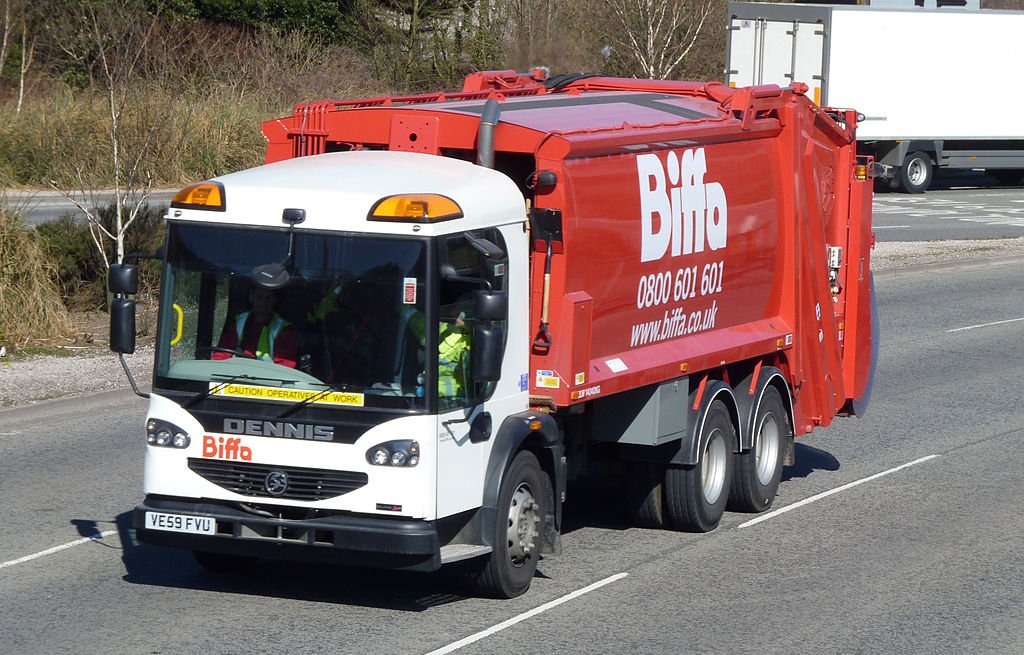
Image Attribution for Biffa Refuse Vehicle, Biffa Waste Management: Graham Richardson from Plymouth, England , via Wikimedia Commons.
What is Biffa?
Biffa is a UK waste and resource-management company. It collects and manages waste from businesses and organisations while also operating services on behalf of local authorities.
The company’s activities cover much of the waste-management chain, including:
- waste prevention and surplus redistribution;
- business and household waste collection;
- dry mixed recycling;
- food and garden waste treatment;
- plastics sorting and reprocessing;
- hazardous and specialist waste services;
- construction and demolition waste management;
- waste transfer and treatment;
- energy recovery; and
- the disposal of material that cannot currently be recovered.
Biffa describes its purpose as changing the way people think about waste and helping the UK move towards a more circular economy. In practice, its operations include activities at several levels of the waste hierarchy, from prevention and reuse to recycling, recovery and final disposal.
Who owns Biffa?
Biffa is owned by Energy Capital Partners, commonly abbreviated to ECP. The infrastructure investment company completed its acquisition of Biffa in January 2023.
Before the acquisition, Biffa was listed on the London Stock Exchange and became a member of the FTSE 250. Following the takeover, Biffa became a privately owned company and its shares were no longer publicly traded.
Companies House records Biffa Limited as an active private limited company. Its registered office is at Coronation Road, Cressex, High Wycombe, Buckinghamshire.
A brief history of Biffa
Biffa’s origins go back to 1912, when Richard Henry Biffa founded Richard Biffa Limited in London. Its early work included removing and selling ash and clinker produced by power stations.
As Britain’s economy and waste-management requirements changed, the company expanded from ash removal into municipal, commercial and industrial waste services.
Biffa was acquired by British Electric Traction in 1971 and subsequently by Severn Trent in 1991. It later passed through other ownership structures before returning to the London Stock Exchange in 2016.
In January 2023, Energy Capital Partners completed its acquisition of the business. Biffa therefore has more than 100 years of operating history, although the legal entities and ownership behind the brand have changed over time.
What services does Biffa provide?
Commercial waste collection
Biffa collects general waste and separately segregated materials from businesses of different sizes. Available services include collections for paper, cardboard, plastics, metals, glass, food waste and other recyclable materials.
It also supplies bins, skips and other containers, together with scheduled and one-off collection services.
Local authority services
Biffa works with local authorities to provide services such as household refuse and recycling collections, food waste collections, street cleansing, garden waste services and the operation of household waste recycling centres.
If a household collection operated by Biffa is missed, the resident will normally need to contact the relevant council. The local authority remains the customer and is responsible for administering the public service.
Recycling and material recovery
Collected recyclable material may pass through transfer stations, material recovery facilities and specialist reprocessing plants. Sorting separates useful materials so that they can be supplied to manufacturers as secondary raw materials.
Biffa has invested particularly heavily in plastic bottle, pot, tub and tray recycling. The objective of closed-loop recycling is to turn suitable recovered plastic back into material capable of replacing virgin plastic in new products.
Food and organic waste
Food waste can be processed through anaerobic digestion, producing biogas and a nutrient-rich digestate. Garden waste and other suitable organic materials can be composted.
Keeping separately collected food waste out of general waste bins can improve material recovery and prevent wet organic material from contaminating otherwise recyclable items.
Hazardous and specialist waste
Biffa also provides specialist services for materials that cannot safely or legally be placed in an ordinary general waste container. These include certain hazardous wastes, asbestos, electrical equipment, batteries, liquids and confidential or commercially sensitive products.
Waste classification and disposal requirements depend on the material and the circumstances in which it was produced. Businesses should obtain competent advice where a waste may be hazardous.
Residual waste and disposal
Not everything collected can be reused or recycled. Biffa therefore also manages residual waste through treatment, energy recovery and, where necessary, permitted landfill disposal.
Recycling and recovery should not be confused with waste prevention. Under the waste hierarchy, preventing unnecessary material use and reusing products generally take priority over recycling, energy recovery and disposal.
You can read more in our guides to what recycling means and energy from waste and incineration.
30 key facts about Biffa waste management
- Biffa’s history dates back to 1912. That gives the company more than a century of experience in the changing UK waste industry.
- The original business was founded by Richard Henry Biffa as Richard Biffa Limited.
- Early operations included removing ash and clinker from power stations, long before modern household recycling systems were introduced.
- Biffa is a British company, although its ultimate owner is a US-based infrastructure investment business.
- Biffa’s headquarters and registered office are in High Wycombe, Buckinghamshire.
- Energy Capital Partners acquired Biffa in January 2023.
- The company is now privately owned and is no longer listed on the London Stock Exchange.
- Biffa’s chief executive is Michael Topham, who became CEO in 2018 after previously serving as its chief financial officer.
- Biffa reported 11,050 employees for its 2024/25 financial reporting period.
- The company reported serving approximately 95% of UK postcodes, giving it extensive national coverage.
- Biffa recorded 106,659 industrial and commercial customers in its FY25 performance data.
- It reported collecting approximately 3.57 million tonnes of waste during the same reporting period.
- The amount of waste processed was approximately 3.91 million tonnes.
- Its frontline collection fleet comprised 3,722 vehicles in the FY25 data.
- The fleet serves businesses and organisations as well as household collection contracts operated for local authorities.
- Biffa provides waste and street-cleansing services to more than 30 UK local authorities.
- Its services include general waste, recycling, glass, cardboard, food waste, hazardous waste, skips and specialist collections.
- Biffa’s FY25 figures listed 66 waste transfer stations. These allow collected material to be consolidated, sorted or transferred for further treatment.
- The same report listed 18 material recovery, plastics recovery and polymer facilities.
- Biffa reported 19 composting and anaerobic-digestion facilities.
- It also listed seven operational landfill sites, illustrating that final disposal remains part of its integrated waste-management operations.
- Biffa reported collecting 558,191 tonnes of business waste for recycling.
- Its latest report calculated plastic recycling capacity at approximately 230,000 tonnes, following a change to a methodology based on proven processing rates.
- Biffa says its polymer operations process more than 10 billion items of plastic packaging each year, including bottles, pots, tubs and trays.
- Approximately 95.7% of the collected plastic it traded in FY25 was traded within the UK, with the remainder going to countries in the European Union.
- Biffa’s Company Shop Group helps manufacturers and retailers redistribute usable surplus products instead of discarding them.
- Company Shop Group reported redistributing 113 million products in 2024.
- It also reported preventing approximately 46,000 tonnes of food and drink from becoming waste during that year.
- Biffa reported generating 566 GWh of electricity from waste in its FY25 environmental data.
- The company reported a 37% reduction in market-based Scope 1 and Scope 2 emissions against its 2019 baseline. This does not mean its operations are emission-free, but it indicates progress against the company’s stated baseline.
Biffa and the circular economy
Large integrated waste companies have an important role in collecting and processing material, but a circular economy requires more than collecting additional tonnes.
The greatest environmental benefit may come from preventing products and materials from becoming waste in the first place. Redistribution, reuse, repair, better product design and reduced packaging can retain more of the value invested in products.
Biffa’s activities now include surplus redistribution and packaging consultancy alongside its traditional collection and treatment services. Its plastics operations can also return recovered material to manufacturing, reducing demand for some virgin resources.
However, waste collection, sorting, recycling, transport and treatment all consume energy and produce environmental impacts. Residual waste operations can also involve incineration or landfill. Claims about sustainability should therefore be judged using transparent data, independently checked performance and the complete waste hierarchy.
Is Biffa only for businesses?
No. Businesses can contract directly with Biffa, but the company also provides household services under contracts with local authorities.
A householder whose council uses Biffa does not normally have a direct commercial contract with the company. Questions about bin collection days, missed household collections or replacement council bins should generally be directed to the relevant local authority.
Biffa also operates the Green Waste Club, a subscription service for garden waste collections in participating areas.
Frequently asked questions about Biffa
What does Biffa do?
Biffa collects, transfers, sorts, recycles, treats, recovers and disposes of waste. It serves commercial customers, public-sector organisations and local authorities and also provides specialist waste and consultancy services.
Who owns Biffa?
Biffa is owned by Energy Capital Partners, which acquired the company in January 2023.
Is Biffa a private company?
Yes. Biffa was previously listed on the London Stock Exchange, but it became a privately owned company following its acquisition by Energy Capital Partners.
Is Biffa a British company?
Yes. Biffa is incorporated in England and Wales and is headquartered in High Wycombe. Its ultimate owner, Energy Capital Partners, is based in the United States.
When was Biffa founded?
The business traces its origins to 1912, when Richard Henry Biffa founded Richard Biffa Limited in London.
Where is Biffa based?
Biffa’s headquarters and registered office are at Cressex Business Park in High Wycombe, Buckinghamshire.
Does Biffa collect household bins?
Yes. Biffa provides household waste and recycling collections for a number of UK councils. Residents should normally contact their local authority about a missed collection or council bin service.
Does Biffa recycle plastic?
Yes. Biffa operates specialist plastics sorting and reprocessing facilities. Its latest sustainability reporting calculated approximately 230,000 tonnes of plastic processing capacity.
Does Biffa operate landfill sites?
Yes. Its FY25 performance data listed seven operational landfill sites. Landfill is used for material that cannot be recovered through available and permitted alternatives.
Is Biffa the largest waste company in the UK?
Biffa describes itself as a UK leader in waste management and has one of the country’s largest collection networks. Rankings can vary depending on whether size is measured by revenue, waste collected, customer numbers, fleet size or the particular waste sector being considered.
Sources and further information
- Biffa: About the company
- Biffa: Management structure
- Biffa: Sustainability Report and performance information
- Biffa: Waste services and products
- Companies House: Biffa Limited
This is an independent informational article. WastersBlog is not affiliated with, endorsed by or acting on behalf of Biffa or Energy Capital Partners. Company figures and services can change, so readers requiring current commercial information should consult Biffa directly.
First published: 19 December 2018. Substantially rewritten and updated: 19 July 2026.



Oh, bless your heart for thinking you know about Biffa’s waste management. Let me enlighten you with a fact that your little list missed. Biffa is pioneering in converting non-recyclable plastics into high-grade fuel. It’s not just about recycling; it’s about innovation and leading the industry towards sustainability. So, next time you think you know all there is about Biffa, remember, that you don’t.