Sham recycling is the fraudulent practice of labelling waste as “recycled” while actually dumping, burning, or stockpiling it, usually to evade disposal costs or regulations. It involves dishonest claims where collected materials are not truly reprocessed, threatening environmental damage, and the US EPA defines this as non-legitimate recycling.
Basics of Sham Recycling
- Sham recycling is a federal offence according to US RCRA, where hazardous waste is disguised as recycling to avoid strict disposal regulations.
- Four specific factors are used by the US EPA to determine whether recycling is legitimate — fail any one of them and you could be facing serious legal consequences.
- Significant financial penalties are faced by companies caught sham recycling, potential criminal charges, and full liability under hazardous waste regulations.
- Improper storage of reused materials — like keeping them in leaking containers — is one of the fastest ways the US EPA flags a sham recycling operation.
- Recordkeeping is mandatory — if you can't document where, how, and in what volumes materials are being reused, the US EPA will presume sham recycling is occurring.
Most people assume recycling is always a good thing — but when it's used as a legal loophole to dump hazardous waste without consequence, it becomes one of the most damaging environmental violations a company can commit.
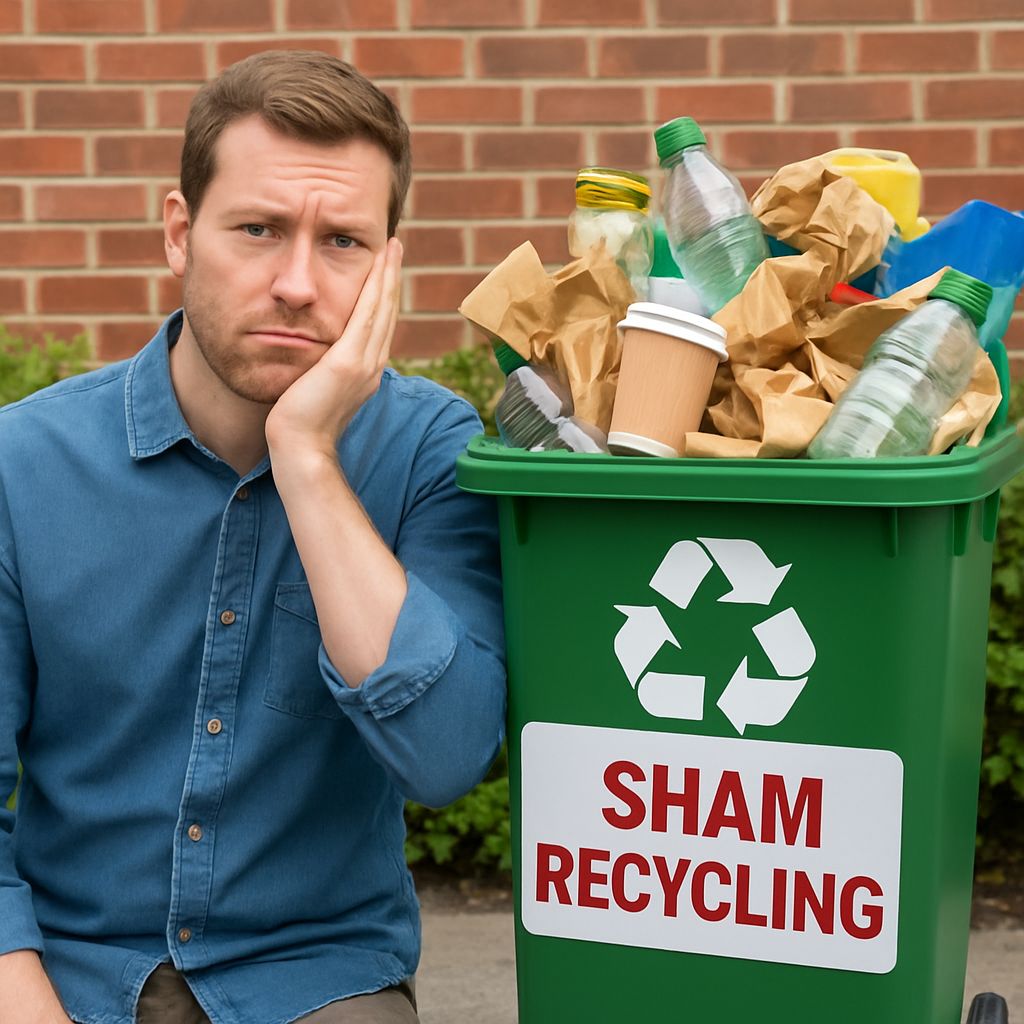
Sham recycling is a much more prevalent issue than many people think, and its impact extends well beyond a simple regulatory fine. It's important for any organization that deals with hazardous materials to understand what sham recycling looks like, how regulators identify it, and what it costs — both environmentally and legally. Hazardous Waste Experts can help guide businesses through these exact compliance challenges, ensuring they stay on the right side of environmental law.
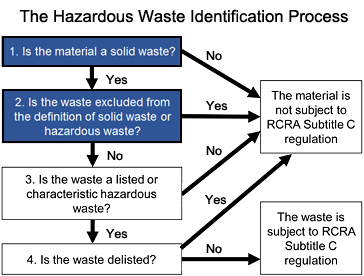
“Hazardous Waste Exclusions …” from www.epa.gov and used with no modifications.
Sham Recycling: A Hidden but Prevalent Problem
Recycling is, by definition, a valuable and essential activity. However, when “recycling” is used as a smokescreen for inappropriate waste disposal — particularly when dealing with hazardous materials — it ceases to be a green initiative and becomes a regulatory violation. The EPA has always been aware of this difference, and since the inception of the Resource Conservation and Recovery Act (RCRA) program, it has maintained a clear distinction between genuine recycling and what it officially refers to as sham recycling.
The problem is that it's not always clear when recycling is a sham. Some operations genuinely think they're recycling properly, only to discover later that their paperwork, storage methods, or material use doesn't stand up to inspection. Others intentionally take advantage of regulatory loopholes. Regardless, the result is the same.
Understanding Sham Recycling
Sham recycling is a term used to describe the act of mislabeling hazardous waste disposal as “recycling” to sidestep the more stringent rules and regulations associated with hazardous waste management. According to 40 CFR section 261.2(b)(4) and (g), hazardous secondary materials that have been sham recycled are considered both solid and hazardous wastes. This means they are fully governed by RCRA regulations, irrespective of the recycling label they have been given.
Understanding Sham Recycling According to the EPA
According to the EPA, sham recycling is any recycling activity that is primarily done to avoid hazardous waste requirements rather than to achieve a real recycling result. This definition was established through a series of regulatory rules, with the most recent version being finalized in 2018. The EPA's stance is clear: if the recycling isn't legitimate, the exemption isn't either. For those interested in legitimate recycling practices, check out this plastic recycling guide.
As per the EPA, sham recycling happens when a secondary material is either ineffective or barely effective for its intended use, when it is used in excess of the amount required, or when it is managed in a manner that is inconsistent with its intended use as a commercial product. Any of these conditions is sufficient to result in a sham recycling determination. For more information on proper recycling practices, check out this plastic recycling guide.
The EPA also mandates that businesses treat reused hazardous secondary materials in the same way they would treat their virgin raw materials. If a generator cannot prove this through appropriate documentation, the EPA will assume sham recycling is occurring under 40 CFR 261.2(f).
What's the Difference Between Sham Recycling and Real Recycling?
Whether a recycling practice is sham or legitimate depends on whether it produces a genuine, useful result or whether it's just a way to get rid of waste under the guise of being eco-friendly. Let's compare the two based on the key criteria used by the US EPA:
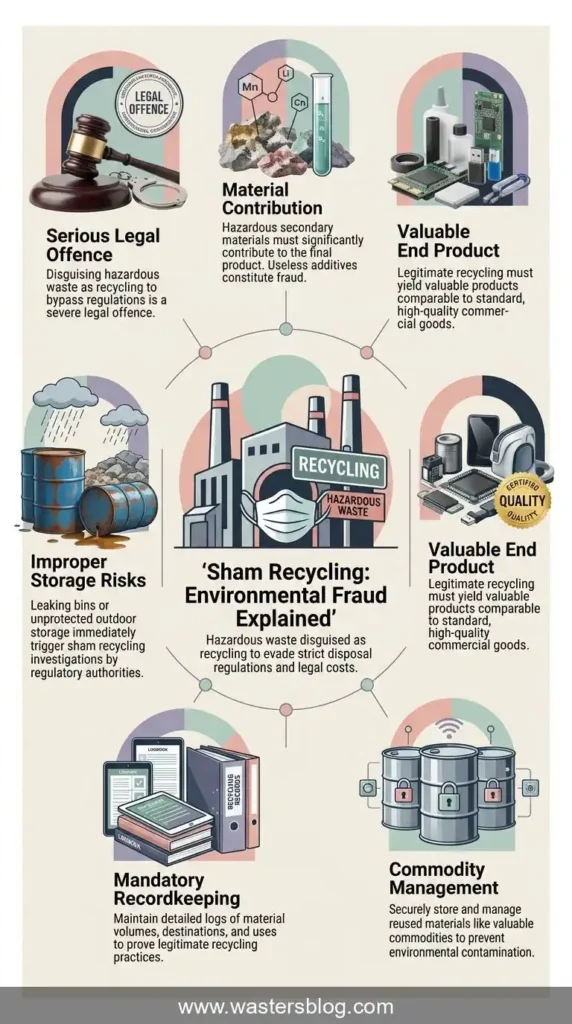
- Material contribution: Real recycling requires that the hazardous secondary material contributes significantly to the recycling process or product. Fake recycling involves materials that are ineffective or contribute nothing of value.
- Product value: Real recycling produces a product or intermediate that is comparable to a commercial product. Fake recycling does not produce such a comparable product.
- Commodity management: Real recyclers store and handle materials as valuable commodities. Fake recyclers store materials in ways that suggest disposal — like leaking containers or unprotected outdoor storage.
- Documentation: Real recycling is supported by thorough records showing volumes, destinations, and uses. Fake recycling operations typically lack this paper trail.
Understanding where your operations fall on this spectrum is not just a compliance exercise — it's the difference between a real environmental contribution and a federal violation. For further insights, you can explore this guide on recyclable packaging.
The Reasons Businesses Turn to Sham Recycling
Getting rid of hazardous waste under RCRA can be costly, heavily monitored, and logistically difficult. For some businesses, the financial allure of marking waste as a “recyclable material” to avoid these costs is substantial. Proper hazardous waste disposal necessitates licensed carriers, sanctioned treatment facilities, thorough manifests, and continuous compliance surveillance — all of which come with actual costs. For businesses looking to understand more about waste management options, exploring waste management companies can provide valuable insights.
On the other hand, sham recycling can seem like a more affordable, quicker option. Some businesses knowingly take advantage of this. Others accidentally stumble into it by not confirming that their recycling plans actually satisfy the EPA's four legitimacy factors.
Important note: The EPA has made it clear that if recycled materials are not stored or handled in a way that protects them from significant economic loss, it's probably sham recycling. Just as you would store a valuable raw material, so should you store a recycled material.
The Four Elements of Legitimate Recycling
The legitimacy standard of the EPA is not ambiguous — it is based on four definite, codified elements. All recycling of hazardous secondary materials must satisfy these elements to be eligible for any recycling exemption or exclusion under RCRA. Missing even one can subject a company to full hazardous waste liability.
1. The Necessity of Useful Contributions from Hazardous Secondary Materials
Our first factor is that hazardous secondary materials must provide a beneficial contribution to either the recycling process or the final product. This means that the material must do more than just take up space or act as a covert disposal method. It has to have a true, provable function — the same function that a new raw material would have in the same process.
2. The Recycling Process Must Yield Useful Products
Recycling that doesn't produce a product of commercial or industrial value is not recycling — it's disposal. The second factor states that the recycling process should result in a product or intermediate that has real market value or utility. This product should be something a buyer would be willing to buy, use, or apply in a real process. For more information on avoiding such practices, you can read about sham recycling.
That's why the heavy metal sludge-in-concrete example is such a blatant case of sham recycling. The sludge doesn't add anything to the concrete's structural or chemical properties – it just gets hidden in it. No real product benefit, no real recycling.
3. Recyclables Should Be Treated Like Gold
The way you handle and store recyclable hazardous materials speaks volumes to the EPA about how much you value them. The third legitimacy factor requires both the generator and the recycler to treat these materials as they would any precious commodity — this means they should be properly contained, shielded from the weather, and stored in conditions that prevent loss or contamination.
Materials that are supposed to be recycled but are kept in leaking drums, left outside without any form of secondary containment, or stored in conditions that would be considered unacceptable for a raw material are clear warning signs. The EPA will often cite storage conditions as proof of intent — and poor conditions almost always indicate an intent to dispose, not to recycle. For more information on proper waste management practices, check out this article on waste management companies.
4. Recycled Products Must Be Similar to Legitimate Products
The fourth and last legitimacy factor demands that the output of the recycling process should be similar to a legitimate commercial product or intermediate. If the recycled product doesn't look like something a company would typically purchase, sell, or use in a real industrial process, it probably doesn't meet this standard. The EPA also permits recyclers to evaluate, document, and certify legitimacy in situations where direct similarity is more challenging to establish — but that certification process comes with its own documentation burden.
Real-World Instances of Sham Recycling Practices
Sham recycling isn't just a hypothetical idea buried in legal jargon — it's a real-world issue that sometimes occurs in industrial operations, either intentionally or through carelessness. The EPA has identified several specific situations that it deems sham recycling, and comprehending these instances is the most effective way to identify when a recycling claim has crossed the line.
Concrete Adulterated with Heavy Metal Sludges
Even the EPA cites this as a classic case of sham recycling. It’s claimed that when heavy metal sludges — a byproduct of some industrial and manufacturing processes — are added to concrete, they are being “recycled” into a construction material. However, these sludges do nothing to enhance the concrete’s structural strength, chemical properties, or performance characteristics.
In this case, the concrete is merely serving as a grave for hazardous waste. There's no improvement to the product, no material contribution, and no similar commercial equivalent. This practice doesn't pass muster under any of the EPA's four legitimacy factors. It's a clear failure. Any company that tries to use this method to dodge the costs of hazardous waste disposal is assuming a huge legal and environmental risk.
Using More Materials Than Necessary For a Process
One significant sign of sham recycling is when a hazardous secondary material is used in quantities that far exceed what the process actually needs. Legitimate recycling uses materials at levels that match their functional role — just like a manufacturer would use a raw material. When the amounts used greatly exceed what is technically or economically reasonable, it indicates that the material is being discarded under the pretense of use, rather than being genuinely incorporated into a process.
The Environmental Protection Agency (EPA) monitors usage rates to identify discrepancies and potential misuse. If your process requires 10 units of a material, but you are using 100 units of a hazardous secondary material that supposedly does the same job, that discrepancy will immediately raise suspicions during an inspection or audit.
Incorrect Storage and Management of Recycled Materials
The EPA often uses storage conditions as a quick and easy way to determine if a company is legitimately recycling. If a company truly sees a hazardous secondary material as a valuable resource, they will store it properly. This means using the right containers, storing it in the right conditions, and having secondary containment and inventory controls.
When these materials are found in leaking storage areas, left exposed to the elements, or kept in conditions that no one would use for a valuable raw material, the EPA's interpretation is clear: the company doesn't actually consider the material valuable, which means it's being disposed of — not recycled. This isn't just a theoretical interpretation; it is specifically cited by the EPA as a basis for sham recycling determinations under 40 CFR 261.2(f).
Impact of Sham Recycling
Sham recycling has far-reaching effects that damage ecosystems, expose communities to harmful contamination, and even force companies to close due to severe penalties. It’s not a harmless way to bypass regulations.
The Environmental Impact of Incorrect Waste Disposal
When materials that are harmful to the environment are disposed of incorrectly under the guise of recycling, they don’t just vanish. Instead, they seep into the soil, pollute our groundwater, and release poisonous compounds into the air. Heavy metals, solvents, and other dangerous byproducts that end up in unregulated environments can persist for many years. The communities closest to these sites are the ones who suffer the most, often without even realizing the source of the contamination until significant damage has already been done. This is exactly why RCRA was created with such strict regulations – the consequences of making mistakes are long-lasting and, in many cases, irreversible.
RCRA's Legal and Financial Repercussions
If a company is found to be involved in sham recycling under the Resource Conservation and Recovery Act (RCRA), they lose any recycling exemptions or exclusions they may have been claiming. This means they are retroactively subject to all hazardous waste regulations. Every shipment, storage period, and disposal event that occurred under the false recycling claim is now a potential violation, each carrying its own penalty exposure. For more information on recycling practices, check out our plastic recycling guide.
RCRA enforcement can be both civil and criminal. Civil penalties under RCRA can reach up to $70,117 per day per violation, adjusted for inflation. Criminal penalties for knowing violations can include fines and imprisonment. The financial exposure from even a short period of non-compliance can be staggering. Learn more about the impact of waste management compliance to ensure adherence to regulations.
| Type of Violation | Penalty Range | Additional Consequences |
|---|---|---|
| Violation of Civil RCRA | Up to $70,117 per day per violation | Costs for remediation, shutdown of the facility |
| Knowing Violation (Criminal) | Fines + up to 5 years in prison | Executives may be personally liable |
| Determination of Sham Recycling | Full retroactive liability for hazardous waste | Loss of all exemptions for recycling |
What makes the enforcement of RCRA particularly aggressive is that the EPA doesn't need to prove intent to assess civil penalties. A good-faith mistake that results in a determination of sham recycling is still a violation — the regulatory consequences apply regardless of whether the company intended to break the law.
Aside from the direct penalties, businesses also have to deal with the costs of clean-up, third-party liability for pollution, damage to their reputation, and in severe instances, the shutdown of the entire facility. These additional costs frequently exceed the original penalty amounts.
UK Waste Regulations Legal and Financial Penalties
The Environment Agency in the United Kingdom governs sham recycling and prosecutes it under the Environmental Permitting (England and Wales) Regulations 2016, and the Waste (England and Wales) Regulations 2011. If companies are found operating without the necessary environmental permit, or incorrectly identifying waste disposal as recycling, they can face unlimited fines in Crown Court. Additionally, the individuals involved could face possible jail time.
The UK Environment Agency has been ramping up its efforts to crack down on waste crime, including sham recycling, which reportedly costs the UK economy hundreds of millions of pounds each year, according to the Environment Agency. Companies that are found to be exporting waste under the guise of it being recyclable – especially to countries with less stringent environmental regulations – could face further punishment under the Transfrontier Shipment of Waste Regulations 2007. This is an area that has seen a rise in international regulatory cooperation.
The Role of Recordkeeping in Safeguarding Against False Sham Recycling Accusations
Keeping detailed records is the most effective way to protect yourself from false sham recycling accusations. According to 40 CFR 261.2(f), if a generator is unable to provide records that show how, where, and how much hazardous secondary materials are being reused, the EPA has the express authority to assume sham recycling. This is not a grey area — the regulation puts the onus of proof on the generator and recycler, not the EPA to prove any misconduct.
For recycling hazardous secondary material to be effective, you need to keep detailed records. This includes tracking the material from when it is generated to when it is reused, documenting how much is used versus how much is generated, showing that the materials are being stored and handled like they are valuable commodities, showing product specifications that indicate how the recycled material contributes to the final product, and getting certifications of legitimacy when you can't establish that the product is directly comparable. The more complete and consistent your documentation is, the harder it will be for an inspection or audit to determine that your recycling is a sham.
Keeping Your Recycling Practices Above Board
It’s not difficult to adhere to the EPA’s legitimacy standard, but it does require a regular review of how you manage, document and verify your recycling activities. The companies that fall foul of sham recycling are typically those that have set up a recycling arrangement without checking whether it actually complies with all four legitimacy factors. It’s much less expensive to carry out a proactive compliance review than it is to face a retroactive enforcement action. For more insights, you can explore how waste management companies ensure compliance with regulations.
Adhere to EPA Guidelines for Hazardous Waste Recycling
Begin by applying the EPA's four legitimacy factors to each recycling process your company employs. Question whether the hazardous secondary material truly adds value to the process or product. Ensure that the recycling output has legitimate commercial value. Verify that both your company and your recycler are treating the material as a valuable commodity. And confirm that the final product is comparable to a legitimate commercial product or intermediate. If you can't definitively answer yes to all four questions with supporting documentation, the process needs to be reevaluated or replaced with a compliant hazardous waste disposal method.
Handle Recycled Items as New Items
By sticking to this one rule, you can avoid many of the typical signs of fake recycling. Keep hazardous recycled items in the correct, undamaged containers with the right labels. Use secondary containment. Keep track of your inventory. Keep items safe from weather and pollution. These aren't just good habits — they're the actual things the EPA checks for when deciding if an item is being handled as a valuable product or just being stored until it can be thrown away.
When the conditions in which you store your hazardous secondary materials don't match the conditions in which you'd store the virgin raw material it's replacing, you've found the exact thing an EPA inspector will hone in on. Closing that gap is not only a requirement for compliance, but a clear sign of legitimate recycling intent.
Sham Recycling: A Grave Offence, Not a Matter of Semantics
Sham recycling is a serious matter that straddles the line between environmental damage and regulatory fraud, and the EPA views it in the same light. It is not a simple matter of paperwork or a minor compliance issue. When hazardous waste is disguised as recycled material, the impact is felt in communities, ecosystems, and company financial statements, and it can be challenging and sometimes impossible to reverse. The four legitimacy factors exist for a reason: to ensure that only genuine recycling activities benefit from regulatory exemptions. Any company that handles hazardous secondary materials has both a legal and an environmental obligation to ensure that every recycling claim it makes can withstand full regulatory scrutiny.
Commonly Asked Questions
Here, you'll find responses to the most frequently asked questions about false recycling, its legal definition, how it's identified, and what happens to companies that overstep the mark.
How Does RCRA Legally Define Sham Recycling?
Sham recycling is a deceptive practice where hazardous waste disposal is falsely labeled as recycling to evade regulatory requirements. According to RCRA, as specified in 40 CFR section 261.2(b)(4) and (g), hazardous secondary materials that are sham recycled are considered both solid waste and hazardous waste. As a result, they are fully subject to all relevant RCRA regulations. The EPA established this definition through a series of regulatory rules. The most recent version was finalized in 2018. This definition applies no matter what label a company puts on the activity.
What Are the Consequences of Sham Recycling?
Sham recycling carries heavy penalties that can be enforced on several levels at the same time. A company that is discovered to be sham recycling loses any recycling exemptions or exclusions it was using and is held retroactively accountable for complete hazardous waste compliance throughout the entire time the sham scheme was in operation. Additionally, civil and criminal penalties are directly applicable.
- Civil penalties: Up to $70,117 per day per violation under RCRA, adjusted for inflation
- Criminal penalties: Fines and up to 5 years imprisonment for knowing violations
- Retroactive liability: Every shipment, storage period, and disposal event under the false recycling claim becomes a potential individual violation
- Remediation costs: Companies may be required to fund full environmental cleanup of any contamination resulting from the improper disposal
- Operational consequences: Facility shutdowns, loss of operating permits, and debarment from federal contracting are all possible outcomes
It is worth emphasizing that civil penalties under RCRA do not require proof of intent. A company that made a good-faith error in its recycling arrangements still faces full civil penalty exposure once a sham recycling determination is made.
In the UK, companies face severe penalties under the Environmental Permitting (England and Wales) Regulations 2016, including unlimited fines at the Crown Court level and personal imprisonment for individuals involved in the violation. This means that the stakes are just as high in the UK as they are in the US, with businesses needing to understand the differences between UK skips and US dumpsters.
What Techniques Does the EPA Use to Spot Sham Recycling?
The EPA employs a mix of onsite inspections, paperwork checks, and material use assessments to uncover sham recycling. Inspectors scrutinize how hazardous secondary materials are stored and handled — leaky containers, unprotected outdoor storage, and inadequate inventory management are immediate warning signs. They also examine records to ensure that usage volumes align with the stated recycling purpose and that the recycling product has actual market value. Under 40 CFR 261.2(f), if a generator fails to provide documentation demonstrating how, where, and in what quantities materials are being reused, the EPA has the authority to assume sham recycling without requiring additional proof of intent.
Reclamation vs. Recycling: What’s the Difference?
The Resource Conservation and Recovery Act (RCRA) defines recycling and reclamation as two different activities, each with its own set of rules and regulations. Legitimate recycling involves using or reusing a hazardous secondary material in a process without having to process it further to restore its useful properties. Reclamation, on the other hand, involves processing a hazardous secondary material to recover a usable product or to regenerate it into a useful product. Both activities can qualify for regulatory relief under RCRA, but each has its own set of rules and exemptions, and the legitimacy factors apply to both. Misclassifying a reclamation activity as direct reuse — or vice versa — can inadvertently create compliance gaps.
Can a Company Be Accused of Sham Recycling Even If They Had Good Intentions?
Absolutely — and it’s crucial for compliance teams to understand this. The EPA’s civil penalty authority under RCRA doesn’t need to prove that the company had bad intentions. If a recycling arrangement doesn’t meet all four legitimacy factors, it’s considered sham recycling, no matter what the company originally intended. A company that entered into a recycling arrangement with the best intentions but failed to verify legitimacy, keep proper documentation, or ensure the right storage conditions can still face the full range of civil penalties and retroactive hazardous waste liability. For companies involved in waste management, understanding the waste management industry is essential to avoid such pitfalls.
That's why it's so risky to wait for a problem to arise before dealing with it in the hazardous waste industry. The cost of an internal compliance audit to verify legitimacy is a fraction of what a single RCRA enforcement action can generate in penalties, remediation costs, and legal fees.
The message here is clear: intentions do not equal compliance. Only recycling activity that is documented, verifiable, and meets all four of the EPA's legitimacy factors counts as actual recycling under RCRA. Everything else, no matter what it's labeled as, is hazardous waste disposal and will be treated as such by regulators. If you're not sure if your current recycling practices meet this standard, the most cost-effective choice you can make is to get a compliance review now. Hazardous Waste Experts specialize in this type of compliance guidance, helping organizations identify and resolve hazardous waste management issues before they become enforcement actions.