
We have a free home vermicomposting project for you, but first, let us explain. Vermicomposting is a sustainable, odour-free process of breaking down organic household waste—like food scraps and paper—using special earthworm breeds (typically “red wigglers”) to create nutrient-rich compost known as vermicast.
After receiving several queries recently when we were asked, “What is Vermicomposting?” we wrote this article in reply. And, “Why is it Becoming Increasingly Popular?” Is also answered here.

The humble earthworm has for millennia lived in our soils largely unseen, improving the quality of these materials to support the whole network of ecosystems above. The sheer volume of soil on this planet which are processed every day by tiny earthworms is not just huge. It's unimaginably large!
Is it any wonder that more and more people are realising the potential benefits of farming these creatures? In this article, we define “What is Vermicomposting”, and then we explore the recent rise of vermicomposting.
What is Vermicomposting? – A Definition
Vermicomposting is the process of using selected species of earthworms to help compost biodegradable wastes, and stems from the established business of vermiculture (the breeding of earthworms, mainly for the fishing bait market).
Vermicomposting Compared with Normal (Aerobic) Composting
While vermicomposting and traditional composting both involve the aerobic decomposition of biodegradable matter by microorganisms, there are important differences in the way the two processes are carried out.
- The most notable is that the temperature of composting piles can exceed 70°C, but vermicomposting is carried out at relatively low temperatures (under 25°C). When growing worms, it is vitally important to keep the temperature within the soil/compost below 35°C, otherwise the earthworms will migrate to a cooler location, or die off. It follows that true aerobic composting of green/ organic matter cannot support worm life; vermicomposting is not simply composting with added worms! The conditions for vermicomposting differ from composting.
- The worms used in vermiculture are all litter-dwelling species that live in the rotting litter or biodegradable matter on the surface of soils, and produce worm casts. In traditional composting, compost piles are mixed and aerated mechanically.This would not suit the worms, which are active in vermicomposting/ vermiculture. In vermicomposting, it is the earthworms that fragment, mix and help aerate the waste, and most of this activity includes the ingestion of the compost/soil materials, and the deposition of worm casts. In the passage through the worm, the soil/compost material is mixed, healthy bacteria grow, and enzymes are produced as part of the worm's digestive function.
The worm casts are, as a result, uniquely blessed with bacteria and enzymes, the action of which makes them ideally suited as a source of plant nutrients.
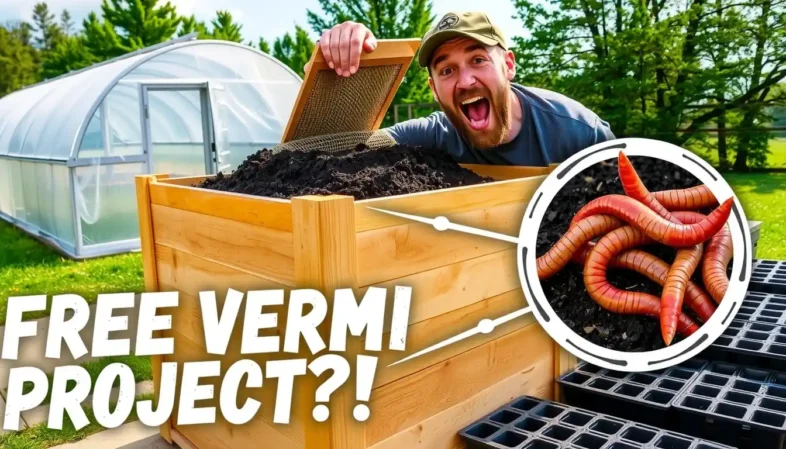
Try Out Our Home Vermicomposting Project!
Watch our video below, then scroll down, and download the accompanying free Home Vermicomposting pdf to use for reference while your worms grow and your compost matures!

Click below to download our unique Home Vermicomposting PDF:

The Best Worms for Vermicomposting
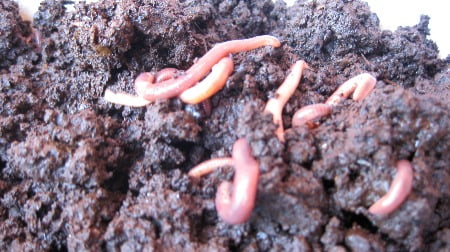
The three species most commonly used in vermicomposting in the UK are Dendrobaena veneta (blue nosed worm), Eisenia fetida (tiger or brandling worm), and Eisenia andrei (red tiger worm).
Eudrilus eugeniae is a tropical species grown in warmer countries.
What is Vermicomposting? – The Best Vermicomposting Method
The most widely used vermicomposting system, worldwide, is the ‘bed' method, which involves applying thin layers of waste material to the surface of beds containing high densities of earthworms.
New layers of waste are applied to beds on a regular basis, and the earthworms move upwards into the fresh waste to feed and to process the material. Earthworm numbers increase as more waste is applied until a limiting density is reached. The earthworms are then harvested, or the beds are divided.
Why is Vermicomposting so Popular?
In the developed world, vermicomposting provides a method of waste processing which is normally very acceptable to the local community, and produces a premium and very saleable/ in-demand compost product.
Vermicomposted waste is also waste which will not need to be sent to landfill, and therefore has the support of national governments and local waste planners. This is particularly important in Europe, where the EU Directive rules call for a high degree of waste recycling and a reduction in landfilling. The targets set must be achieved throughout the community nations. Failure to meet the waste-diversion and recycling target in an area will likely result in fines being levied on some underperforming local authorities (municipalities), in some countries in the next few years.
Where local authorities in the developed world fail to comply, it is likely in many cases to be due to the difficulty in developing and commissioning enough waste diversion capability in all areas. Not only must new facilities for composting be built and commissioned, but this must be done fast enough to comply with the EU deadlines imposed.
One reason that Vermicomposting is popular as it provides local authorities with an excellent method for treating waste so that it is diverted away from landfill, and can be implemented relatively quickly.
In the developing world, composting provides a means by which smallholders and farmers may accept suitably segregated wastes and earn an additional income from the products of vermiculture, without requiring unaffordable investment in order to get started.
Vermicomposting also provides a real benefit to the local economy from both the high productivity of land fertilised with vermicompost, and the reduced watering demand once the soils have become of a much higher quality, arising from the land application of this type of compost.
Vermicomposting as an Introduction to Running Your Own Business
Also, developing (Third World) worm farmers gain much practical experience from their businesses.
Achieving the degree of self-sufficiency, which is a necessary part of running a small vermicomposting business, is a great training for later entrepreneurial success.
It seemingly produces a breed of self-respecting and capable businesspeople, ready to move into other areas of the economy with their newly won skills and earnings. Such individuals and the families they support are then very much capable of further developing the economies of their countries and improving the quality of life for all.
 What is Vermicomposting – A Conclusion
We hope this article has answered your questions about “What is Vermicomposting”.
Frequently Asked Questions: Vermicomposting
What is vermicomposting?
Vermicomposting is a sustainable, odour-free method of breaking down organic waste—like food scraps and paper—using specific breeds of earthworms. The result is a nutrient-dense, premium compost known as vermicast.
How is vermicomposting different from regular composting?
While both involve organic decomposition, the mechanics are quite different:
- Temperature: Traditional aerobic composting can exceed 70°C. Vermicomposting must stay cool, typically under 25°C, to keep the worms alive.
- Aeration: Instead of being mechanically turned or mixed, the worms do the heavy lifting by fragmenting and aerating the waste as they move through it.
- Biology: Vermicompost is uniquely rich in bacteria and enzymes produced during the worm's digestive process.
Which worms are the best for a home setup?
In the UK, the most common and effective species are:
- Dendrobaena veneta (Blue-nosed worm)
- Eisenia fetida (Tiger or brandling worm)
- Eisenia andrei (Red tiger worm)
In tropical climates, the species Eudrilus eugeniae is more common.
What is the “bed method” of vermicomposting?
The bed method is the most popular global system. It involves applying thin layers of organic waste to the surface of a bed containing a high density of worms. As the worms process the material, they move upward into the fresh waste, allowing for a continuous cycle of decomposition and worm harvesting.
Why is vermicomposting becoming so popular?
It is gaining traction for several environmental and economic reasons:
- Waste Diversion: It keeps organic waste out of landfills, where it would otherwise produce harmful methane.
- Regulatory Compliance: It helps local authorities meet recycling targets and avoid landfill fines.
- Better Soil: Vermicompost improves soil quality and reduces the amount of water needed for irrigation.
- Low Barrier to Entry: It requires very little investment, making it an ideal “green” business for entrepreneurs in both developed and developing nations.
Is it true that vermicomposting is odour-free?
Yes! Because the process is aerobic and the worms process the waste efficiently, a well-maintained vermicomposting system is a clean, odour-free way to manage household food scraps.
[This is an updated version of the original article, which was posted on Jun 7, 2006. Updated April 2018 and March 2026. FAQs added April 2026.]

This is really a great article! I’m doing research on available information about recycling for school children, and I’m glad I found this. I hope to share this with others in the future. Thanks for making it!?
really good thanks!
This is really a terrific not so brief write-up! I’m investigating on easily absorbed details all about vermicomposting for teaching children, along with the video especially (video I mean really) I am glad on my good luck when I located this.
Great you have fantastic suggestions?
The page here wonderfully exhibits the concept of vermicomposting. You should explain how the garden materials can be segregated and recycled into green vegetation and woody materials. It’s amazing how these can be recycled into wonderfully productive soil, rather than leaving it to be unsightly in a corner?