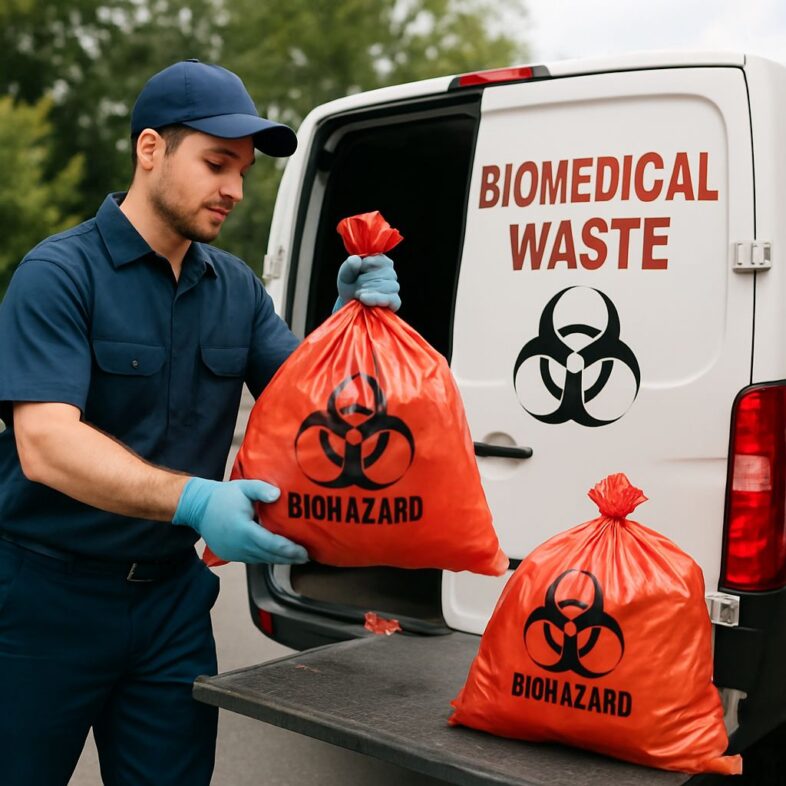
On-Site vs. Off-Site Biomedical Waste Treatment: For most healthcare facilities, off-site biomedical waste treatment is the most practical and cost-effective option. This is because on-site treatment requires expensive equipment, dedicated space, trained personnel, and a significantly higher regulatory burden.
There are three main disposal options: on-site treatment, off-site treatment via a licensed haulier, and mail-back solutions. Each of these options is suited to very different facility sizes and waste volumes.
On-site treatment methods include incineration, autoclaving, and microwave technology. However, the infrastructure costs and compliance obligations make them impractical for most small to mid-sized facilities.
With off-site treatment, liability and compliance responsibility are transferred to a licensed medical waste disposal company. This significantly reduces the operational burden on your staff.
Keep reading to find out the one specific scenario where on-site treatment actually makes financial sense — and whether your facility qualifies.
Choosing the wrong biomedical waste treatment method can cost your facility thousands of dollars, expose your staff to serious health risks, and put you in violation of state and federal regulations.
Many healthcare facilities prefer to use off-site treatment, and there's plenty of data to support that choice. Eco Medical Waste, a licensed medical waste disposal provider, helps facilities all over California make this decision daily. On-site treatment may seem like a good idea, but the operational requirements make it impractical for most clinics, hospitals, and specialty practices.
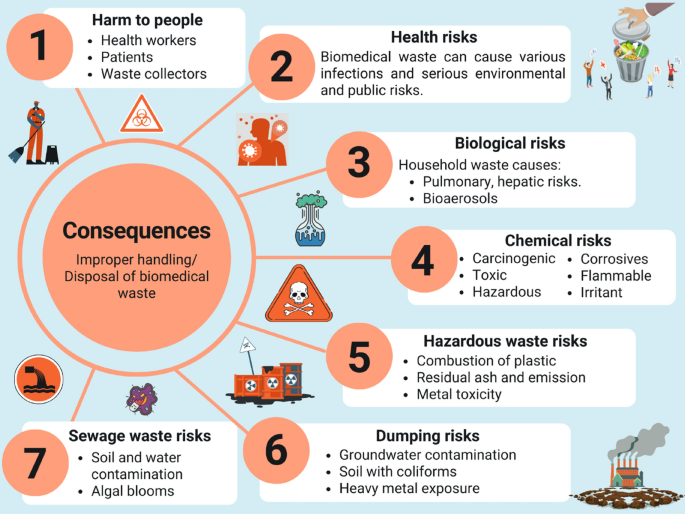
On-Site vs. Off-Site Biomedical Waste Treatment risks: “Harnessing the foundation of biomedical waste management for fostering public health: strategies and policies for a clean and safer environment | Discover Applied Sciences | Springer Nature Link” from link.springer.com and used with no modifications.
Main Points: Is On-Site or Off-Site Biomedical Waste Treatment Better for Your Facility?
The main thing every facility manager needs to consider is whether they have the physical space, budget, trained staff, and regulatory infrastructure to treat waste on-site. For most facilities, the answer is no — and off-site treatment through a licensed hauler is the more practical, safer, and more cost-effective option.
Why Most Facilities Should Avoid On-Site Waste Treatment
While on-site treatment may seem like a way to maintain control, it actually means taking on more responsibility. You would be responsible for maintaining equipment, training staff, acquiring permits, and verifying treatment. Each of these responsibilities comes with a high cost and risk of non-compliance. A single malfunction in equipment or gap in documentation could result in regulatory fines that are much higher than the cost of off-site disposal services.
Most facilities are disqualified simply by the operational footprint. Autoclaves that can handle significant waste volumes need dedicated utility connections, regular biological indicator testing, and operator certification. Incinerators have air quality permit requirements at the state level. These aren't minor administrative hurdles; they're full-blown operational programs that require ongoing management.
Three Methods of Biomedical Waste Disposal
Before we dive into the comparison between on-site and off-site treatment, it's helpful to know the three disposal options that healthcare facilities can choose from:
- On-Site Treatment: At the point of generation, biomedical waste is treated and destroyed at the facility using approved technologies like autoclaving, incineration, or microwave treatment.
- Off-Site Treatment: A licensed medical waste haulier collects your waste on a scheduled basis and transports it to a certified treatment facility for processing and final disposal.
- Mail-Back Solutions: The facility packages its waste in a pre-approved mail-back kit and ships it directly to a licensed treatment facility via a certified carrier.
A brief note on mail-back solutions is warranted here before we delve further into on-site vs. off-site biomedical waste treatment here. They work well for very low-volume generators — think a single-provider private practice generating a small container of sharps waste per month. But the moment your waste volume scales up, mail-back becomes both cost-prohibitive and logistically cumbersome. It is not a realistic option for mid-to-large facilities.
Off-site treatment is a practical middle-of-the-road solution. It can handle any volume, takes the task of treatment away from your staff, and puts the responsibility of compliance documentation in the hands of a licensed professional. For most healthcare facilities, this is the only solution they need.
1. On-Site Treatment
On-site treatment refers to a facility that manages the entire waste management process itself, from the point of creation to the point of destruction and documentation. The most frequently used on-site technologies are:
- Autoclaving (Steam Sterilisation): Uses high-pressure steam at temperatures typically exceeding 121°C (250°F) to deactivate pathogens. Requires biological indicator testing to verify efficacy.
- Incineration: High-temperature combustion that destroys all biological and chemical components of waste. Heavily regulated due to emissions and requires state-level air quality permits.
- Microwave Treatment: Uses microwave energy combined with steam to deactivate infectious agents. Less common than autoclaving but gaining traction in certain facility types.
- Chemical Treatment: Applies approved disinfectants to neutralise liquid biohazardous waste streams, typically used for specific waste categories rather than general biomedical waste.
Each of these methods requires not just the physical equipment, but an entire supporting infrastructure — trained operators, maintenance contracts, spare parts inventory, compliance recordkeeping systems, and in many cases, dedicated physical space that meets building code and environmental requirements.
Just buying and setting up a medical-grade autoclave can cost between $30,000 and more than $100,000, depending on how much it can hold. And that doesn't even include the cost of setting it up, upgrading your utilities, or the cost of running it. Incineration equipment costs a lot more and you have to go through a regulatory approval process that can take months before you can legally start using it.
2. Off-Site Treatment
Off-site treatment is the most common method of biomedical waste disposal for one simple reason: it's effective. A certified medical waste disposal company arranges regular collections from your premises, transports the waste in vehicles that comply with DOT regulations, and treats it at a licensed facility. The only responsibilities of your staff are to segregate the waste correctly, contain it in approved containers, and store it in a compliant holding area until the day of collection. This process ensures that waste is managed safely, similar to how energy from waste and incineration is handled to minimise environmental impact.
3. Mailing Back
Mailing back is a disposal method that is both FDA-approved and recognised by the EPA. It is primarily used by patients receiving healthcare at home, independent practitioners, and those who generate very low volumes of waste. The process involves the waste generator receiving a pre-approved container, filling it with the appropriate waste, sealing it according to the provided instructions, and shipping it through a certified carrier such as UPS or FedEx to a facility licensed to treat the waste.
The main constraint when considering on-site vs. off-site biomedical waste treatment is the amount of waste. The majority of mail-back kits are created for sharps and small amounts of biohazardous waste.
For facilities that consistently produce regulated medical waste — such as pathological waste, chemotherapy waste, or large amounts of contaminated materials — mail-back is neither feasible nor cost-effective.
Understanding On-Site Biomedical Waste Treatment
On-site treatment means that the facility has a small treatment operation within their existing structure. It starts at the point of waste generation. The staff separates waste into appropriate categories. Infectious, sharps, pathological, pharmaceutical, and chemotherapy waste each follow different handling protocols. Waste is then transported internally to the treatment unit. It is processed using the approved method. The resulting treated waste (now classified as regulated solid waste in most states) must still be disposed of through a licensed solid waste hauler.
Popular On-Site Treatment Methods
Autoclaving is the most common on-site treatment technique used for infectious and sharps waste. A correctly validated autoclave cycle operates at a minimum of 121°C at 15 psi for a minimum of 30 minutes, although many state regulations and facility protocols require longer exposure times for larger or denser waste loads. Facilities that use autoclaves are required to run biological indicator tests, usually with Geobacillus stearothermophilus spore strips, on a regular basis to ensure the sterilisation process is working properly.
Incineration is the only treatment method that completely destroys all waste components, including sharps, pathological waste, and pharmaceutical waste. However, the permitting requirements make it effectively inaccessible for most US healthcare facilities. Facilities operating incinerators must comply with the EPA's Maximum Achievable Control Technology (MACT) standards under 40 CFR Part 63, Subpart WWWWW, which governs hospital, medical, and infectious waste incinerators (HMIWIs). These standards regulate emissions of dioxins, furans, mercury, particulate matter, and other pollutants — requiring continuous emissions monitoring in many cases.
Needs for Room, Tools, and Staff
The spatial needs for on-site treatment are substantial and frequently underestimated. An autoclave unit that can manage the waste volumes produced by even a moderately sized outpatient clinic usually requires a dedicated utility room with improved ventilation, a floor drain that connects to a licensed sanitary sewer system, a steam supply or built-in steam generator, and reinforced flooring that can support the unit's weight when fully loaded.
The issue of personnel requirements further complicates matters. Staff members who operate treatment equipment must undergo documented training on the specific unit, emergency procedures, and waste classification protocols. In many states, healthcare autoclave operators are required to keep records of every treatment cycle, which includes temperature logs, pressure readings, exposure times, and biological indicator results. This is not a task that can be assigned lightly. It requires dedicated, trained personnel with accountability built into your compliance program.
Regulatory Compliance Obligations for On-Site Treatment
Running an on-site biomedical waste treatment system means your facility is in the direct line of fire of multiple regulatory agencies at the same time. The EPA governs incineration emissions and certain hazardous waste streams under RCRA at the federal level. OSHA's Bloodborne Pathogens Standard (29 CFR 1910.1030) governs worker protection during waste handling. The Department of Transportation regulates any movement of untreated waste — even within your own facility's campus in some jurisdictions. In addition to federal oversight, every state has its own medical waste management regulations, and many are significantly stricter than federal minimums.
Just the paperwork is a significant burden. Facilities that use on-site treatment must keep records of treatment logs, equipment calibration, biological indicator tests, staff training certifications, and waste manifests. These records can be inspected at any time. If there is a compliance issue in any of these areas, the facility could be fined or shut down. With off-site treatment, most of this paperwork is handled by your licensed haulier. They are legally required to keep chain-of-custody records and provide you with certificates of destruction.
The fact is that when considering on-site vs. off-site biomedical waste treatment, what seems at first to be a straightforward decision becomes more complicated the more you look into the pros and cons!
How Off-Site Biomedical Waste Treatment Operates
Off-site treatment is designed to be simple. Your facility's obligation stops at correct segregation, containment, and short-term storage. A certified medical waste haulier comes to your facility on your scheduled service day, picks up your approved containers, and takes everything to a licensed treatment facility using vehicles and packaging that comply with DOT regulations. After that, the haulier is legally responsible for the treatment, documentation, and final disposal.
You can tailor the frequency of service to your waste generation rate and your state's storage time restrictions. In most states, the on-site storage of untreated biomedical waste is limited to 30 days at room temperature. However, some jurisdictions allow certain waste categories to be stored for up to 90 days under refrigerated conditions. Your haulier will assist you in setting up a pickup schedule that keeps you within these limits without overpaying for unnecessary service frequency.
The Journey of Your Waste Post-Collection
Once a licensed haulier collects your biomedical waste from your facility, it is taken to a facility that has been approved for treatment and disposal. Here, the waste is treated using industrial-scale treatment technology. The most common method of treatment at these facilities is large autoclave systems, which can process thousands of pounds of waste per cycle. Once treated, the sterilised material is classified as regulated solid waste and is sent to a licensed landfill or waste-to-energy facility for final disposal. Your haulier will maintain manifest documentation throughout this entire process, which tracks your waste from the point of collection to final disposal. This documentation can be used to prove regulatory compliance during inspections.
Off-Site Facilities Treatment Methods
Off-site treatment facilities use the same basic technologies as on-site systems, but they do so on a much larger scale with infrastructure designed for that purpose and teams dedicated to compliance. The most common methods include autoclaving with a large capacity, incineration in a rotary kiln for pathological and chemotherapy waste, and in some facilities, advanced technologies like electrothermal deactivation systems.
It's important to remember that not all types of waste can be treated the same. This is a key factor to consider when choosing an off-site provider — you need to ensure they are licensed to manage all types of waste management that your facility produces.
Biomedical Waste Treatment Method by Waste Type:
Waste Category Accepted Treatment Methods Notes Infectious / Biohazardous Waste Autoclaving, Incineration, Microwave Most common waste stream; autoclave preferred Sharps Waste Autoclaving, Incineration Must be contained in puncture-resistant containers Pathological Waste Incineration Autoclaving generally not acceptable per most state regs Pharmaceutical Waste Incineration, High-Temperature Incineration DEA-controlled substances require specific protocols Chemotherapy Waste High-Temperature Incineration only RCRA hazardous waste rules may apply depending on agent Liquid Biohazardous Waste Chemical Treatment, Autoclaving Drain disposal may be permitted after treatment in some states/nations
On-Site vs. Off-Site: A Direct Comparison
When you place both options side by side across the factors that actually matter to a healthcare facility — cost, compliance burden, staff safety, operational convenience, and scalability — the comparison is rarely close. Off-site treatment wins on nearly every practical metric for facilities generating anything short of very high waste volumes.
But don't just assume that you will go off-site and cease considering on-site vs. off-Site biomedical waste treatment until you have spoken to the main service providers in your area and obtained a quotation.
Comparing the Costs
There are three different cost layers for on-site treatment that facilities often undervalue at the beginning. The first is capital expenditure, which is the cost of acquiring, installing, and validating the treatment equipment. The second is the continuous operational cost, which includes utilities, maintenance contracts, consumables like biological indicator strips, and replacement parts.
The third, and most often ignored, is the labour cost of trained personnel who are dedicated to operating and documenting the treatment process. Off-site treatment, on the other hand, combines all of these variables into a predictable per-pickup service fee, without any capital outlay and no hidden operational costs. For facilities that do not generate extremely high waste volumes on a daily basis, off-site treatment is almost always the more economical choice when the total cost of ownership is properly calculated.
On-Site vs. Off-Site Biomedical Waste Treatment – Regulatory Compliance
When you choose on-site treatment, your facility is responsible for adhering to the rules and regulations of multiple agencies, including the EPA, OSHA, DOT, and your state environmental agency. Each of these agencies can independently conduct an inspection. If you opt for off-site treatment, the primary responsibility for compliance falls on your licensed haulier. Your facility is only responsible for correctly classifying waste, using compliant containers, accurately labelling, and adhering to storage time limits. This is a significantly smaller compliance burden that most facilities can handle with existing staff.
Easy to Use and Impact on Operations
One of the most overlooked benefits of off-site treatment is how easy it is to use. Your medical team can focus solely on patient care and proper waste separation at the source. The carrier takes care of everything downstream. There are no treatment cycle failures to troubleshoot during a busy clinical day, no equipment downtime scenarios that leave you holding untreated waste with nowhere to put it, and no staff overtime triggered by treatment equipment maintenance issues.
Potential Hazards to Workers and the Building
Implementing on-site treatment can expose non-medical staff who manage treatment machinery to immediate risks of pathogen exposure. An autoclave operator who deals with incorrectly packaged waste or who has to fix a door seal that fails in the middle of a cycle is genuinely at risk of exposure. This kind of risk wouldn't be present in an off-site treatment scenario. Incinerators also carry more risks, including those related to the byproducts of combustion, handling ash, and equipment catching fire.
Off-site treatment does not eliminate all risks for your staff – there are still risks of exposure to bloodborne pathogens from proper waste handling and container management that must be addressed through your OSHA compliance program. However, the overall safety risk is significantly lower when your facility is not operating treatment equipment on-site. Licensed hauliers have their own OSHA compliance programs, workers' compensation coverage, and liability insurance – all of which your facility is not responsible for managing.
Adaptability to Changes in Waste Volume
Off-site treatment can easily adapt to your facility's needs. If you double your waste volume by adding a new service line or increasing patient capacity, all you need to do is adjust your pickup frequency or container count with a simple phone call. There's no need to worry about upgrading equipment, applying for new permits, or training additional staff due to the volume change. Your service cost will adjust accordingly, and your compliance posture will remain unchanged.
On-site treatment doesn't scale well. If a facility outgrows its autoclave capacity, it is left with a choice to make regarding capital equipment — buy a larger unit, add a second unit, or find a workaround that likely leads to compliance risk. None of these options are inexpensive or quick. Getting regulatory approval for new or upgraded treatment equipment can take months, and during that time, you have a growing waste volume problem with a fixed treatment capacity limit. For any facility with realistic growth projections, this scalability gap is a major strategic problem.
On-Site Treatment: When it's the Best Option
There's one situation in which on-site treatment is the most logical choice, both financially and operationally: when you're dealing with a high volume of waste, and you're located in a remote area where it would be too expensive to transport the waste off-site due to the distance. Large rural hospital systems, military medical facilities, or disaster response units that are operating in areas without any nearby licensed treatment infrastructure might find that it's worth it to invest in on-site treatment technology, especially when the alternative is having to pay high transportation costs for every single pickup over a multi-year contract period. For more insights on managing waste effectively, check out this article on waste management.
On-site treatment can be a good fit for facilities that produce certain high-risk waste categories that require specialised handling. These include select agent research laboratories or biosafety level 3 and 4 facilities.
In these cases, regulatory requirements or biosecurity protocols effectively require on-site destruction before waste leaves the facility perimeter. However, outside of these specific situations, on-site treatment is a solution in search of a problem that most healthcare facilities simply don't have.
Most Healthcare Facilities Find Off-Site Treatment to Be the Most Sensible Option
When you remove the technical jargon and look at the most important factors — overall cost, risk of non-compliance, staff safety, ease of operations, and scalability — off-site biomedical waste treatment via a licensed haulier is the obvious, sensible solution for the vast majority of healthcare facilities.
It turns a complex operational requirement into a predictable, manageable service contract that allows your team to concentrate on their primary responsibility: patient care.
Common Questions Abouty On-Site vs. Off-Site Biomedical Waste Treatment
What is the most used method of biomedical waste treatment?
Autoclaving, also known as steam sterilisation, is the most common biomedical waste treatment method used both on-site and off-site. It uses high-pressure steam at a minimum of 121°C (250°F) to deactivate pathogens in infectious and sharps waste. It is cost-effective at scale, well-understood by regulators, and accepted in all 50 states as an approved treatment method for infectious waste streams.
The second most popular method is incineration, which is the mandated treatment for certain waste types, such as pathological waste, chemotherapy waste, and some pharmaceutical waste streams. The only method that completely destroys all biological, chemical, and sharps components simultaneously is high-temperature incineration at rotary kiln facilities, which typically operate between 980°C and 1,200°C. Learn more about energy from waste and incineration processes.
Can small clinics legally treat biomedical waste on-site?
Most states allow small clinics to treat biomedical waste on-site, as long as they obtain the necessary permits, use approved treatment equipment, keep accurate treatment records, and show that they comply with all relevant state and federal regulations. There is no universal ban based solely on the size of the facility. For more information, you can explore the benefits of off-site treatment.
However, what is legally permissible and what is practically feasible can be two very different things. Most small clinics do not have the physical space, capital budget, or trained personnel necessary to operate an on-site treatment system in a compliant manner. The regulatory burden of maintaining an on-site treatment program – documentation, biological indicator testing, equipment calibration records, staff certifications – is the same regardless of facility size. For small clinics, off-site treatment through a licensed haulier is almost always the more practical and cost-effective solution.
How often should a facility schedule off-site biomedical waste pickups?
The frequency of pickups should be determined by the rate at which your facility generates waste and the maximum storage time limits set by your state. Most states set a 30-day storage limit for untreated biomedical waste stored at room temperature, although some states allow up to 90 days under refrigerated conditions for certain types of waste.
As a practical guideline, facilities should schedule pickups often enough that they never approach their storage limit — building in a buffer protects against unexpected volume increases and prevents compliance violations caused by storage time overruns. Your licensed haulier should assess your waste volume during onboarding and recommend a service frequency that keeps you comfortably within regulatory limits.
What kinds of biomedical waste can be treated off-site?
Off-site treatment facilities that are licensed can handle all types of biomedical waste categories. This includes waste that is infectious and biohazardous, sharps waste, pathological waste, pharmaceutical waste, chemotherapy waste, and liquid biohazardous waste.
The key is to make sure that your haulier and their designated treatment facility have the right permits to accept and process every category of waste that your facility generates. Not all off-site providers have permits for every type of waste. For example, chemotherapy waste and DEA-controlled pharmaceutical waste require specific permits and treatment protocols that not every haulier has.
Does off-site biomedical waste treatment provide documentation for regulatory compliance?
Yes — one of the biggest practical benefits of off-site treatment is documentation. Certified medical waste hauliers are legally obligated to keep chain-of-custody manifests that track your waste from pickup to final treatment and disposal. After each service cycle, your facility gets documentation that verifies your waste was transported and treated in compliance with applicable regulations. Many hauliers also offer destruction certificates for specific waste categories.
When it comes to regulatory inspections, this package of documentation can be used as proof of compliance.
State environmental agencies, OSHA inspectors, and accreditation bodies such as The Joint Commission may ask for waste disposal records during facility reviews. If you have complete documentation provided by the haulier on file, your risk of non-compliance is significantly reduced compared to if you were to keep internally generated treatment records for an on-site system.