

Extending your mattress lifespan — and learning how to increase the lifespan of your mattress — matters on two levels. First, every bit of saving from keeping a mattress for longer helps with the cost of living. Who doesn't want that? Second, the amount of waste society produces falls if every mattress lasts a little longer.

If millions of people keep their beds clean and comfortable for a little longer, it soon adds up to a significant benefit for the environment. And is it really necessary to change a mattress as soon as the manufacturers suggest? Read on to find out.
The article that follows is written by Ellie Porter, today's guest poster. After it, we add the average lifespan of a mattress, the commercial pressures behind “replace every eight years”, and — new for UK readers — how to recycle or get your old mattress collected.
How to Increase the Lifespan of Your Mattress
Did you know more than 50,000 mattresses end up in landfills every day? It's a shame, because 80% of a mattress is recyclable. One way to help your wallet and keep the planet healthy is to increase the useful life of your mattress so you replace your bed less often.
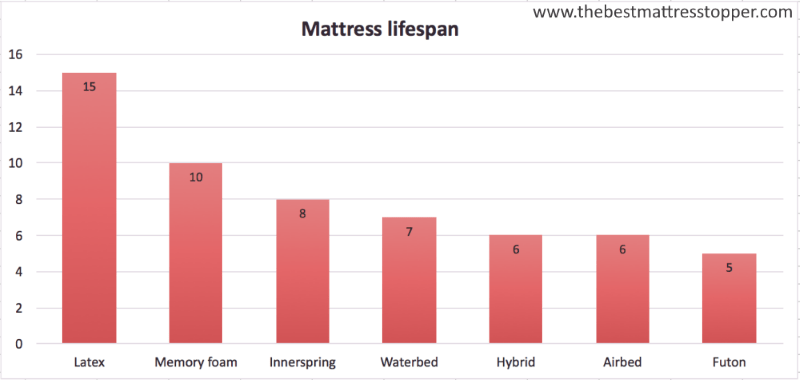
In order from worst to best, here's roughly how long each mattress type should last, although it varies widely by manufacturer and quality:
- Innerspring mattress – 5 to 6-year lifespan
- Hybrid mattress – 5 to 6-year lifespan
- Memory foam mattress – 6 to 7-year lifespan
- Latex mattress – 7 to 10-year lifespan
Prefer to watch rather than read? This short video sums up the key points on how to make your mattress last longer, from rotating it to using a protector:
Step 1 – Know your mattress
Every mattress is different. Materials and design dictate care and useful life. Is it flippable? If it is and you don't flip it, it can wear out faster. Most mattresses can be rotated head to foot every three months, as long as the design is consistent from top to bottom. Also, be sure to use a recommended bed base — that gives you the best chance of delaying the day when your mattress is good for nothing except mattress disposal.
Step 2 – Maintain properly
Proper mattress care is easy — but easy to neglect. Taking care of the bed can drastically improve its lifespan. First, fit a mattress protector and pad to guard against spills and basic wear. Second, wash your sheets weekly, so body oils and sweat don't leach into the bed. Third, air the bed out when you change the sheets.
Step 3 – Protect from pets
Many people sleep with their fur babies on the bed, but allowing pets on your sleep surface wears it out faster. Consider getting them a pet bed. If you can't sleep without your four-legged friend, put a thick towel or blanket on the bed and encourage them to use that instead.
Step 4 – Keep it clean
Every four to six weeks, strip the bed down completely and clean it. Vacuum off debris and use a lint roller for the more stubborn bits. For a natural clean, sprinkle with bicarbonate of soda and spritz with lemon juice, let it dry, then vacuum thoroughly. There's no need for harsh chemicals.
Step 5 – Don't abuse your bed
Excessive wear and tear means a shorter useful life. Try not to drop onto the bed — you'll tend to make the edge sag. Use your muscles to sit down by lowering yourself gently; that's better for your back, too. Of course, never jump on your bed (or let the kids). Try not to eat in it. Don't let the cat sharpen her claws on it. And if you spill, clean it up as soon as possible — which also reduces dust mites. Finally, mend any small rips or tears before they spread.
Don't buy the hype – replace only when required
The mattress industry promotes the slogan “replace every eight” to push the idea that you need a new bed on a set schedule. In reality, you only need to replace it when it has broken down — noticeable indentations, sunken spots, tears, or springs poking through. One way to prevent landfilling is to invest in a decent mattress and take good care of it.
If your mattress is near the end of its useful life, be sure to recycle it to a verified facility and don't toss it in the landfill. When you buy your next mattress, look for one with proven longevity and maintain it properly.
Guest Post Author: Ellie Porter, Managing Editor | SleepHelp.org
The Average Lifespan of a Mattress
Earlier we listed how long a mattress should last. Here we look at how long they actually stay in use. By “mattress lifespan” we mean the period in which a mattress retains its original support and comfort. Mattresses are expensive, though, and many people have higher priorities than a perfect bed.
Mattresses deteriorate over time, and the rate depends on materials, manufacturing quality, care, and how hard they are used. A poor-quality foam comfort layer can deteriorate noticeably within a year, while a quality latex core can last 20 years or more; innerspring cores typically last around 10 years.
The comfort layer is almost always the first to fail, which is why many mattresses are double-sided to extend their life. A separate topper can be used instead of, or alongside, a comfort layer — it reduces wear and is replaceable without changing the whole mattress. Most high-end mattresses have a lifespan of 7–10 years, and can last beyond that with good care.
The video below adds helpful context on when a mattress is genuinely worn out and how long different types tend to last:
Mattress warranties and expected lifespan
In the United States, mattress warranties typically run for 10, 20 or sometimes 25 years — but a warranty addresses manufacturing defects and faster-than-normal deterioration, not normal wear over time. There's a general expectation that mattresses should last about 10 years, which is also roughly how long people keep them, though this varies by age group. That expectation is shaped by sales pitches, the assumption that a mattress will last the length of its warranty, and comparison with other household items. UK guidance is similar: The Sleep Charity suggests reviewing your mattress around the seven-year mark and replacing it when it no longer supports you comfortably.
Commercial pressures toward shorter lifespans
The mattress replacement cycle is a key driver of income for the industry. A five-year replacement cycle yields double the sales of a ten-year cycle — so manufacturers have a financial incentive to shorten it. Notably, the International Sleep Products Association (ISPA) established the Better Sleep Council (BSC) in 1979 with the stated goal to:


“shorten the mattress replacement cycle”,
in addition to encouraging people to
“invest in better bedding”.
Mattress Lifetime Study Results
An industry-funded 2006 study of real mattress lifetimes by researchers at Oklahoma State University (funded by the BSC) provided data. Of 59 people with poor sleep who received free replacement mattresses for existing ones five years or older (average age 9.5 years), the study found improved sleep — particularly where the old mattresses were cheap. A follow-up paper by some of the same authors reinforced these conclusions.
The BSC subsequently cited this study in the ISPA-published trade magazine BedTimes to advocate a more frequent replacement cycle — specifically to “consider replacing a mattress every five to seven years” — a recommendation based largely on this study. via Wikipedia.
Mattress Life – Our Verdict
Our view of the mattress lifetime study is as follows:
- Improved sleep was seen when mattresses were replaced after just five years, and this applied most strongly to cheap mattresses.
- We haven't seen a detailed breakdown, but it seems logical that buying a better-quality branded mattress matters for longevity.
Here at the Wastersblog, our focus is always on sustainability. Halving the lifespan of a mattress might raise profits for manufacturers and sellers, but the added burden on planetary resources would be huge.
If you care about quality of life for the future, we'd encourage you to spend on quality and longevity every time. It's good to recycle your mattress if you possibly can — but the most sustainable option is, without doubt, to buy a quality mattress with a long warranted life, despite the higher upfront cost.
Where possible:
- Extend the comfortable use of your mattress with a mattress topper if the top surface loses its comfort.
- Avoid innerspring mattresses in general.
- Use a longer-life foam mattress, and consider a firmer model for longevity.
The good news is that the quality mattress you buy will be more comfortable than the economy model from day one.
Green Mattress Recycling and Collection in the UK
However long you make your mattress last, the day will come when it needs to go. In the UK you have several green mattress recycling and collection options — and the right choice depends on the mattress's condition and whether you're buying a replacement. Because around 80% of a mattress can be recycled — steel springs, foam, felt and timber are all recoverable — it's well worth avoiding the skip.
Recycle through a dedicated mattress recycler
Specialist recyclers strip mattresses down and divert the materials from landfill. To find a verified facility, use a mattress recycling locator or search for a certified recycler near you. The National Bed Federation lists approved recyclers and runs a certification scheme for responsible end-of-life bed processing in the UK.
Donate to the British Heart Foundation
If your mattress is still in good, saleable condition, the British Heart Foundation (BHF) offers a free furniture collection from your home. There are important conditions: by law, upholstered items like mattresses must have an intact fire-safety label, with no rips or tears exposing the inner fabric, and must be free of stains, marks and odours. You book online, and your local store contacts you to arrange a date. A worn-out mattress won't qualify — for those, use a recycler instead.
Pay your retailer to take the old one away
Buying a new bed? Most large retailers will collect and recycle your old mattress when they deliver, usually for a fee:
- Dreams operates a zero-to-landfill policy and charges, as of late 2026, £40 for a single mattress and £60 for a double, king or super king. See the current prices on the Dreams recycling page.
- John Lewis will remove and recycle your old mattress when delivering your new one, working with a certified recycling partner — check the details at John Lewis when you order.
- Dunelm runs a Take Back Scheme — textiles can be dropped off in store, and bulky items can be collected for recycling through its partners for a fee.
Always confirm the current charge and terms at the point of ordering, as retailer schemes and prices change.
Book a council bulky-waste collection
Your local council will collect large items such as mattresses as part of its bulky-waste service, usually for a small fee. Find your council's service via GOV.UK. Ask whether the mattress will be recycled rather than sent to landfill, as this varies between councils.

Frequently Asked Questions
How long does a mattress last on average?
Most good-quality mattresses last seven to ten years, though it varies by type and care. Innerspring and hybrid models tend to last five to six years, memory foam six to seven, and latex seven to ten or more. Replace yours when it sags, develops lumps, or stops supporting you comfortably — not just because of its age.
How much do Dreams charge to take away an old mattress?
As of late 2026, Dreams charges £40 to collect and recycle a single mattress and £60 for a double, king or super king, as part of its zero-to-landfill policy. Check the Dreams recycling page for the latest prices, as they can change.
Does the British Heart Foundation collect mattresses for free?
Yes — the British Heart Foundation offers free furniture collection, but your mattress must be in saleable condition with an intact fire-safety label and no rips, tears, stains or odours. If it's worn out, it won't qualify, so use a dedicated recycler instead.
Can you recycle a mattress, and how much of it is recyclable?
Yes. Around 80% of a mattress is recyclable — including steel springs, foam and timber. Use a certified recycler (the National Bed Federation lists approved ones), your retailer's take-back service, or a council bulky-waste collection that recycles rather than landfills.
How can I make my mattress last longer?
Use a mattress protector, rotate it every three months, wash bedding weekly, keep pets off the surface, clean it every four to six weeks, and avoid jumping or dropping onto it. Buying a quality mattress in the first place and maintaining it well is the single biggest factor in a long mattress lifespan.
[First published on 30 August 2018. Updated 13 February 2020. Rewritten November 2026.]




The suggestions are given for augmenting the life span of a mattress are quite informational and impressive.