
Recycling is the process of collecting waste materials, sorting and processing them, and using the recovered material to manufacture new products. Paper, cardboard, glass, metals and certain plastics are among the materials commonly recycled in the UK.
Recycling helps keep useful materials in circulation and can reduce demand for newly extracted raw materials. However, it is not the first or only answer to waste. Preventing waste and reusing products normally provide greater environmental benefits than breaking materials down and recycling them.
This guide explains how recycling works, what UK households can recycle, what should not go in an ordinary recycling bin and how to avoid common mistakes that reduce the quality of recovered materials.
Key Takeaways
- Recycling turns suitable waste into material for new products.
- Waste prevention and reuse come before recycling in the waste hierarchy.
- Paper, cardboard, metal packaging, glass bottles and jars, and many plastic containers are commonly collected for recycling.
- Electrical equipment, batteries, textiles and hazardous household products need specialist collection routes.
- An item being technically recyclable does not mean that it belongs in your household recycling bin.
- Food, liquids and unsuitable items can contaminate otherwise useful recyclable materials.
- Since 31 March 2026, Simpler Recycling requirements have applied to household waste collections in England.
If you are uncertain about an item, check your council’s instructions rather than guessing.
Watch our video on this subject, which contains the text from the top part of this page. Don't forget to come back again though! There is more to read after the video. Scroll down to read more!

What Is Recycling?
Recycling is a process through which waste materials are recovered and made into new materials, substances or products.
For example:
- Waste paper and cardboard can be pulped to make new paper products.
- Glass bottles and jars can be crushed into cullet and used in new glass products.
- Steel and aluminium cans can be separated, melted and manufactured into new metal products.
- Suitable plastic packaging can be sorted by polymer, cleaned and processed into flakes or pellets.
- Separately collected food and garden material can be composted or treated by anaerobic digestion.
Recycling is more than placing an item in a coloured bin. The collected material must be suitable, sufficiently clean, correctly sorted and capable of being processed into a useful output.
A product has not been successfully recycled merely because it was collected. It must pass through sorting and processing before the recovered material can replace at least some newly produced raw material.
Recycling and the Waste Hierarchy
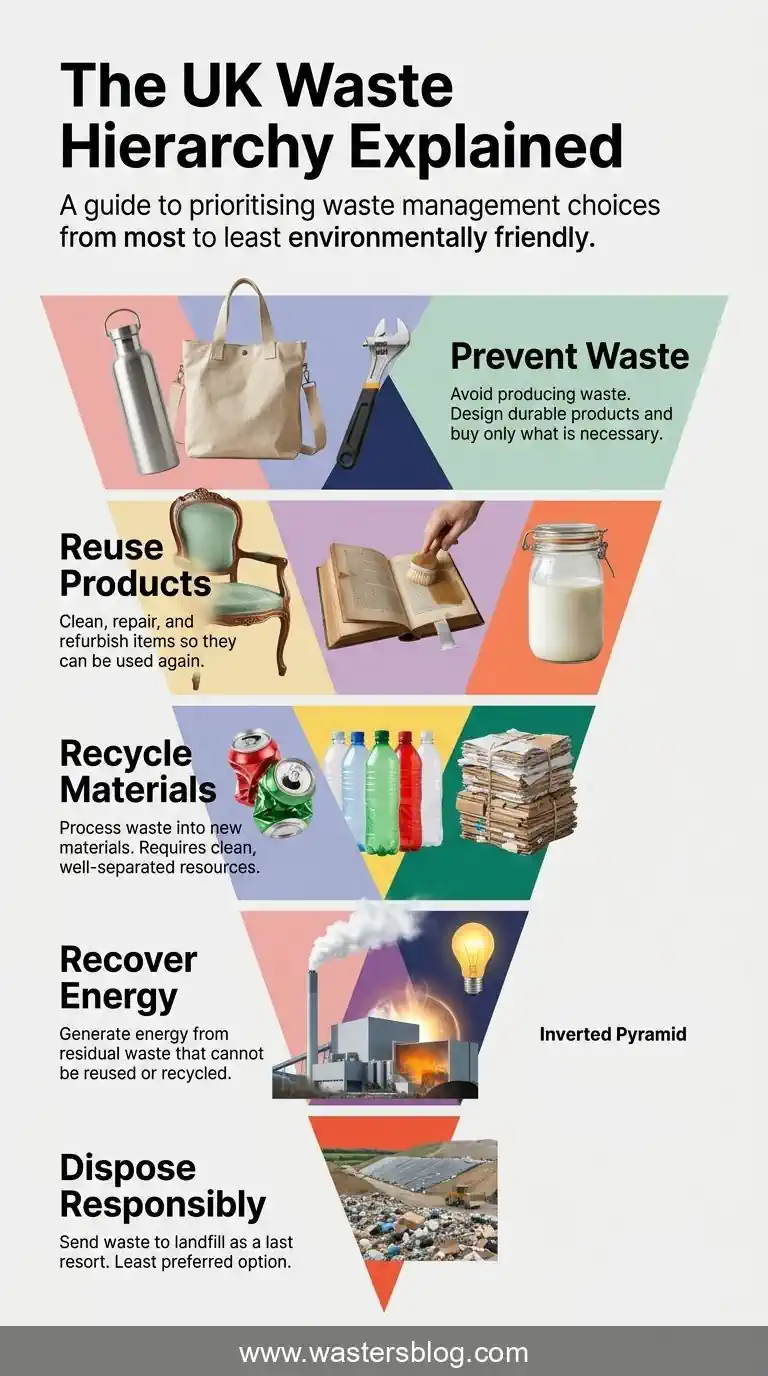
Recycling is important, but it is only one part of responsible waste management. The waste hierarchy ranks the available options in the following order:
- Prevention: avoid producing waste in the first place.
- Preparing for reuse: clean, check, repair or refurbish an item so it can be used again.
- Recycling: process waste into new materials, substances or products.
- Other recovery: recover value from waste, commonly in the form of energy.
- Disposal: use landfill or another final disposal method as the last resort.
The order matters. Keeping a working phone, chair, bottle or electrical appliance in use normally preserves more of its existing value than destroying it and recovering the component materials.
Similarly, avoiding unnecessary packaging is usually better than producing, transporting, collecting and recycling it.
You can read more in our guide to the waste hierarchy and why reduce, reuse and recycle still matter.
How Does Recycling Work?
The exact process depends on the material and collection system, but most recycling passes through six broad stages.
1. Collection
Recyclable materials are collected from homes, businesses, schools, recycling centres, bottle banks, retailer take-back points and other designated locations.
Some materials are collected together, while others must be kept separate. A council might collect glass, metal and plastic packaging in one container but require paper and cardboard to be placed in another.
2. Sorting
Mixed recycling is taken to a sorting facility, often called a material recovery facility or MRF. There it may pass through conveyors, screens, magnets, eddy-current separators, optical sorters and manual quality-control stations.
Different technologies separate materials by properties such as size, shape, weight, colour, magnetism and chemical composition.
Learn more about the separation methods used to recover recyclable materials.
3. Cleaning and Preparation
Contamination and unsuitable material must be removed. Depending on the material, the recyclables may then be washed, shredded, crushed, screened or baled.
Preparation creates a more consistent material that a reprocessing plant can accept.
4. Reprocessing
The prepared material is converted into a usable secondary raw material. Paper becomes pulp, glass becomes cullet, metals are remelted and plastics may be converted into flakes or pellets.
5. Manufacturing
The recovered material is used to manufacture new products. These may be similar to the original item, such as a metal can becoming another can, or different products, such as recycled plastic being used in drainage pipes or outdoor furniture.
6. Buying Recycled Products
Recycling depends on demand. When consumers, businesses and public bodies buy products containing recycled material, they help create a market for the material collected.
The recycling loop is not complete until recovered material has been used productively.
What Can Be Recycled at Home?
The following table covers materials commonly collected from UK households. Exact arrangements vary, particularly between the four UK nations and between local authorities, so always follow the instructions provided for your address.
| Material | Common examples | Important cautions |
|---|---|---|
| Paper and card | Newspapers, magazines, envelopes, cereal boxes and delivery boxes | Keep reasonably clean and dry. Flatten boxes where requested. |
| Glass packaging | Glass bottles and food jars | Drinking glasses, mirrors, ceramics and heat-resistant cookware have different compositions. |
| Metal packaging | Food cans, drink cans, clean foil and accepted aerosols | Do not place batteries, electrical equipment or gas cylinders in this stream. |
| Rigid plastic packaging | Bottles, pots, tubs and trays | Follow local instructions. Not every plastic object belongs in packaging recycling. |
| Food waste | Unavoidable leftovers, peelings, bones and other accepted food scraps | Remove ordinary packaging unless the collection service says otherwise. |
| Garden waste | Grass cuttings, leaves, small branches and plant material | Collection may be separate, optional or charged for. Soil, plastic pots and treated timber may be excluded. |
Paper and Card Recycling
Paper and cardboard are widely collected and recycled. Commonly accepted items include newspapers, magazines, writing paper, envelopes and cardboard packaging.
Paper fibres become shorter and weaker each time they are processed. This means that fresh fibre still has an important role in paper manufacturing, even where high recycling rates are achieved.
Keep paper and cardboard reasonably clean and dry. Heavily food-soiled card, wet paper and products laminated with plastic or foil may be unsuitable for normal paper recycling.
If part of a pizza box is clean, it may be possible to recycle that section while placing the heavily contaminated portion in the appropriate waste stream. Follow your council’s instructions.
Glass Recycling
Glass bottles and jars can be collected, sorted by colour where necessary, crushed and used to manufacture new glass products.
However, not every glass object has the same composition. Drinking glasses, mirrors, window glass, light bulbs, cookware and ceramics may melt at different temperatures or contain other materials.
Only put the types of glass requested by your collection service into a bottle bank or household glass recycling container. Ceramics and unsuitable glass can contaminate batches intended for container-glass manufacturing.
Metal Recycling
Steel and aluminium packaging is valuable because the recovered metal can be processed into new products.
Steel can be separated using magnets. Aluminium and other non-ferrous metals can be separated using equipment such as eddy-current separators.
Empty food and drink cans are commonly accepted in household recycling. Metal cookware, tools, bicycles, electrical equipment and large scrap items may also be recyclable, but they usually require a recycling centre or specialist scrap collection.
For more information, see our guide to which metals can be recycled.
Plastic Recycling
Plastic is not one material. It is a large family of polymers, and different products may also contain pigments, adhesives, labels, coatings and other materials.
Many plastic bottles, pots, tubs and trays are collected from households. They may be sorted by polymer and colour before being washed and processed.
Other plastic items can be more difficult. Black plastic, multilayer packaging, toys, garden furniture, plant pots, hoses and flexible films may require different sorting or treatment routes.
The numbered plastic identification symbol does not automatically mean that an item can go in your household recycling bin. It identifies the material and does not guarantee that your collection system can sort and recycle that product.
Food and Garden Waste Recycling
Organic waste can be recycled through processes such as composting and anaerobic digestion.
Composting uses controlled biological decomposition to produce a soil improver or growing-media ingredient. Anaerobic digestion breaks organic material down without oxygen, producing biogas and a nutrient-containing digestate.
Food waste should not be mixed with dry paper, glass, metal and plastic recycling. Use the food-waste caddy or container supplied by your collection authority.
Garden waste may be collected separately by residents living in flats or taken to a household waste recycling centre. Home composting is another useful option for suitable garden and uncooked kitchen material.
England’s Simpler Recycling Requirements
Since 31 March 2026, household waste collectors in England have been required to meet the Simpler Recycling requirements.
The core material streams covered by the requirements include:
- Paper and card
- Glass
- Metal
- Plastic, including cartons
- Food waste
- Garden waste
- Residual waste
Councils may use different containers and, where permitted, collect some dry recyclable materials together. Householders should therefore continue following the collection instructions issued by their council.
Plastic film packaging and plastic bags are due to be included in household plastic recycling collections in England from 31 March 2027.
The rules discussed above apply to England. Scotland, Wales and Northern Ireland operate under their own recycling policies and collection arrangements.
For the official position, see the government’s Simpler Recycling household guidance.
Items That Need Specialist Recycling
Some items should not be placed in an ordinary household recycling bin even though useful materials can be recovered from them.
Electrical and Electronic Equipment
Computers, televisions, mobile phones, cameras, kitchen appliances and other electrical products contain metals, plastics, glass and electronic components.
Working equipment should be repaired, donated, sold or passed on where practical. Broken equipment can be taken to an appropriate recycling centre, retailer take-back scheme or specialist waste electrical and electronic equipment collection.
Batteries
Never place loose batteries in an ordinary recycling or residual-waste bin. Damaged lithium-ion batteries can cause serious fires in collection vehicles and waste facilities.
Use battery collection points at participating shops, recycling centres or other authorised locations. If a battery is built into an electrical product, follow the instructions for recycling the complete device.
Mobile Phones
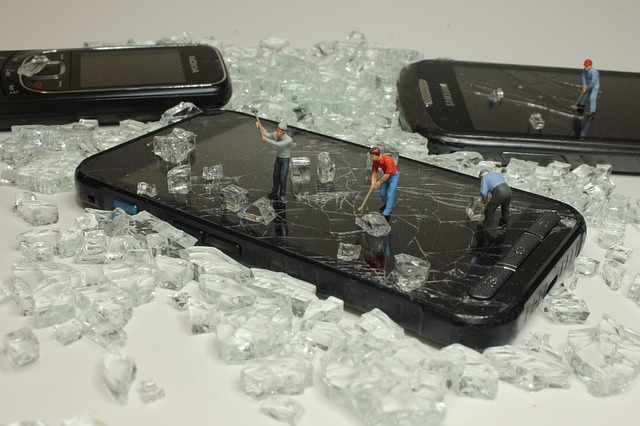
Working phones may retain reuse value and can sometimes be sold or donated. Non-working phones should go to an established electronics-recycling or take-back scheme.
Remove personal information, sign out of accounts and perform an appropriate factory reset before handing over a device. Remove the SIM card and memory card unless the receiving organization instructs otherwise.
Textiles and Footwear
Wearable clothing and usable footwear should be donated, sold or reused where possible. Damaged textiles may be accepted through council, charity or retailer collection schemes, but standards vary.
Do not leave bags outside an overflowing textile bank, where they may become wet and unusable.
Paint, Oils and Chemicals
Paint, engine oil, solvents, pesticides and other household chemicals require controlled disposal or recycling. Take them to a facility that specifically accepts the product.
Do not pour oils, paint or chemicals into drains, onto the ground or into ordinary recycling containers.
Large and Bulky Items
Furniture, mattresses, bicycles, large appliances, rubble and building materials may be accepted at household waste recycling centres or through booked collection services.
If the item remains usable, prioritize repair, resale, donation or a local reuse organization.
What Should Not Go in a Household Recycling Bin?
The exact exclusions depend on the collection service, but common problem items include:
- Nappies and sanitary products
- Loose batteries
- Electrical and electronic equipment
- Food and liquids mixed with dry recycling
- Garden hoses, cables and other items that can tangle around machinery
- Ceramics, crockery and drinking glasses in bottle-and-jar collections
- Mirrors and heat-resistant glass
- Gas cylinders and pressurized containers not accepted by the service
- Paint, oil and household chemicals
- Plastic toys and other non-packaging plastics unless specifically accepted
- Textiles placed in ordinary mixed recycling
- Closed bags of recycling, unless the collection instructions require them
Recycling collections are designed for specified materials, not for every unwanted household object.
What Is Recycling Contamination?
Contamination occurs when unsuitable material is mixed with otherwise recyclable waste.
Examples include food inside a container, broken crockery mixed with glass bottles, nappies placed among paper, or batteries hidden inside mixed recycling.
Contamination can:
- Reduce the quality and value of recovered material
- Make sorting more difficult and expensive
- Damage machinery
- Create health and safety risks
- Cause fires
- Result in otherwise useful material being rejected
You do not normally need to scrub every container until it is spotless. Empty it and remove significant food or liquid residue according to the local instructions.
What Is Wishcycling?
Wishcycling means putting an uncertain item in a recycling bin in the hope that it can be recycled.
It may feel environmentally responsible, but unsuitable items do not become recyclable simply because they have been placed in a recycling collection. Instead, they can contaminate good material and increase sorting costs.
The better rule is:
If in doubt, check—do not guess.
Look at your council’s website, consult the packaging label or use the Recycle Now household recycling locator.
Why Is Recycling Important?
When it is carried out effectively, recycling can provide several environmental and economic benefits.
- It keeps useful materials in circulation.
- It can reduce demand for newly extracted raw materials.
- It can reduce energy use for some manufacturing processes.
- It reduces the quantity of suitable material sent for disposal.
- It supports markets for secondary raw materials.
- It provides employment in collection, sorting, processing and manufacturing.
- It can reduce some environmental damage associated with raw-material extraction.
These benefits are not identical for every material. They depend on collection distances, contamination, sorting efficiency, processing technology, energy sources and what the recovered material replaces.
Recycling still requires vehicles, machinery, energy and industrial processing. That is why prevention and reuse sit above it in the waste hierarchy.
Do All Materials Recycle in the Same Way?
No. Different materials have very different properties.
- Glass can be crushed and remelted, but colour, composition and contamination affect how it can be used.
- Steel and aluminium can retain valuable properties when recovered and processed correctly.
- Paper fibres shorten during repeated processing, so new fibre is still needed.
- Plastics include many polymers and product formats, some of which are much easier to sort and recycle than others.
- Electrical equipment may be suitable for reuse, component recovery or specialist material treatment.
- Food and garden waste are biologically processed rather than melted or mechanically remanufactured.

This is why broad claims that an item is “100% recyclable” can be misleading. The practical outcome depends on whether it is collected, identified, separated, processed and used in a new product.
How to Recycle Correctly at Home
- Follow the instructions supplied by your council.
- Empty bottles, cans, pots, tubs and trays.
- Remove significant food and liquid residue.
- Keep paper and cardboard reasonably clean and dry.
- Flatten cardboard if requested.
- Replace or remove lids according to the collection instructions.
- Do not place batteries or electrical equipment in ordinary bins.
- Use recycling centres and retailer schemes for specialist items.
- Donate, repair or sell usable products before recycling them.
- Do not place uncertain objects in the recycling and hope for the best.
Frequently Asked Questions
What is recycling in simple words?
Recycling means collecting and processing waste so that its material can be used again. Examples include turning waste paper into new paper, melting metal cans to make new metal products and processing glass bottles into glass cullet for manufacturing.
What are the main stages of recycling?
The main stages are collection, sorting, cleaning and preparation, reprocessing, manufacturing and purchasing products containing recovered material. An item has not completed the recycling process merely because it has been placed in a recycling bin.
What materials can be recycled?
Commonly recycled materials include paper, cardboard, glass packaging, steel, aluminium and certain plastics. Electrical equipment, batteries, textiles, wood, construction materials and oils may also be recyclable through specialist services.
Can all plastic be recycled?
No. Plastic products are made from different polymers and may contain labels, pigments, adhesives and several combined materials. Some plastic packaging is widely collected, while other products require specialist treatment or do not currently have a practical recycling route.
Should I wash recycling?
Containers should normally be emptied and have significant food or liquid residue removed. They do not usually need to be scrubbed until spotless. Follow local instructions and avoid wasting large quantities of hot water solely to clean packaging.
Should lids and labels be removed?
This depends on the material and collection system. Many services ask householders to replace lids on empty bottles, while others may provide different instructions. Labels often remain attached because processing plants can remove them. Check your council’s guidance.
Can drinking glasses go in a glass recycling bin?
Usually not. Drinking glasses, cookware, mirrors and ceramics have different compositions from bottles and jars. They can contaminate container-glass recycling and should be taken to an appropriate facility or placed in the instructed waste stream.
Why should batteries not go in household bins?
Batteries, particularly damaged lithium-ion batteries, can be crushed during collection and sorting. This can start fires in vehicles and waste facilities. Use a retailer battery point, recycling centre or another authorised collection service.
What is recycling contamination?
Contamination is unsuitable material mixed with recyclables. Examples include food, liquids, nappies, batteries, ceramics and closed bags containing unknown waste. Contamination can lower material quality, damage equipment and cause recyclable loads to be rejected.
What is wishcycling?
Wishcycling is putting an uncertain item in the recycling bin and hoping the sorting plant can recycle it. This can create contamination and additional costs. Check the local collection instructions before disposing of an unfamiliar item.
Is recycling better than reuse?
Reuse normally ranks above recycling because it preserves more of the value already invested in a product. Repairing and continuing to use an appliance generally requires less processing than breaking it down and manufacturing another product from its materials.
What happens at a material recovery facility?
A material recovery facility sorts mixed recyclables into separate streams. It may use conveyors, screens, magnets, eddy-current separators, air systems, optical sorters and manual quality-control stations. The separated materials are then prepared for specialist reprocessors.
Does recycling save energy?
Recycling can reduce energy use for some materials, particularly where recovered material replaces energy-intensive extraction and primary production. The actual saving varies according to the material, transport, contamination, processing method and energy source.
Can food waste be recycled?
Yes. Separately collected food waste can be treated by anaerobic digestion or composting. Anaerobic digestion produces biogas and digestate, while composting produces a soil-improving material when the process and inputs meet the necessary standards.
Are recycling rules the same throughout the UK?
No. Waste policy is devolved, and collection systems differ between England, Scotland, Wales and Northern Ireland. Even where the same core materials are collected, container colours, collection frequencies and preparation instructions may vary.
Conclusion
Recycling recovers useful material from waste and returns it to productive use. It can conserve resources, support manufacturing and reduce the amount of suitable material sent for disposal.
Good recycling depends on more than putting items in a bin. Materials need to be collected correctly, kept free from avoidable contamination, sorted effectively and processed into outputs that manufacturers can use.
Householders can help by following local instructions, keeping dry recycling reasonably clean, using specialist collections for batteries and electrical equipment, and avoiding wishcycling.
Most importantly, remember the correct order: prevent waste where possible, reuse products for as long as practical and recycle suitable materials when they finally become waste.
[First published: 18 May 2018. Substantially rewritten and updated: 12 July 2026.]

We have heard that some clothes manufacturers will take back their old clothes and even make new clothes with the textiles after shredding them down and re-weaving the fibres. Is that true and where can I find a way to recycle my clothes like that?