We live in an era of relentless technological upgrade. Every year, millions of UK consumers rush to snap up the latest flagship smartphone, seduced by faster processors, multi-lens cameras, and 5G connectivity. But while our appetite for new devices remains high, what happens to the phones we leave behind?
Beneath the surface of our daily tech consumption lies a quiet environmental blind spot: drawer hoarding. While broad recycling metrics suggest the UK is making progress on municipal waste, mobile phone recycling figures reveal a starkly different story of low recovery rates, massive resource loss, and tens of millions of functional or recoverable devices gathering dust in British homes.
Key Takeaways
- Unused phones contain valuable resources: Keeping old handsets in drawers prevents their materials from returning to productive use.
- Overall WEEE figures do not tell the whole story: Collection totals measured by weight can obscure what happens to small, lightweight devices.
- Data security concerns can delay disposal: Preparing a phone properly and choosing a suitable reuse or recycling service can help address those concerns.
- Reuse and material recovery serve different purposes: Working phones may be suitable for continued use, while unsuitable devices can enter appropriate recycling channels.
- Businesses need a documented process: Retired company phones require careful handling of both stored information and the physical equipment.
UK Mobile Phone Hoarding Statistics: A Quick Reference
How many unused mobile phones are sitting in UK homes? Research consistently identifies a substantial stockpile, but published estimates differ because surveys count different things: unused phones, working spare handsets, recently replaced devices, or unwanted electronics generally. The figures below retain their dates and definitions so they can be quoted accurately.
Mobile Phone Hoarding: The Main Figures at a Glance
| Research date | Statistic | What the figure actually measures | Source |
|---|---|---|---|
| 2019 | 23% of UK households had an unused mobile phone. | A household survey finding, not a count of individual handsets. The research covered adults aged 16–75. | Royal Society of Chemistry / Ipsos MORI |
| 2020 | 55 million phones were estimated to be sitting in UK drawers. | A historical national estimate cited by giffgaff, attributed to a LADbible OnePulse survey from 2020. | giffgaff: Check Your Drawers |
| 2022 | 24 million mobile phones had been kept as spares over the preceding three years. | Phones retained following replacement during a three-year period, rather than the entire historical stockpile. | Deloitte: Digital Consumer Trends 2022 |
| 2022 | 7 million smartphones were expected to be retained that year as owners upgraded. | A forecast of annual additions to retained phones, not a measured net increase after disposals. | Deloitte: Digital Consumer Trends 2022 |
| 2023, reported March 2024 | Approximately 7 million old handsets were put away in British homes during 2023. | GfK's estimate of handsets stored during one year, rather than sold or traded in. | GfK Tech360 / NIQ |
| April–May 2024 | 52% of UK mobile owners said they kept old handsets. | A survey of 3,119 mobile owners. Respondents could have used different routes for different old phones. | YouGov Custom Research |
| October 2024 | The average Brit had at least two old phones stashed away at home. | Vodafone's reported finding from a survey of 2,000 UK adults, conducted on 4–7 October 2024. | Vodafone / 3Gem |
| 2026 | Four in five Brits were holding onto a defunct mobile phone. | A finding reported by Currys from an Opinium study of 2,000 UK adults. “Defunct” meaning out of date, unused, or unusable, not be interpreted as physically broken. | Currys / Opinium |
Important distinction: A stock estimate describes phones held at a particular time. An annual retention estimate describes phones entering storage. They cannot be added together without accounting for phones subsequently sold, donated, reused or recycled.
Is Mobile Phone Hoarding Getting Worse or Better?
The available surveys do not establish a reliable, like-for-like national trend. They demonstrate persistent hoarding, but different questions, age ranges, samples and definitions prevent a defensible calculation of how much the UK's total phone stockpile has grown or fallen.
Deloitte's forecast of 7 million smartphones retained during 2022 and GfK's estimate of around 7 million handsets stored during 2023 suggest that substantial numbers continued entering drawers in successive years. However, these are separate studies, and neither figure deducts devices leaving storage.
There are also signs of continued reluctance to recycle electricals more broadly. Currys reported that only around one-third of UK adults had recycled unwanted electricals during the previous year in 2022. Its 2026 release again reported that only about one-third had recycled tech in the preceding year. These similar findings suggest a persistent participation problem, but they are not a phone-specific recycling time series.
A defensible journalistic conclusion: “UK surveys show that mobile phone hoarding remains widespread, with millions of handsets entering storage annually. However, the published findings do not provide a consistent national series proving whether the total stockpile is rising or falling.”
What Happens to Old Phones Instead of Recycling?
GfK's Tech360 findings, published in March 2024 and discussing behaviour in 2023, provide a useful breakdown:
| Reported action | Percentage |
|---|---|
| Kept the old handset as a spare | 33% |
| Gave it to family or friends | 15% |
| Recycled it | 13% |
| Traded it in against a new phone | 8% |
| Threw it away | 5% |
These are selected reported outcomes, rather than a complete distribution. Giving a working handset to another person is reuse, rather than hoarding.
Source: GfK Tech360 findings, published by NIQ, 28 March 2024.
Why Do People Keep Their Old Phones?
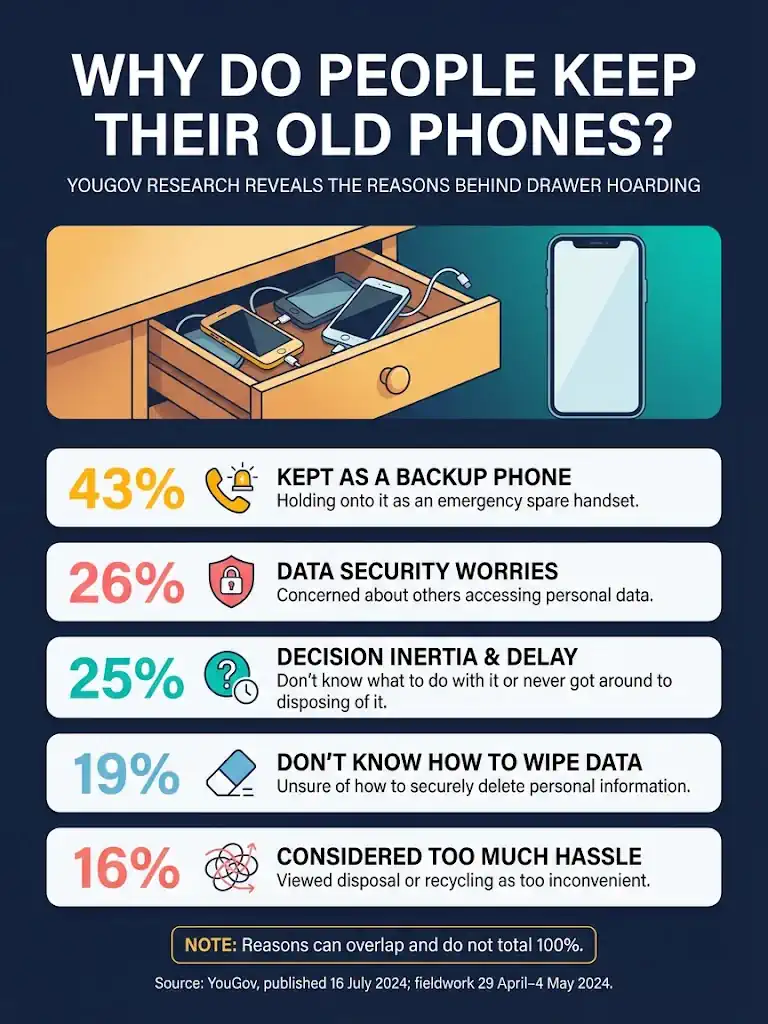
YouGov's 2024 research asked people keeping their previous handset why they retained it. The findings included:
- 43% kept it as a backup phone.
- 26% worried about security and other people accessing their data.
- 25% did not know what to do with it or never got around to disposing of it.
- 19% did not know how to wipe their data.
- 16% considered disposal too much hassle.
The reasons can overlap and should not be added together. Source: YouGov, published 16 July 2024; fieldwork 29 April–4 May 2024.
Which Old Phone Brands Were Most Commonly Hoarded?
Nokia stands out in both historical research and more recent evidence about retained first phones. However, brand-level findings should not be described as a ranking of individual handset models.
A 2011 study by F. O. Ongondo and I. D. Williams, published in Waste Management, recorded the following extra phones stockpiled by university students:
| Brand | Stockpiled handsets recorded in the study |
|---|---|
| Nokia | 1,615 |
| Sony Ericsson | 726 |
| Samsung | 535 |
| Motorola | 426 |
| Other brands | 203 |
| Total | 3,505 |
These are study counts, not national totals. Approximately 61% of students answering the relevant question reported owning extra phones. The findings describe a historical student population and cannot establish today's UK brand rankings.
Source: Ongondo, F. O. and Williams, I. D. (2011), Greening academia: Use and disposal of mobile phones among university students, Waste Management, 31(7), 1617–1634, Table 1.
Currys' 2026 research adds another historical clue: one-third of Brits still had their first-ever mobile phone, and one-quarter of those retained first phones were Nokias. That is evidence of Nokia's presence in sentimental collections, rather than proof that Nokia accounts for one-quarter of all hoarded phones.
What about the Nokia 3310, Nokia 3210 or Motorola RAZR? These are recognisable examples to discuss when illustrating older handsets, but the sources reviewed do not establish a representative UK hoarding ranking for individual models. Describing any of them as “Britain's most hoarded phone” would go beyond the evidence.
How Much Money Is Tied Up in Unused Phones?
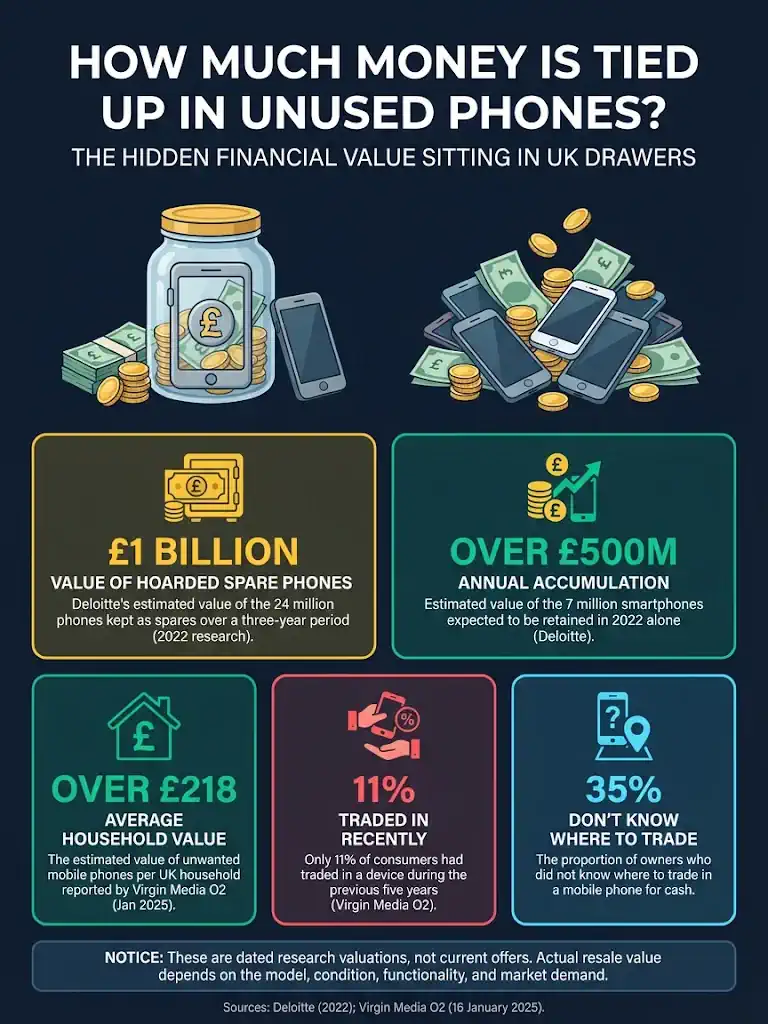
- £1 billion: Deloitte's estimated value, at the time of its 2022 research, of the 24 million phones kept as spares over the preceding three years.
- More than £500 million: Deloitte's estimated value of the 7 million smartphones it expected consumers to retain during 2022.
- More than £218 per household: The average value of unwanted mobile phones reported by Virgin Media O2 in January 2025.
- 11%: The proportion who had traded in a device during the previous five years in the same Virgin Media O2 research.
- 35%: The proportion who did not know where to trade in a mobile phone for cash.
These are dated research valuations, not current offers. Actual resale value depends on the model, condition, functionality and market demand.
Sources: Deloitte, 2022; Virgin Media O2, 16 January 2025.
Avoid Confusing Phone Statistics with All Unused Electricals
Some widely quoted numbers describe a much broader collection of products than mobile phones:


- 51% of households: The Royal Society of Chemistry's 2019 finding for households with at least one unused electronic device, rather than an unused phone specifically.
- 69%: The proportion of households with unused electronics intending to retain devices as spares in that research. This is not a phone-only percentage.
- 37%: The data-security concern reported among people not recycling electronic devices in the same research. Again, it is not exclusive to phones.
- 880 million items: Material Focus's estimate of unused working electrical items, published in its early-2024 campaign material and drawing on 2023 hoarding research. This includes many product categories.
For accurate reporting, always state the research year, the population measured and whether a statistic refers to phones or electrical products generally. A newly published article repeating an older estimate does not turn that estimate into a new measurement.
Sources: Royal Society of Chemistry: 2019 research findings and methodology; Material Focus: unused electricals research and survey dates.
Why Broad WEEE Statistics Mask the Mobile Phone Recycling Crisis
When reviewing official UK Waste Electrical and Electronic Equipment (WEEE) collection data, headline figures often look reassuring on paper, with national compliance totals frequently hovering around the mid-to-high 40% range. However, relying on aggregate WEEE numbers creates a false sense of security regarding mobile phones.
The reality of these statistics includes:
- The Appliance Skew: Total WEEE tonnage figures are heavily propped up by large, heavy domestic appliances—such as washing machines, refrigerators, and large cookers—which are routinely collected through municipal recycling centres or retailer take-back schemes when replaced.
- The Small Electronics Blind Spot: Small-format IT and telecommunications equipment (smartphones, fitness trackers, tablets, and chargers) suffer from disproportionately low recycling rates, often languishing in single-digit or low double-digit recovery brackets.
- The Leakage Factor: Because mobile phones are small, portable, and hold residual sentimental or trade-in value, they are uniquely susceptible to “drawer storage” rather than formal disposal, meaning they never enter the official WEEE compliance pipeline at all.
The Environmental Toll: Critical Raw Materials and Urban Mining
To understand why hoarding a mobile phone in a drawer is an environmental issue, you have to look beyond the plastic casing and glass screen into the chemistry of a modern smartphone.
Inside every handset lies a micro-ecosystem of finite, energy-intensive elements:
- Precious Metals: Gold, silver, copper, and palladium are vital for wiring, connectors, and circuit boards. It takes roughly 41 mobile phones to recover just a single gram of gold—meaning millions of hoarded phones represent a literal vault of precious metals sitting idle.
- Technology Critical Elements: Smartphones rely on rare-earth and specialty elements such as cobalt (primarily used in lithium-ion batteries), lithium, indium, and yttrium.
Failing to recycle these devices triggers a direct economic and environmental penalty known as primary extraction reliance. When functional or recyclable metals remain locked in UK kitchen drawers, global manufacturers are forced to mine virgin ore overseas. Primary mining consumes vast amounts of energy, destroys natural habitats, generates toxic tailings, and carries a heavy carbon footprint.
By contrast, urban mining—recovering these materials from existing e-waste streams—closes the loop, reduces mining demand, and drastically cuts emissions.
Business and B2B Compliance: The Corporate Mobile Upgrade Cycle
While consumer hoarding grabs the headlines, a parallel challenge exists in the commercial sector: corporate mobile device management and WEEE compliance.
As businesses regularly upgrade employee smartphone fleets every 24 to 36 months, companies face strict legal responsibilities under UK environmental and data protection laws:
- The Waste Duty of Care: Under UK waste regulations, businesses are legally classified as waste producers. Disposing of old company handsets into general commercial waste or leaving them unsecured breaches duty-of-care obligations. Old phones must be handed over to licensed carriers and processed by Approved Authorised Treatment Facilities (AATFs).
- GDPR and Data Sanitization: Unlike domestic users who worry about family photos, corporate entities face severe regulatory penalties if company emails, client data, or proprietary software leak through retired hardware.
- The ITAD Solution: Forward-thinking organizations partner with accredited IT Asset Disposition (ITAD) specialists who provide certified data destruction, serialized auditing, and transparent recycling certificates.
Ultimately, whether dealing with a household drawer or a corporate asset register, shifting mobile phones out of long-term storage and back into certified processing streams is essential for meeting UK circular economy goals.
Conclusion: Turning Idle Handsets into Action
The narrative around mobile phone recycling in the UK often gets bogged down in an all-or-nothing debate. Consumer trade-in platforms fight fiercely for near-mint, latest-generation devices, leaving older, broken, or obsolete handsets out in the cold. Meanwhile, millions of phones remain tucked away in drawers, acting as silent monuments to linear consumption.
Yet, this stagnation is entirely fixable. By reframing the conversation away from consumer pocket change and toward macro-level e-waste statistics, resource security, and urban mining, we can change how society views old tech. Whether you are an individual clearing out a bedside table or a facilities manager auditing a corporate device upgrade, every handset returned to a certified AATF or responsible trade-in channel protects finite global resources and keeps toxic materials out of landfill.
It's time to empty the drawers.
What Can You Do Next?
- Audit Your Household: Check your cupboards and drawers for legacy tech. You might be sitting on more value and critical materials than you realize.
- Prioritize Certified Channels: If you are recycling, use accredited schemes that guarantee secure data wiping and transparent UK WEEE processing.
- Explore Corporate Take-Backs: If you manage a business, partner with certified IT Asset Disposition (ITAD) providers to ensure your old corporate fleets re-enter the circular economy safely.
Frequently Asked Questions About Mobile Phone Recycling
Why is keeping unused mobile phones in drawers an environmental issue?
Unused phones contain valuable metals and other materials that remain unavailable for reuse or recovery while the devices are stored. Returning suitable phones to use, or sending unsuitable devices for appropriate recycling, helps keep those resources in circulation.

What is WEEE?
WEEE stands for Waste Electrical and Electronic Equipment. It includes discarded electrical and electronic products such as mobile phones, computers, and household appliances.
Why do overall WEEE collection figures reveal little about mobile phone recycling?
Overall WEEE collection figures combine many types of equipment and are commonly expressed by weight. Heavy appliances can dominate the totals, so those figures alone cannot show how effectively small, lightweight mobile phones are being collected.
What does urban mining mean in mobile phone recycling?
Urban mining means recovering useful materials from existing products and waste. For mobile phones, this can include recovering metals from circuit boards and other components so they can return to productive use.
Should an old mobile phone be reused or recycled?
A working phone may be suitable for continued use, resale, donation, or refurbishment, depending on its condition and suitability. A device that is unsuitable for further use should enter an appropriate electronics recycling channel so its materials can be recovered.
What is IT Asset Disposition (ITAD)?
IT Asset Disposition (ITAD) is the managed retirement of IT equipment, including company mobile phones. Services can include assessing devices for reuse, handling stored data securely, tracking equipment, and arranging appropriate recycling.
[Published in 2019. Updated May 2020. Latest November 2026 update was a complete rewrite with a new focus.]