
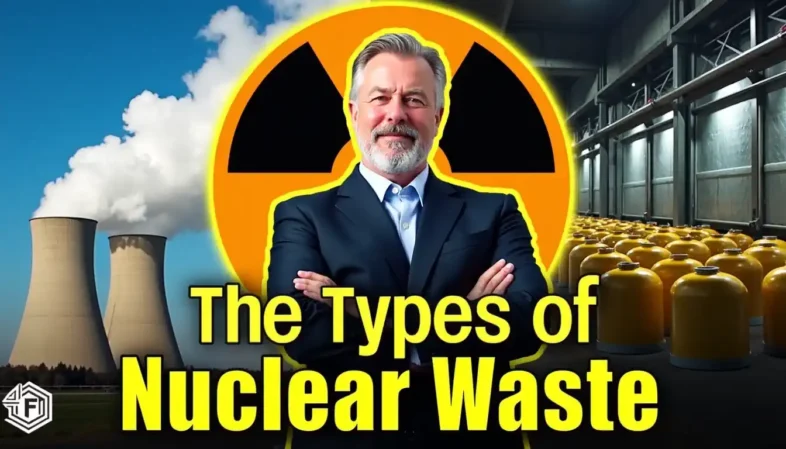
Understanding the types of radioactive waste helps you make sense of public safety, environmental protection, and our energy future. Nuclear power plants generate electricity for millions of homes, yet the radioactive waste they create raises real questions for communities everywhere.
Here is the surprising part.
Over 95 percent of the total radioactivity from nuclear electricity generation comes from high-level waste, even though it makes up less than 1 percent of the total waste volume from all types of nuclear waste. A tiny fraction of the waste holds almost all of the danger.
That single fact is the key to understanding how experts keep this material under control. Scientists classify nuclear waste by radioactivity level, heat output, and the half-life of its isotopes, and this classification system decides exactly how each type gets handled.
This guide breaks down the types of nuclear waste and how they are classified in plain language. You will learn where radioactive waste comes from, how professionals treat it, and what happens to it over the long term.
Key Takeaways
- Nuclear waste falls into five main categories: very low-level, low-level, intermediate-level, high-level, and transuranic waste. Each requires different safety handling and storage approaches.
- High-level waste accounts for over 95 percent of total radioactivity despite representing less than 1 percent of total waste volume, making it extremely concentrated and dangerous.
- Scientists use vitrification, synroc technology, and phosphate-based ceramics to transform radioactive materials into solid, stable forms that resist leaking for thousands of years underground.
- Deep geological repositories located 400 to 680 meters below Earth's surface permanently isolate radioactive materials, with Finland's Onkalo opening in 2025 and France planning the Cigeo facility.
- Reprocessing recovers 96 percent of spent fuel for recycling into new uranium-based and mixed-oxide fuels, greatly reducing the volume of waste that needs permanent disposal.
What is Nuclear Waste?
Nuclear waste is any radioactive material that humans concentrate, separate, or expose through their activities. The nuclear fuel cycle produces the largest share, but nuclear weapons reprocessing, medical procedures, industrial uses, and naturally occurring radioactive materials (NORM) from resource extraction all add to the total.
Radionuclides are unstable isotopes that release ionizing radiation as they decay. This radiation can harm human health and the environment. Different isotopes give off different types of radiation for different lengths of time, which is why classification matters so much.
Several groups keep watch over all types of nuclear waste materials:
- The Canadian Nuclear Safety Commission (CNSC) and Atomic Energy of Canada Limited (AECL) track and control radioactive substances in Canada.
- Operators like Ontario Power Generation and Hydro-Québec manage large amounts of spent fuel and legacy waste from their nuclear operations.
- The International Atomic Energy Agency sets the safety standards that nations follow to protect public health.
Radioactive waste forms when human activity disturbs or concentrates radionuclides that would otherwise stay harmless in nature. The chemical makeup of these substances affects how easily they move and how likely they are to contaminate the environment.
Spent nuclear fuel from nuclear reactors is one of the biggest sources of high-level radioactive waste in the world. The fission products and actinides inside used nuclear fuel demand careful attention during storage and disposal. Low-level waste, intermediate-level waste, and high-level waste each need their own handling approach based on radioactivity levels and half-life.
How Is Nuclear Waste Classified?
Nuclear waste falls into five main categories, each with a different level of radioactivity and danger. Scientists sort these materials by how much radiation they emit, how long they stay dangerous, and how much heat they produce.
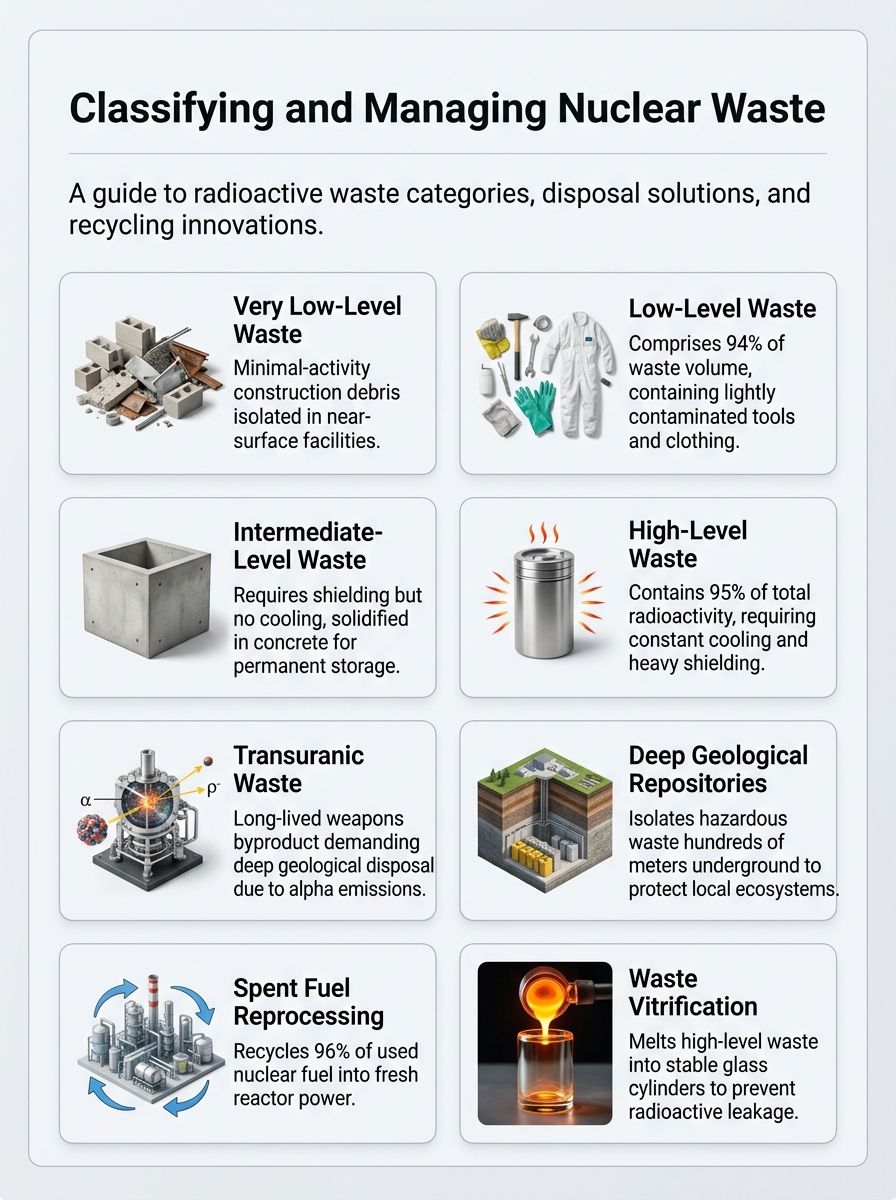
Very Low-Level Waste (VLLW)
Very low-level radioactive waste contains only minimal radioactivity concentrations. It includes construction materials, concrete, and debris that workers collect during decommissioning work at nuclear facilities.
VLLW is a type of nuclear waste that often comes from cleanup efforts at historically contaminated sites, where teams separate out materials with only trace radioactive content. The UK does not explicitly break out VLLW in official statistics, yet operators manage it separately from low-level waste and intermediate-level waste.
Disposal sites for VLLW use near-surface facilities designed for isolation. They do not need the intense containment measures required for LLW or HLW, though staff still monitor everything against regulatory limits.
Managing very low-level radioactive waste well shrinks the total volume that needs stricter controls. Facilities like Chalk River Laboratories and Canadian Nuclear Laboratories handle VLLW during decommissioning and routine maintenance, following guidelines set by the CNSC and AECL.
Very short-lived low-level radioactive waste sometimes lands in the VLLW category, depending on its isotope mix and decay behaviour. Accurate classification here prevents unnecessary expense and storage headaches for nuclear energy operators, and it supports sustainable development goals through long-term environmental protection.
Low-Level Waste (LLW)
Low-level waste sits just above very low-level waste on the radioactivity scale, but it makes up a much larger share of total volume. This category covers everyday items like paper, rags, tools, and clothing that hold small amounts of mostly short-lived radioactivity.
These materials come from medical facilities, industrial operations, and the nuclear fuel cycle itself. LLW accounts for 94% of the radioactive waste volume across the UK.
According to the UK Radioactive Waste and Materials Inventory guidelines, LLW is strictly defined by law as containing no more than 4 gigabecquerels (GBq) per tonne of alpha activity, or 12 GBq per tonne of beta and gamma activity. These hard numbers matter because they draw the exact legal line between LLW and the more dangerous intermediate category, so operators know precisely which handling rules apply.
Workers dispose of most LLW in Cumbria using grouted metal containers and concrete vaults that keep the radioactive material safely contained underground. Before disposal, operators compress or burn LLW to shrink its volume.
The industry splits LLW into four classes (Types of Nuclear Waste), each with its own handling procedures based on radioactivity levels and the half-life of the isotopes present:
- Class A
- Class B
- Class C
- Greater Than Class C (GTCC)
Surface or near-surface storage works well for LLW, since it usually does not need heavy shielding during handling and transport.
“The best way to manage low-level waste is to reduce it at the source, then treat it properly before it ever reaches a storage facility.”
Intermediate-Level Waste (ILW)
Intermediate-level radioactive waste sits between low-level and high-level waste in radioactivity and hazard. It contains more radioactivity than LLW and generally needs shielding during storage, but not cooling.
ILW is a type of Nuclear Waste that makes up 6% of the radioactive waste volume in the UK, yet it creates real challenges for nuclear safety and security. Sources include contaminated materials from nuclear decommissioning, reactor components, and sludges from treatment processes.
The chemical and radiological makeup of ILW varies widely depending on where it comes from in the nuclear fuel cycle. Facilities store it in engineered environments to prevent contamination and protect public health.
Workers solidify intermediate-level radioactive waste in concrete or bitumen before disposal. This locks the material in place and cuts the risk of leaks over long periods.
Nuclear reprocessing, uranium mine and mill waste processing, and spent fuel management all generate ILW streams. The long-term plan for this waste is geological disposal, with deep geological repositories offering secure containment far underground.
The IAEA and national regulators set strict guidelines for ILW handling, and safeguards protect both workers and nearby communities. Technical cooperation programmes help countries build management strategies that fit their own nuclear technology. Transmutation and recycling continue to advance, offering new ways to shrink both the volume and the hazard of this waste.
High-Level Waste (HLW)
Nuclear reactors and fuel reprocessing facilities produce high-level waste, the most radioactive material in the nuclear industry. It forms when the nucleus of an atom splits during power generation, releasing enormous energy and creating intensely radioactive byproducts.
HLW accounts for over 95% of total radioactivity from nuclear electricity generation, yet it represents less than 1% of the total volume of radioactive waste in the UK. The country's 60-year nuclear program generated just 2,150 cubic meters of HLW by 2019, which shows how concentrated this waste really is.
A few numbers put the global picture in focus:
- A 1,000-megawatt nuclear power plant produces roughly 27 tonnes of spent fuel each year.
- Worldwide, the total grows by about 12,000 tonnes annually.
- As of 2010, about 250,000 tonnes of nuclear HLW sit in storage globally, excluding amounts lost in accidents.
Because HLW generates significant heat from radioactive decay, it needs constant cooling and heavy shielding to keep people safe. Scientists convert it into a glass-like ceramic material through a process called vitrification. This type of nuclear waste transforms liquid waste into a solid form that resists leaching, ready for secure storage in deep geological repositories.
The fission products in HLW are mostly short-lived isotopes that decay fairly quickly. Some materials like plutonium, though, stay dangerous for extremely long periods. Storage duration depends entirely on which radioactive isotopes each batch contains.
Mixed oxide fuel and other advanced materials sometimes go through reprocessing to recover usable components, which cuts the volume needing permanent disposal. Cameco and New Brunswick Power are among the major organisations managing nuclear fuel cycles and waste streams in North America.
Transuranic Waste (TRU)
Transuranic waste (TRUW) is material contaminated with alpha-emitting transuranic radionuclides that have half-lives longer than 20 years and concentrations above 100 nCi/g (3.7 MBq/g). Most of it comes from nuclear weapons production and decommissioning in the United States.
Elements like neptunium-237, plutonium-238, and americium-241 make up the bulk of TRUW. The Waste Isolation Pilot Plant (WIPP) in New Mexico serves as a dedicated deep geological repository for this waste.
Transuranic waste demands the deepest geological repositories because its radioactivity persists for thousands of years.
TRUW poses serious radiological hazards because of its alpha emissions and long half-lives. Mixed oxide fuel (MOX) production and weapons dismantling generate large quantities that demand advanced containment systems and constant monitoring.
Strict national and international frameworks govern how facilities handle, store, and dispose of TRUW. Storage sites maintain tight security protocols and environmental monitoring to catch any leaks early, protecting communities near repository sites from unnecessary exposure.
Where Does Nuclear Waste Come From?
Nuclear waste comes from many places, and each source creates a different kind of radioactive material. Power plants, medical facilities, weapons programs, and industrial operations all produce waste that needs careful handling.
Nuclear Fuel Cycle
The nuclear fuel cycle starts with uranium mining and processing, where workers extract yellowcake (U3O8) from the earth. That material then goes through enrichment, rising from its natural 0.7% U-235 to about 4.4% for reactor use.
Technicians convert enriched uranium into uranium dioxide (UO2), which becomes the fuel pellets loaded into reactor assemblies. These pellets sustain the chain reaction that generates electricity.
Over time, fission products build up inside the fuel rods, with cesium-137 and strontium-90 as key components. Eventually these products slow the chain reaction, and operators swap in fresh fuel rods.
Depleted uranium, mostly U-238, emerges as an enrichment byproduct. Military uses and mixed oxide fuel (MOX) production take advantage of its high density.
Spent nuclear fuel contains mostly uranium, fission products, and transuranic elements that stay radioactive for a long time. The actinide mix shapes long-term decay patterns, which makes reactor fuel choices important. Thorium cycles produce different spent fuel profiles, including U-233, which affects radioactivity curves for up to one million years.
Decommissioning of Nuclear Plants
Once nuclear facilities stop producing power, they leave behind large waste streams. Decommissioning generates big quantities of contaminated concrete and metals from reactor structures.
Workers classify this debris as very low-level waste or low-level waste depending on contamination levels. The U.S. has over 108 designated contaminated sites, with some cleanups complete and others still underway. The Fernald site in Ohio is a well-known example, with uranium contamination reaching the Great Miami Aquifer.
Early segregation during demolition pays off in real numbers. One project processed 1,200 tonnes of demolition waste from a retired research reactor, carefully sorting materials by contamination level:
- 86 percent was recovered as VLLW suitable for near-surface disposal.
- LLW headed for deeper vaults dropped by 72 tonnes.
- Material that could have needed long-term ILW storage became manageable near-surface VLLW disposals instead.
Decommissioning transforms nuclear facilities into safe, clean spaces through careful planning and execution.
Segregation separates radioactive materials from clean debris, and volume reduction cuts storage and disposal costs. The Department of Energy set a goal of cleaning all contaminated sites by 2025, though real obstacles remain.
Workers follow strict regulatory standards throughout every project, protecting public safety and the environment. These systematic steps turn aging facilities into remediated sites and protect groundwater for future generations.
Nuclear Weapons Dismantling
Governments face a different challenge entirely: dismantling nuclear weapons and managing the radioactive materials inside them. This work generates waste streams that differ sharply from typical reactor byproducts and demands long-term storage solutions.
Decommissioned bomb materials contain alpha-emitting actinides like plutonium-239, plus beta and gamma emitters such as tritium and americium. The beta decay of plutonium-241 produces americium-241, which is harder to store because it emits both gamma rays and alpha particles.
Plutonium-238 has powered radioisotope thermoelectric generators in nuclear devices, adding more complexity to the waste stream. Separating plutonium from americium uses pyrochemical processes or truncated PUREX extraction, both requiring specialised facilities and trained staff.
Decay products complicate classification too. Uranium-236 forms from plutonium-240 impurities, and trace uranium-235 appears from plutonium-239 decay. Long-term storage raises security concerns as well, since decaying materials could potentially become accessible for weapons use. National security rules also limit what the public can know about specific bomb designs, which makes transparent communication about this waste difficult.
Medical Applications
Hospitals and clinics generate radioactive medical waste through diagnostic and therapeutic procedures. Doctors inject technetium-99m, a gamma emitter, to track organ function, while treatments use isotopes like iodine-131 (8.0-day half-life) and yttrium-90 (2.7-day half-life) to destroy cancer cells and treat thyroid conditions.
Medical teams pick short-lived radioisotopes on purpose. These materials break down quickly, which lowers radiation exposure for patients and the environment. Even so, diagnostic procedures contribute about 0.6 mSv of average annual radiation exposure per person worldwide.
Other isotopes serve specific medical roles:
- Cobalt-60 (5.3-year half-life) and caesium-137 (30-year half-life) support cancer treatment and sterilisation.
- Iridium-192 (74-day half-life) and strontium-89 (52-day half-life) assist other treatments but decay much faster.
Medical waste falls into the low-level waste category thanks to its short-lived radioactivity. Facilities handle it three ways: decay storage lets short-lived isotopes fade in secure containers, incineration burns organic material while containing radioactive particles, and landfill disposal works for waste with minimal activity.
Regulators oversee every stage, from the moment doctors use an isotope through final disposal. These tools remain essential to modern healthcare, balancing accurate diagnosis and effective treatment against responsible waste handling.
Industrial Uses
Industry generates a surprising amount of radioactive waste that most people never think about. Radiography equipment, oil well logging tools, and similar devices produce gamma and neutron emitters that require careful handling.
The oil and gas industry creates especially tricky waste streams. Radium and its decay products contaminate processing facilities, while radon gas seeps into oil and brine during extraction. Propane processing areas face particularly high contamination from radon decay, which coats the inside of pipework with solid radioisotopes.
Workers exposed to oil and brine face serious health risks from radiation doses above safe limits. Yet the U.S. has exempted brine disposal from hazardous waste regulations since the 1980s, leaving gaps in protection.
Naturally occurring radioactive materials, or NORM, also emerge from coal burning and mining. Coal contains uranium, barium, thorium, and potassium at lower concentrations than Earth's crust. Even so, a single 1000-megawatt coal power plant exposes the population to 490 person-rem per year, compared with just 4.8 person-rem from a nuclear facility of the same size.
That gap is striking. Fossil fuel processes can release radioactive substances into the environment at rates far above those from nuclear energy production.
Naturally Occurring Radioactive Materials (NORM)
Nature itself produces radioactive materials we often overlook. Naturally occurring radioactive materials exist in rocks, soil, and even our own bodies.
Your body holds about 17 milligrams of potassium-40 right now, and you consume roughly 0.4 milligrams daily through food and water. Granite and other common rocks contain low levels of radioactivity from potassium-40, thorium, and uranium, exposing people to between 1 and 13 millisieverts a year depending on location. Worldwide, natural radioisotopes deliver an average of 2.0 millisieverts per person annually.
Human activity concentrates these natural substances too:
- Coal combustion is projected to release 2.9 million tons of uranium and thorium from 1937 through 2040.
- Rare-earth mining produces slightly radioactive waste because thorium and radium occur naturally in the ore.
- Oil and gas residues often contain radium and its decay products, with radon present in extracted oil and gas.
Technologically enhanced naturally occurring radioactive material, known as TENORM, forms when industrial processes concentrate these substances. Regulators apply less strict rules to TENORM than to nuclear reactor waste, despite comparable radiological risks. That regulatory gap makes proper classification and safe handling harder across industries.
What Makes Each Nuclear Waste Type Different?
Nuclear waste types differ in radioactivity, half-life, and heat output. Those three traits decide how we handle and store each category safely.
Radioactivity Levels
Radioactivity levels determine how dangerous nuclear waste really is. Scientists measure them in becquerels or curies to gauge the strength of radiation each waste type produces.
Very low-level waste contains barely any radioactivity, while high-level waste packs enormous radioactive energy into a small volume. The UK shows this contrast perfectly: HLW makes up less than one percent of total waste volume yet holds over ninety-five percent of all radioactivity from nuclear electricity generation. A tiny container of HLW poses far greater risk than massive piles of LLW paper, rags, tools, and clothing.
Different measurements trigger different handling rules. Intermediate-level waste needs shielding during storage and disposal, while transuranic waste involves alpha-emitting radionuclides with half-lives beyond twenty years and concentrations above one hundred nanocuries per gram.
Accurate measurement prevents misclassification. In one controlled instrument validation run, operators collected 72 waste packages over six weeks to confirm gamma spectrometer thresholds used to separate LLW from ILW. The results were clear:
- The spectrometer flagged 18 packages above the preliminary ILW threshold.
- Confirmatory lab assays on those 18 showed average activity 2.7 times the LLW upper limit.
- The matched results supported tighter LLW/ILW gate settings and fewer classification errors.
Good measurement helps workers pick the right storage methods, protective equipment, and disposal strategies. The radioactivity of radioactive waste also fades over time as radionuclides decay into stable nuclides, so some waste becomes safer with each passing year.
Half-life of Isotopes
Half-life measures the time it takes for half the atoms in a radioactive sample to decay into a different element. It tells us how long nuclear waste stays dangerous.
Short-lived isotopes release intense radiation quickly, then fade fast. Long-lived isotopes emit weaker radiation but stick around for thousands or even millions of years. Spent fuel from thorium cycles contains U-233, which shapes the radioactivity curve for up to one million years.
Half-lives vary dramatically across waste types:
- Strontium-90 and caesium-137 are medium-lived fission products that persist for decades.
- Long-lived fission products stretch across hundreds of thousands to millions of years.
- Minor actinides, heavy elements formed by neutron capture, carry half-lives from years to millions of years and pose serious radiotoxicity as alpha emitters.
- Transuranic waste involves alpha-emitting radionuclides with half-lives beyond 20 years.
Understanding these decay timescales is essential for choosing the right storage methods and treatment approaches for each waste category.
Heat Generation Potential
High-level waste generates significant heat from radioactive decay, and that heat is one of the biggest challenges in nuclear waste management. Cesium-137 and strontium-90 are the main sources, releasing intense thermal energy as they break down.
This decay heat forces engineers to design storage and disposal facilities that handle extreme temperatures. Spent fuel rods need years of cooling after removal from a reactor before moving to dry storage.
Thermal output data shows why. A typical 1,000 MWe reactor's annual discharge of 27 tonnes follows a clear decay heat curve:
| Time After Discharge | Total Heat Output |
|---|---|
| One week | 45 kW |
| One year | 2.4 kW |
| Ten years | 0.35 kW |
Modeling based on these figures supports a five-year wet storage hold to hit a 95 percent heat reduction target before transfer to passive dry cask systems. That is exactly why spent fuel spends years in water before facilities move it into dry storage containers.
Reprocessing shrinks the heat-generating waste too. Scientists recycle 96 percent of spent fuel back into uranium-based and mixed-oxide fuels, leaving just 4 percent of minor actinides and fission products that still add long-term heat and radiotoxicity. One-third of all spent nuclear fuel has already been reprocessed, easing cooling demands for some waste streams.
Why Is Classifying Nuclear Waste So Challenging?
Sorting nuclear waste into the right groups is harder than it sounds. Scientists must measure radiation precisely, track how long isotopes stay dangerous, and follow rules that differ from country to country.
Hazard Assessment
Hazard assessment sorts radioactive waste into low-level, intermediate-level, and high-level categories based on radioactivity and the safety measures each requires. Scientists measure radioactivity, examine isotope half-lives, and determine containment needs under different international regulatory frameworks.
High-level waste presents the toughest challenge. It makes up less than 1% of total waste volume yet holds over 95% of total radioactivity from nuclear generation. Long-lived fission products like technetium-99 and iodine-129 complicate assessments further, with half-lives spanning thousands of years.
Transuranic waste adds its own twist. Experts split it into contact-handled and remote-handled types based on surface dose rates, which determine how workers can safely touch or move the material.
Several factors shape every assessment:
- Half-life duration of the isotopes present
- Radioactivity intensity
- Heat generation potential
- Local regulatory requirements and international policies
No dedicated civilian high-level nuclear waste repository exists anywhere in the world yet, which forces nations to rely on temporary storage. Careful evaluation ensures waste handlers apply the right safety protocols, containment systems, and warning labels for each hazard level.
Regulatory Standards and Guidelines
The International Atomic Energy Agency sets the standards that shape how countries classify radioactive waste. These standards guide regulations across the globe and create a shared framework most nations follow.
Standards still differ by region, though. The U.S. EPA's proposed nuclear waste exposure limits are significantly more permissive than European standards, and that gap affects how waste gets handled and stored in different places.
Oversight tightens for long-lived isotopes like strontium-90 and plutonium-239, since these materials stay dangerous for thousands of years and carry proliferation risks. Each country adapts IAEA guidelines to fit its own needs. Low-level waste splits into Class A, B, C, and GTCC, each with specific disposal methods, while transuranic rules distinguish contact-handled from remote-handled waste based on contamination levels and half-lives.
Agencies enforce these standards through inspections, testing, and documentation that tracks waste from creation to final disposal. In the UK, as detailed in an October 2025 regulatory oversight report, the Office for Nuclear Regulation (ONR) and the Environment Agency lead this work. They are actively checking that higher activity waste packaged today will meet the strict licensing criteria of the future Geological Disposal Facility, so nothing conditioned now becomes a problem decades down the line.
Methods for Accurate Classification
Accurate classification requires scientists and regulators to measure radioactivity levels and assess the half-life of every isotope present. Professionals follow standardized steps to sort waste correctly and choose the right disposal strategy.
- Measure radioactivity intensity with detection equipment like gamma spectrometers and beta counters to identify the specific isotopes present.
- Calculate half-life values for each radioactive element. Shorter half-lives mean faster decay, which affects storage duration.
- Apply IAEA standards through the RADWASS framework so classification stays consistent across countries and facilities.
- Conduct hazard assessments covering both radioactivity levels and heat generation potential, then document the findings.
- Sort waste into the established categories: very low-level, low-level, intermediate-level, high-level, or transuranic waste.
- Analyze chemical composition alongside radioactive content to pick the right treatment method and prevent misclassification.
- Document waste origin, whether nuclear fuel cycle, medical, or industrial, since origin predicts contamination patterns and decay behavior.
- Use transmutation where possible to convert long-lived isotopes into shorter-lived ones, simplifying future management.
- Review the regulatory standards for your jurisdiction before finalizing any classification decision.
- Verify that high-level waste classification captures the material holding over 95 percent of total radioactivity in under 1 percent of volume. Errors here create serious safety risks.
Structured decision tools speed this up. One compact six-step decision ladder guides technicians through source tagging, a gamma screen, full isotopic assay if the gamma reading exceeds the threshold, a half-life scoring matrix, a containment decision, and final routing.
Pilot use of this ladder in a simulated run of 150 items cut reassays by 38 percent. It gives technicians a fast, auditable path that trims unnecessary lab work while keeping classification accurate, which makes it practical for facilities handling mixed waste from reactor operations and decommissioning.
Environmental and Safety Concerns
Nuclear waste poses serious threats to the environment and public safety if it is not managed properly. Radioactive materials can leak into soil and water, contaminating ecosystems and harming health for generations.
Prevention of Illegal Dumping
Illegal dumping of radioactive materials threatens public health directly. Criminal organisations, including the ‘Ndrangheta mafia clan in Italy, have trafficked and disposed of nuclear waste through unlawful channels, bypassing every safety protocol.
Governments fight back with strict enforcement measures, surveillance systems, and international cooperation. The 1996 Protocol to the London Dumping Convention established rules preventing ocean disposal of nuclear waste, creating legal barriers against trafficking.
Several layers of defence work together:
- Strong penalties, criminal investigations, and border controls discourage smuggling operations.
- Public reporting systems let citizens alert authorities to suspicious dumping.
- Secure facilities use physical barriers, monitoring equipment, and trained security personnel.
- Cross-border collaboration ensures traffickers face consistent legal consequences anywhere.
Geologic disposal technology also removes the incentive. Deep underground tunnels permanently isolate radioactive materials, making illegal surface dumping far less attractive. Advanced options like above-ground dry cask storage and deep borehole disposal further reduce opportunities for theft or unauthorised dumping.
Community engagement programs round out the effort, teaching residents about the dangers of illegal dumping and encouraging them to support legitimate waste management facilities.
Risks of Accidents and Leaks
Nuclear waste accidents endanger both people and the environment. High-level waste generates substantial heat and stays highly radioactive, so accidents become far more likely without proper cooling and shielding.
Transuranic waste can reach surface dose rates of 10,000 mSv/h, meaning workers must handle it with extreme care. Alpha-emitting actinides create severe health risks because of their high biological effectiveness and very long half-lives. Even small mistakes during transport or storage can trigger major problems.
Contamination events, like those at the Fernald site in Ohio, show exactly how leaks spread radioactive materials into ecosystems and groundwater. The effects can last for decades.
Long-lived fission products and minor actinides need deep geological repositories to reduce long-term exposure risks. The absence of a dedicated civilian high-level disposal site in the U.S. complicates storage and raises environmental risk.
Proper conditioning, secure wet storage, and dry storage all help prevent incidents, though no system is completely foolproof. Regulatory standards set strict protocols for hazard assessment and classification, keeping communities safer from potential disasters.
How Do Countries Manage Nuclear Waste Globally?
Every country builds its own nuclear waste management plan, with specific rules and timelines for safe storage and disposal. Nations also cooperate through international agreements to share best practices and keep radioactive materials secure across borders.
National Management Plans
Each country develops a radioactive waste management plan based on the waste it actually produces. The IAEA's Radioactive Waste Safety Standards, known as RADWASS, guide these national plans so every nation handles low-level waste, intermediate-level waste, and high-level waste safely.
The UK's national report maps how different waste types spread across the country, which shapes management strategy. Governments use this data to pick the disposal methods that fit their specific waste streams.
National plans typically combine several methods. Deep geological repositories store waste far underground for thousands of years, while transmutation technologies break radioactive materials down into less harmful substances. Waste classification directly determines which practices officials must follow, and international collaboration strengthens every program through shared knowledge.
Funding and Resources for Waste Management
Governments and energy companies invest large budgets to manage nuclear waste safely. This money builds storage facilities, trains specialised workers, and funds new disposal technologies.
National programs pay for monitoring systems, transport equipment, and safety inspections at waste sites. Federal agencies partner with private contractors, and budget planning stretches decades ahead because waste stays hazardous so long. Public funds come from taxpayers, while utilities collect fees from electricity consumers to cover waste costs.
Successful programs need more than money, though. Key resources include:
- Engineers, scientists, and technicians trained in radiation safety and storage protocols
- Research grants for better containment and disposal solutions
- Storage containers, transport vehicles, and monitoring devices
- International partnerships that share funding burdens and technical expertise
Facilities must maintain strict operational standards year after year, and that costs money continuously. Steady funding keeps waste contained, communities safe, and environmental protection front and centre.
International Collaboration and Policies
Nations work together to manage nuclear waste safely. Finland, France, Sweden, Canada, and South Korea are all building deep geological repositories, sharing knowledge and resources along the way.
The IAEA provides guidelines that help countries standardize radioactive waste classification, since each nation runs its own system. Shared standards make it far easier to communicate and follow best practices across borders.
Moving radioactive materials by sea demands strict rules too. The INF Code regulates how countries transport radioactive waste across water, keeping shipments secure from port to port.
International agreements also prohibit ocean disposal of radioactive waste, protecting marine environments from contamination. Countries sign treaties together and enforce them jointly, making sure no nation dumps waste illegally at sea. Protecting the planet takes every nation following the same safety standards.
Conclusion
Understanding nuclear waste classification matters because it shapes how we protect people and the planet. Very low-level, low-level, intermediate-level, high-level, and transuranic waste each require different handling approaches, and knowing the distinctions helps us manage radioactivity safely.
Sources range from the nuclear fuel cycle to medical applications, so tracking where waste comes from and what makes each type unique is essential.
The tools keep getting better.
Vitrification and synroc technologies lock dangerous materials into stable forms that resist water damage for thousands of years. Geological disposal, reprocessing of spent fuel, and advanced recycling recover valuable resources while shrinking what we bury underground.
Want to learn more? Visit your local nuclear authority's website or explore international collaboration efforts to see how your community helps keep radioactive materials secure for future generations.
FAQs
1. What are the main types of nuclear waste?
Nuclear waste falls into three main categories: low-level, intermediate-level, and high-level waste. Low-level waste includes contaminated items like protective clothing and tools, while high-level waste consists of spent reactor fuel that produces intense heat and radiation.
2. How is nuclear waste classified?
Waste is classified by its radioactivity level and how long it remains hazardous. The International Atomic Energy Agency sets the global standards that the UK follows, determining whether waste needs surface storage or deep geological disposal.
3. What is high-level waste, and why is it so risky?
High-level waste is primarily used fuel from nuclear power plants that generates significant heat and radiation. Materials like plutonium-239 remain dangerous for over 24,000 years due to their extremely long half-lives. This requires deep underground storage in specially engineered facilities with continuous monitoring.
4. Where does low-level waste go?
Workers package low-level waste in steel containers and dispose of it at near-surface facilities. In the UK, most of this waste goes to the Low Level Waste Repository in Cumbria, which has been operating since 1959.
[Published 15 April 2018. Updated and rewritten July 2026.]



U r born for making these articles and videos recycling, waste, trash, excentric things…. U r awesome
For me to understand this and to be useful, it needs a lot of hardwork reading and i am lazy!! Make easier please.
Boring article i donot like this very complicated?