
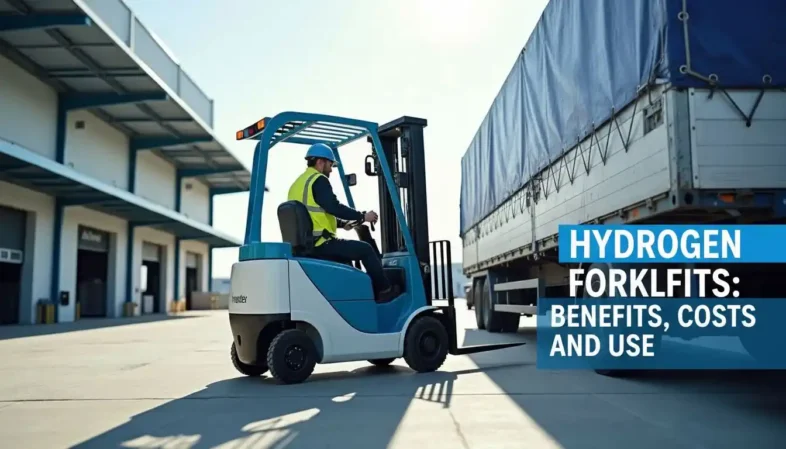
Hydrogen forklifts are electric lift trucks that generate electricity using an onboard hydrogen fuel cell. They can be refuelled in minutes and maintain consistent power during a shift, making them potentially attractive to large warehouses, distribution centres, material recovery facilities and other sites operating intensive forklift fleets.
However, hydrogen is not automatically the cleanest or most economical choice. Its environmental impact depends heavily on how the hydrogen is produced, while the cost and complexity of storage and refuelling infrastructure can make it unsuitable for smaller fleets.
This guide explains how hydrogen fuel-cell forklifts work, where they may be useful and how they compare with modern battery-electric, LPG and diesel lift trucks.
Key Takeaways
- A hydrogen forklift is an electric forklift: the fuel cell generates electricity for an electric drive system.
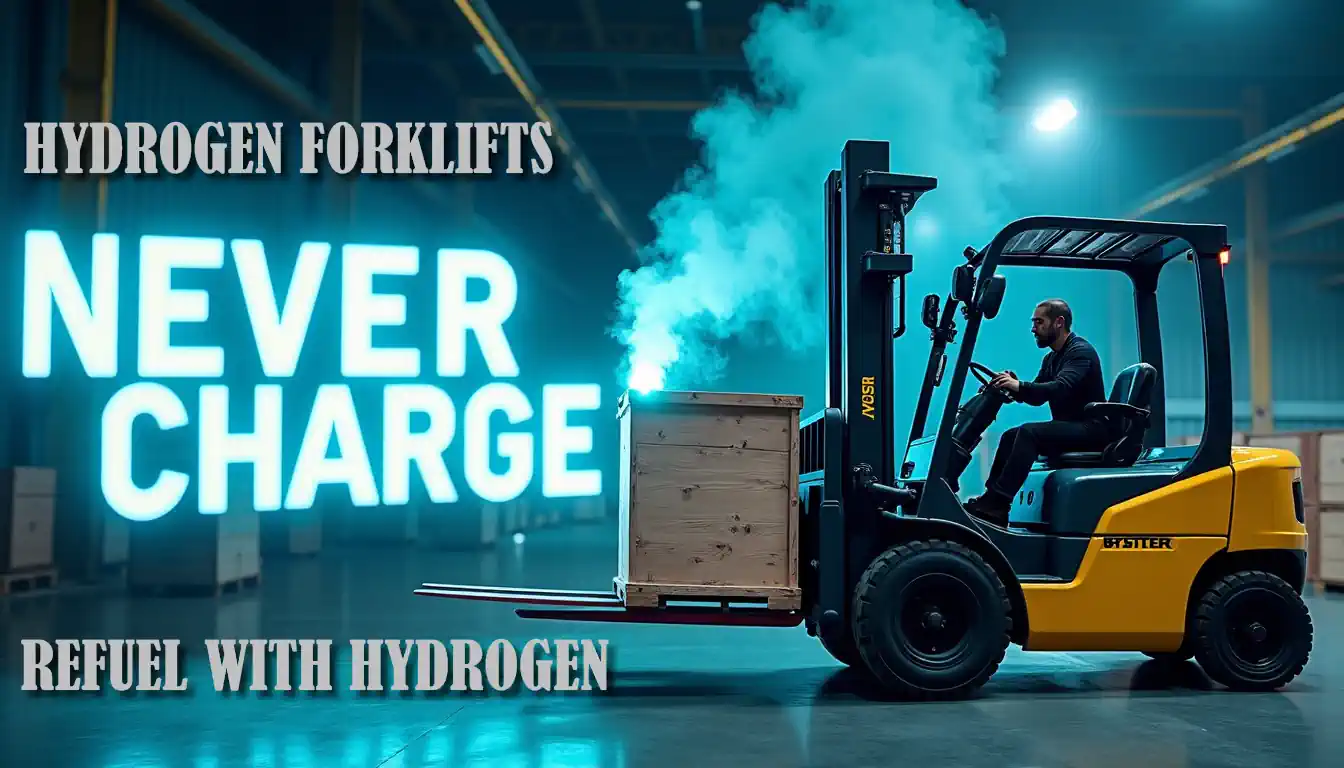
- Hydrogen fuel cells can normally be refuelled much faster than conventional lead-acid batteries can be recharged.
- The strongest business case is usually found in large, centralized fleets operating two or three shifts per day.
- Hydrogen forklifts produce no carbon dioxide from the vehicle during normal fuel-cell operation, but producing and transporting hydrogen may cause substantial emissions.
- Modern lithium-ion forklifts have reduced some of hydrogen’s advantages over older lead-acid battery systems.
- Hydrogen storage, dispensing, ventilation, leak detection and emergency procedures require careful professional design.
- For small or lightly used fleets, battery-electric forklifts will often be simpler and more energy-efficient.
- The correct choice should be based on total cost, operational duty and lifecycle emissions—not on fuel labels alone.
What Is a Hydrogen Forklift?
A hydrogen forklift is a fuel-cell electric vehicle designed to lift and move pallets, bales, containers and other materials.
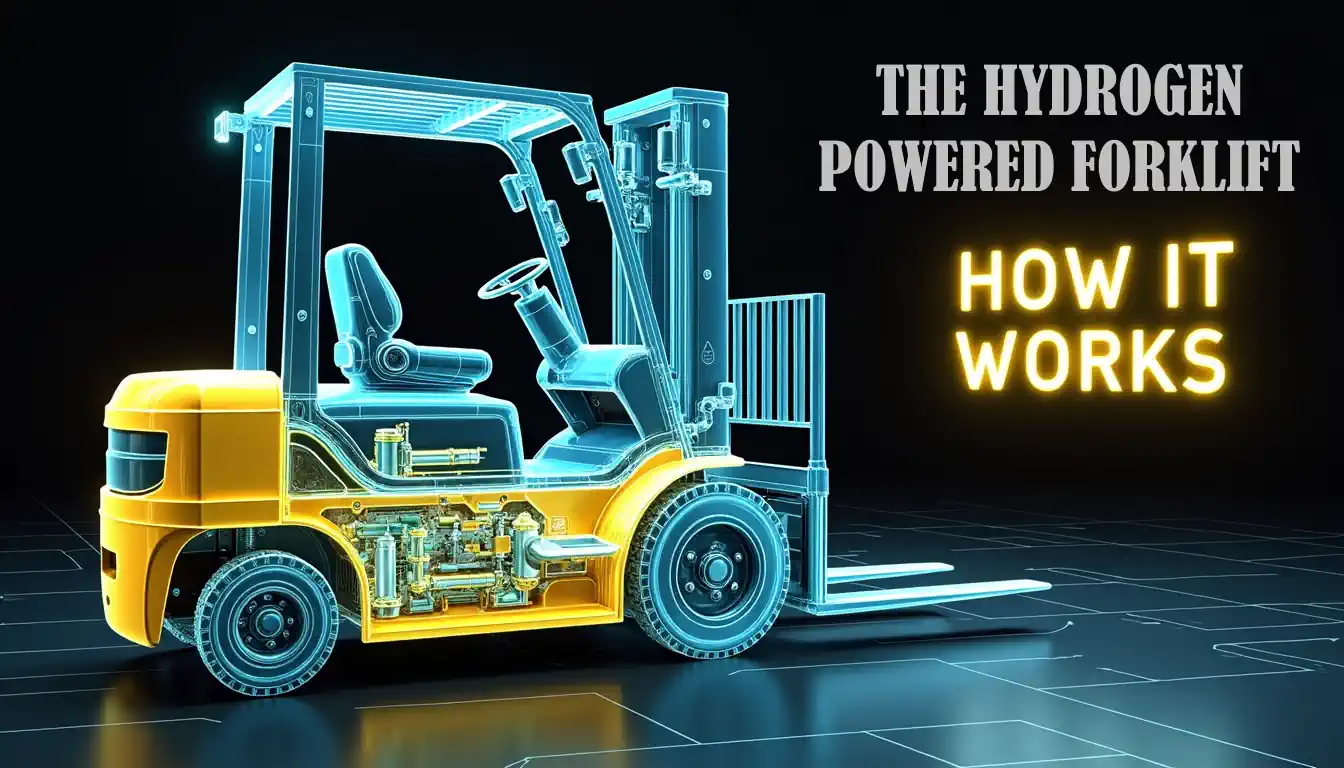
The wheels, hydraulic system and lifting equipment are powered electrically. Instead of relying only on a large rechargeable traction battery, the vehicle carries hydrogen which is supplied to a fuel-cell system.
Most fuel-cell forklifts also contain a smaller battery or another energy-storage device. This acts as a buffer, helping manage sudden power demands and capturing some energy during braking.
Hydrogen is therefore an energy carrier, not the forklift’s final drive mechanism. The fuel cell converts the energy in hydrogen into electricity, and an electric motor moves the truck.
How Does a Hydrogen Fuel Cell Forklift Work?
Many hydrogen forklifts use a proton exchange membrane fuel cell, usually abbreviated to PEM fuel cell.
The basic process is:
- Compressed hydrogen is stored in a tank on the forklift.
- Hydrogen enters the fuel-cell stack.
- Oxygen is taken from the surrounding air.
- An electrochemical reaction produces electricity.
- The electricity powers the forklift’s electric motor and associated systems.
- The principal point-of-use by-products are water and heat.
This is not combustion. A correctly operating fuel cell does not burn hydrogen in an engine.
The forklift can be refuelled from a hydrogen dispenser rather than being connected to a battery charger. The US Department of Energy describes 350 bar as the commonly selected storage pressure for buses and lift trucks, although the design must always follow the vehicle and infrastructure manufacturer’s requirements.
Where Are Hydrogen Forklifts Used?
Hydrogen forklifts have primarily been adopted by large organizations operating centralized material-handling fleets.
Applications include:
- Large distribution centres
- Food and grocery warehouses
- Manufacturing plants
- Automotive factories
- Ports and freight terminals
- Cold-storage facilities
- High-throughput logistics centres
- Some recycling and materials-processing facilities
Hydrogen can be more attractive when forklifts operate for long periods over multiple shifts and must return to a common location for refuelling.
Companies reported as having deployed hydrogen material-handling equipment include Walmart, Amazon and BMW. More recent projects have also been announced in Europe and Asia. Nevertheless, hydrogen remains a specialised minority within the much larger electric-forklift market.
Why Hydrogen Forklifts May Be Relevant to Waste and Recycling Facilities
Forklifts are used throughout the waste and recycling industry. They may move:
- Bales of paper, cardboard, plastic or metal
- Stillages and cages containing recyclable materials
- Containers of electronic equipment
- Processed material awaiting dispatch
- Maintenance equipment and replacement parts
- Packaged products manufactured from recycled material
Facilities such as material recovery facilities, waste transfer stations, paper recyclers, plastics plants and scrap-processing sites often need reliable material-handling equipment.
Hydrogen could be relevant where a large indoor fleet works continuously and lost time for charging or changing batteries has a significant cost. However, many waste facilities operate only a small number of forklifts. For those sites, installing dedicated hydrogen infrastructure may be difficult to justify.
Hydrogen should therefore be considered as one possible element of industrial fleet decarbonisation, not as a standard solution for every waste or recycling plant.
Advantages of Hydrogen Forklifts
Fast Refuelling
Fuel-cell forklifts can generally be refuelled in a few minutes. This can reduce the time vehicles spend away from productive work.
The US Department of Energy identifies rapid refuelling as one of the principal advantages of fuel-cell material-handling equipment, particularly when compared with conventional lead-acid batteries that must be charged, cooled or changed.
Consistent Power
A fuel-cell system can provide relatively consistent voltage while hydrogen remains available. This may help maintain driving and lifting performance throughout a shift.
Traditional lead-acid equipment can experience reduced performance as the battery discharges, although modern battery and control systems have improved considerably.
Reduced Need for Battery Changing
A multi-shift operation using lead-acid batteries may require spare batteries, changing equipment and trained staff to manage the charging room.
A hydrogen system can remove or reduce those requirements. This may release warehouse space and reduce the manual handling associated with battery changes.
No Carbon Dioxide at the Point of Use
A fuel-cell forklift does not normally emit carbon dioxide from the vehicle. This gives it an indoor-air-quality advantage over diesel or LPG internal-combustion equipment.
However, this should be described as zero carbon emissions at the point of use, not automatically as zero-emission over the entire lifecycle.
Suitability for Intensive Operations
The strongest case for hydrogen is often found at sites operating:
- Large fleets
- Two or three shifts per day
- Long operating hours
- Centralized refuelling
- Predictable hydrogen demand
- Processes where equipment downtime is particularly costly
The capital cost of hydrogen infrastructure can then be distributed across many vehicles, and a large quantity of material moved.
Potential Performance in Cold Conditions
Fuel-cell systems may offer operational advantages in cold-storage environments where some battery chemistries experience reduced performance.
This does not remove the need for equipment specifically designed, tested and maintained for the intended temperature range.
Disadvantages and Practical Limitations
Hydrogen Infrastructure Is Expensive
A fleet requires more than suitable forklifts. The site may need hydrogen delivery or onsite generation, compression, storage, dispensing equipment, safety systems, maintenance arrangements and emergency procedures.
These fixed costs can be difficult to justify for a small fleet.
Hydrogen Can Be Expensive
The price depends on how the hydrogen is produced, the quantity purchased, transport distance, storage method and contractual arrangements.
Operators should not compare fuel prices alone. The appropriate calculation is the total cost of ownership, including vehicles, infrastructure, energy, maintenance, labour, downtime and replacement equipment.
The Overall Energy Efficiency Can Be Lower
If electricity is first used to produce hydrogen, which is then compressed, transported and converted back into electricity in a fuel cell, energy is lost at each stage.
Directly charging a battery usually involves fewer conversion stages. Where suitable electricity infrastructure is available, this can give battery-electric forklifts an important efficiency advantage.
Hydrogen Supply Must Be Reliable
A site dependent on hydrogen needs a secure supply. Disruption to deliveries, production equipment, compressors or dispensing systems could affect the entire fleet.
Operators may require storage capacity, backup arrangements or alternative vehicles to maintain business continuity.
Specialist Maintenance Is Required
Fuel cells, high-pressure storage systems and hydrogen dispensers require appropriate technical competence. Spare parts and qualified support may be less widely available than for established battery, LPG or diesel fleets.
Hydrogen Is Highly Flammable
Hydrogen is a very light gas which disperses rapidly in open air, but it has a wide flammable range. It is also colourless and odourless.
Safe use depends on correct equipment design, ventilation, leak detection, ignition control, inspection, maintenance and emergency planning.
Hydrogen Versus Lithium-Ion Battery Forklifts
Many early comparisons presented hydrogen as an alternative to conventional lead-acid batteries. That is no longer a complete comparison because lithium-ion technology has changed the electric-forklift market.
| Consideration | Hydrogen fuel cell | Lithium-ion battery |
|---|---|---|
| Energy supply | Compressed hydrogen delivered or produced onsite | Electricity supplied through charging equipment |
| Replenishment time | Normally refuelled in minutes | Longer charging time, but opportunity charging may be possible |
| Point-of-use emissions | Water and heat during normal fuel-cell operation | No combustion or tailpipe emissions |
| Overall efficiency | Energy is lost during hydrogen production, compression and conversion | Direct charging normally uses fewer conversion stages |
| Infrastructure | Hydrogen storage and dispensing system | Chargers and sufficient electrical capacity |
| Best suited to | Large, intensive, multi-shift fleets | Small to large fleets with suitable charging opportunities |
| Space requirement | Dedicated hydrogen equipment and safety areas | Charging locations; no large changing room necessarily required |
| Supply resilience | Dependent on hydrogen supply and dispensing equipment | Dependent on electricity supply and charging capacity |
Lithium-ion batteries can be charged during breaks and short periods of inactivity. They generally require less routine attention than lead-acid batteries and do not require battery watering or regular battery changes.
Consequently, the hydrogen advantage is most compelling where very fast refuelling creates a measurable operational benefit that outweighs the additional infrastructure and energy costs.
Hydrogen Versus Lead-Acid Battery Forklifts
Compared with traditional lead-acid systems, hydrogen may offer:
- Faster refuelling than full battery charging
- No routine battery changing
- Less space required for storing spare traction batteries
- More consistent performance across a shift
- Reduced labour devoted to battery handling
Lead-acid batteries remain familiar and widely supported. They may be economical where forklifts have predictable periods available for charging, operate only one shift or do not require continuous use.
Hydrogen Versus LPG and Diesel Forklifts
Diesel and LPG forklifts can be rapidly refuelled and are supported by mature supply chains. They may be suitable for heavy-duty and outdoor work, but their internal-combustion engines produce exhaust emissions.
A hydrogen fuel-cell forklift uses an electric drive system and does not produce diesel exhaust or carbon dioxide from the vehicle during normal operation.
Potential hydrogen advantages include:
- Lower point-of-use air pollution
- Quieter operation
- Less engine vibration
- Electric-drive characteristics
- Potential compatibility with low-carbon hydrogen
Potential LPG and diesel advantages include:
- Established refuelling networks
- Lower infrastructure barriers
- Broad equipment availability
- Familiar maintenance systems
- Suitability for small fleets and remote sites
Indoor use of any combustion-powered equipment requires appropriate risk assessment and control of exhaust emissions.
Are Hydrogen Forklifts Really Zero-Emission?
Hydrogen forklifts have no carbon dioxide exhaust at the point of use, but that does not necessarily make them zero-emission over their lifecycle.
The climate impact depends primarily on the source of the hydrogen.
Grey Hydrogen
Grey hydrogen is usually produced from natural gas without capturing the resulting carbon dioxide. This can create substantial upstream greenhouse-gas emissions.
Blue Hydrogen
Blue hydrogen is also generally produced from fossil fuels, but some carbon dioxide is captured and stored. Its impact depends on the capture rate, methane leakage, energy consumption and successful long-term storage.
Green Hydrogen
Green hydrogen is produced by electrolysis using renewable electricity. It can have a much lower carbon footprint, although the result still depends on the electricity source, equipment manufacturing, compression, transport and storage.
Businesses making environmental claims should document the origin and carbon intensity of their hydrogen rather than relying only on the absence of vehicle exhaust.
Hydrogen Storage and Refuelling
A hydrogen forklift installation may include:
- Delivered hydrogen or on-site production
- Compression equipment
- High-pressure storage
- Pipework
- A dispensing station
- Ventilation
- Gas detection
- Emergency isolation
- Fire and explosion risk controls
- Inspection and maintenance systems
The installation must be designed by competent specialists in accordance with applicable legislation, codes, standards, manufacturer requirements and insurer conditions.
Hydrogen infrastructure should not be treated as an ordinary fuel tank added casually to an existing warehouse.
Safety in Warehouses and Waste Facilities
Hydrogen introduces specific hazards, but it does not replace the normal risks associated with forklifts.
Employers must still manage:
- Vehicle and pedestrian separation
- Driver authorization and training
- Speed limits
- Reversing movements
- Visibility and blind spots
- Load stability
- Racking impacts
- Vehicle maintenance
- Daily pre-use checks
- Inspection and thorough examination
The UK Health and Safety Executive warns that lift trucks are involved in a significant proportion of workplace transport accidents. Operators must be properly trained and supervised, regardless of whether the truck uses hydrogen, batteries, LPG or diesel.
Useful UK guidance includes:
- HSE guidance on managing lift trucks
- HSE guidance for lift-truck operators
- HSE guidance on the Provision and Use of Work Equipment Regulations
US forklift certification does not replace the training and legal requirements applicable to a UK workplace.
Costs and Total Cost of Ownership
The purchase price of the forklift is only one element of the decision.
A proper comparison should include:
- Vehicle purchase or lease costs
- Fuel-cell or battery replacement
- Hydrogen or electricity costs
- Hydrogen storage or charging infrastructure
- Site electrical upgrades
- Maintenance contracts
- Inspection and compliance costs
- Operator and technician training
- Refuelling or charging labour
- Productive time lost during refuelling or charging
- Number of vehicles required
- Backup equipment
- Warehouse space occupied by infrastructure
- Expected equipment life
- Residual value
The fastest-refuelling option is not necessarily the least expensive. Likewise, the most energy-efficient option may not provide the best operational result if it requires unacceptable downtime.
The calculation should use actual shift patterns and measured utilization rather than assuming that every forklift operates continuously.
When Does a Hydrogen Forklift Make Sense?
Hydrogen deserves serious consideration where:
- The fleet is large enough to spread the infrastructure cost.
- Vehicles operate continuously across multiple shifts.
- Rapid refuelling produces a measurable productivity benefit.
- Warehouse space for battery charging or changing is constrained.
- A dependable hydrogen supply is available.
- Low-carbon hydrogen can be obtained and verified.
- The business can support specialist maintenance and safety systems.
- The vehicles return regularly to a central refuelling location.
When Is a Battery Forklift Likely to Be Better?
Battery-electric equipment is likely to be more suitable where:
- The fleet contains only a few forklifts.
- Vehicles operate for one shift or have long idle periods.
- Opportunity charging can take place during breaks.
- The site already has sufficient electrical capacity.
- Hydrogen delivery would be expensive or unreliable.
- The business wants the simplest available infrastructure.
- Electricity is available from a low-carbon source.
- Fast refuelling would provide little financial benefit.
For many small recycling facilities and warehouses, a modern battery-electric forklift will remain the more practical option.
The Current Market Position
Hydrogen forklifts are commercially proven and continue to be used by some major warehouse and manufacturing operators. They are not merely laboratory prototypes.
At the same time, their use is concentrated in a relatively small number of large fleets, particularly in the United States. Battery-electric forklifts occupy a much larger part of the global market.
New hydrogen forklift projects continue to appear in Europe and Asia, including trials and deployments involving manufacturers, logistics businesses and heavy-industry sites. These projects demonstrate continued interest, but they do not prove that hydrogen will replace batteries across the wider forklift market.
The most realistic conclusion is that hydrogen is a specialised operational solution rather than the inevitable future of every forklift.
Frequently Asked Questions
Is a hydrogen forklift an electric forklift?
Yes. A hydrogen fuel cell generates electricity, which powers an electric drive system. Most fuel-cell forklifts also contain a smaller battery or another energy-storage device to handle power peaks and recover energy.
How long does a hydrogen forklift take to refuel?
Refuelling can normally be completed in a few minutes, although the exact time depends on the vehicle, storage pressure, dispenser and site procedures. This is one of hydrogen’s main advantages in intensive multi-shift operations.
Do hydrogen forklifts produce emissions?
The vehicle does not normally produce carbon dioxide during fuel-cell operation. Its principal local outputs are water and heat. However, hydrogen production, compression, transport and storage may produce greenhouse-gas emissions, so the full lifecycle must be considered.
Are hydrogen forklifts safe indoors?
They can be used indoors when the vehicle and refuelling installation are correctly designed, ventilated, monitored and maintained. Hydrogen is flammable, colourless and odourless, so leak detection and appropriate emergency systems are important.
Are hydrogen forklifts better than battery forklifts?
Not universally. Hydrogen can provide faster refuelling and high availability for large multi-shift fleets. Batteries normally provide better overall energy efficiency and simpler infrastructure. The best option depends on fleet size, operating hours, energy supply and site conditions.
Are hydrogen forklifts cheaper to operate?
They may reduce downtime and battery-changing labour in intensive operations. However, hydrogen, specialist maintenance and refuelling infrastructure can be expensive. A site-specific total-cost-of-ownership assessment is required.
Do hydrogen forklifts need batteries?
Most fuel-cell forklifts include a smaller battery or another energy-storage system. It supports sudden power demands, smooths the electrical supply and may store energy recovered during braking.
What colour of hydrogen is best for forklifts?
Hydrogen produced using renewable electricity generally offers the strongest potential for reducing lifecycle greenhouse-gas emissions. Buyers should request verified information about production method and carbon intensity rather than relying on colour labels alone.
Can a small recycling facility use hydrogen forklifts?
It is technically possible, but the cost of storage, dispensing and specialist support may be difficult to justify for a small fleet. Battery-electric equipment will often be simpler and more economical unless a shared or existing hydrogen supply is available.
Do forklift operators need special training?
Operators need appropriate lift-truck training regardless of fuel. Additional instruction may be required for hydrogen refuelling, emergencies and site-specific hazards. UK employers must follow applicable health and safety, work-equipment and lifting-equipment requirements.
The Original Hydrogen Forklift Infographic
The following infographic accompanied the original guest contribution to this page. It reflects the case for hydrogen forklifts as it was presented at that time. Readers should use the independently updated article above for the more balanced assessment of lifecycle emissions, current battery technology, costs and operational limitations.
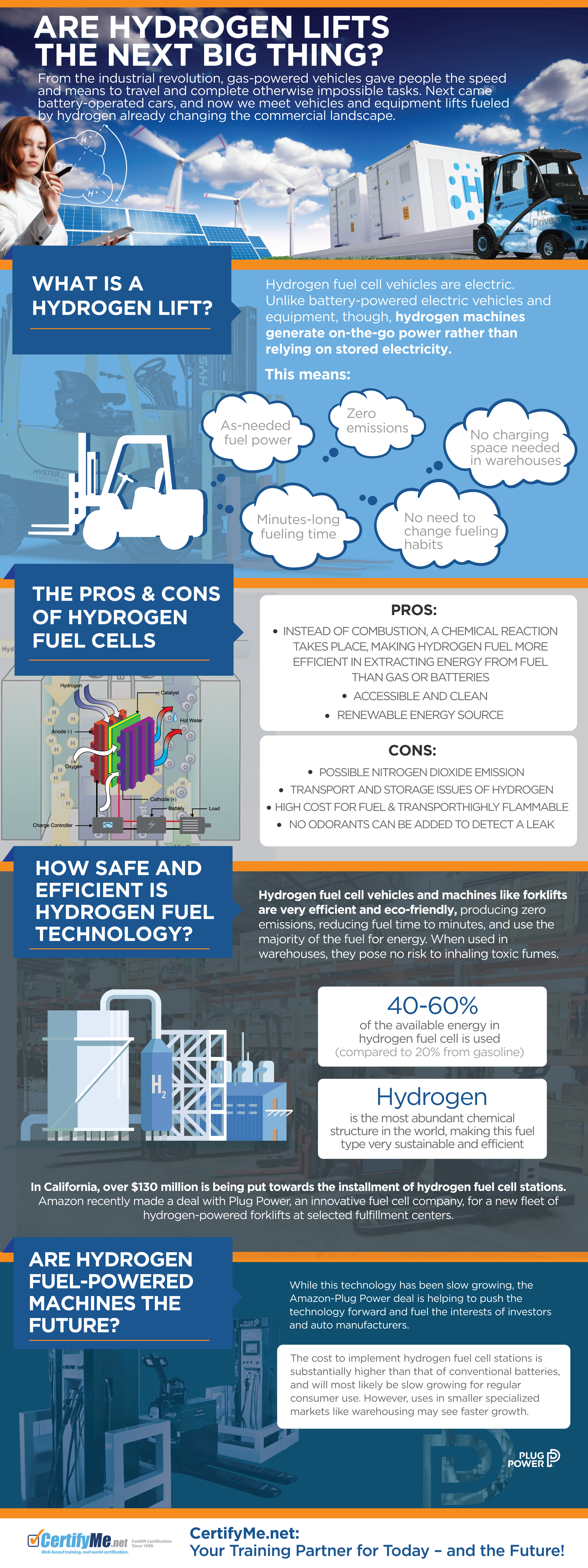
Original infographic supplied by CertifyMe.net.
Conclusion
Hydrogen fuel-cell forklifts are a proven but specialised form of electric material-handling equipment. Their rapid refuelling, consistent power and suitability for intensive multi-shift work can make them valuable to large warehouses and industrial sites.
They may also have a role in some material recovery facilities, recycling plants and other waste-sector operations with large centralised fleets.
However, hydrogen infrastructure is expensive, its overall energy efficiency can be lower than direct battery charging, and its environmental performance depends on how the hydrogen is produced.
For smaller fleets and many ordinary warehouse applications, modern battery-electric forklifts are likely to remain simpler and more efficient. Hydrogen should be selected only where its operational benefits can be demonstrated through a site-specific assessment of total cost, energy use, safety, reliability and lifecycle emissions.
[First published as a guest contribution in 2018. Substantially rewritten and independently updated by The Wasters Blog on 12 July 2026. The original contributor’s agreed link and infographic attribution have been retained.]




The forklift is in fact a great British invention. Ransomes, Sims & Jefferies of my home town of Ipswich made the first real forklifts during World War I.