
Is Your Landfill Conceptual Site Model a Regulatory Time Bomb? What UK Professionals Need to Know
The Conceptual Site Model sits at the heart of every serious landfill environmental management decision made in the UK today. It underpins permit applications, drives site investigation design, informs leachate and gas management strategies, and forms the evidential backbone of contaminated land assessments under Part IIA. Get it right, and you have a powerful tool that gives you clarity and control over even the most complex site. Get it wrong — or worse, treat it as a box-ticking exercise — and you may be sitting on a regulatory liability that quietly grows until it becomes impossible to ignore.
Key Takeaways
- The Conceptual Site Model is the single most important document in landfill
environmental risk assessment — yet it is routinely misunderstood, poorly executed,
and treated as something it was never designed to be. - A CSM is not a one-off report. It is a living, iterative management tool that
must be continuously updated as new site data, monitoring results, and regulatory
expectations evolve. Treating it as anything less is where the problems begin. - The Source–Pathway–Receptor framework is the engine inside every landfill CSM.
Applying it superficially is not the same as applying it correctly — and the
difference between the two has real consequences for regulatory compliance and
community safety. - CSM landfill management looks very different depending on whether you are dealing
with a new site at the design stage, an operational engineered landfill under permit,
or an old closed legacy site with incomplete records. Each scenario carries its own
specific risks and its own specific failure points. - Post-Brexit, the question of which EU landfill legislation still applies to UK
sites — and in what form — is more nuanced than most practitioners realise. Getting
this wrong in a CSM or permit application is a mistake that tends to surface at the
worst possible moment. - The professionals who get landfill environmental risk assessment right are not
necessarily the most experienced in the room. They are the ones with access to the
right frameworks, applied consistently and with genuine rigour. - A weak CSM rarely looks weak on the surface. The gaps that matter most are
almost always in what is missing rather than what is present — and knowing what to
look for is a skill in itself. - For old closed landfills built before modern sanitary standards existed, the
stakes of a poor CSM are highest of all. These are not abstract regulatory concerns
— they are sites where real communities live with real risks that a properly
developed CSM exists specifically to identify and manage.
The uncomfortable truth is that across local authorities, consultancies, and landfill operations up and down the country, the CSM is one of the most frequently misunderstood and poorly executed documents in environmental site management. Not because the professionals working with these sites lack competence — they don't — but because genuinely practical, landfill-specific guidance on what a good CSM looks like, and how to build and maintain one, has always been surprisingly hard to find.
This article won't fix that gap entirely. What it will do is show you exactly where the problems tend to appear, why they matter more than many practitioners realise, and what a fundamentally better approach to the landfill CSM looks like in practice.
The Document That Underpins Everything — Yet Gets Done Wrong More Often Than Not
Ask any experienced environmental consultant or contaminated land officer to name the single document they most commonly find to be inadequate when they pick up a new landfill file, and the answer comes back with depressing regularity: the Conceptual Site Model.
This is not a minor administrative shortcoming. The CSM is not a supporting document or a background appendix. It is the foundation on which every subsequent decision about a landfill site is made. The site investigation is designed using it. The monitoring network is positioned according to it. The risk assessment is structured around it. The permit compliance case rests on it. When the CSM is weak, everything built on top of it is compromised — and in the landfill context, compromised decisions have consequences that can play out over decades.
What makes this particularly challenging is that a weak CSM rarely looks weak from the outside. It can be a substantial, well-formatted document full of maps and cross-sections and technical data. The weaknesses tend to lie not in what is present but in what is missing: the geological nuance that wasn't captured, the receptor that wasn't identified, the pathway that was assumed away rather than investigated, the monitoring data that contradicted the model and was quietly set aside rather than used to revise it.

What a Conceptual Site Model Actually Is — And What Too Many Professionals Think It Is
Here is where a lot of the trouble starts. The Conceptual Site Model is, by definition, an iterative and continuously evolving tool. It is not a report that gets written at the start of a project, signed off, filed, and periodically dusted off for regulatory inspections. It is a living document — a dynamic representation of the site's current best-understood condition — that should be updated every time significant new information becomes available.
In practice, a remarkable number of landfill CSMs in circulation are treated as exactly the kind of static, one-off reports they were never meant to be. They are written at a point in time, they reflect the understanding of that point in time, and they continue to be referenced long after conditions on site, in the surrounding environment, and in the regulatory framework have moved on. The gap between what the CSM says and what is actually happening at the site grows progressively wider — and with it, the gap between the organisation's perceived compliance position and its actual one.
Understanding what a CSM genuinely is — the iterative, continuous, systematically updated tool that the Environment Agency actually expects to see — is the first and most important shift in thinking that separates practitioners who manage landfill sites effectively from those who are, without necessarily realising it, accumulating risk.
The Source–Pathway–Receptor Framework: Powerful in Theory, Problematic in Practice
The Source–Pathway–Receptor model is the intellectual engine inside every Conceptual Site Model, and it is elegantly simple in concept. A contamination risk only exists where a source of contamination, a pathway by which that contamination can travel, and a receptor that can be harmed are all present and connected. Break any one link in that chain, and the risk is broken with it.
In theory, this gives the landfill environmental manager an extraordinarily clear framework for decision-making. In practice, applying the SPR model rigorously to a real landfill site — with its complex geology, multiple potential contamination sources, overlapping pathway mechanisms, and diverse receptor types — is considerably harder than the textbook version suggests.
The sources are rarely straightforward. Leachate generation varies with waste composition, moisture content, and decomposition stage in ways that resist simple characterisation. Gas migration pathways are three-dimensional and dynamic, changing with atmospheric pressure, soil moisture conditions, and seasonal temperature variation. Receptors are frequently more numerous and more varied than a desk study alone will reveal. And the linkages between them — the actual pollutant pathways that determine whether a risk is real or theoretical — require a quality of geological and hydrogeological understanding that takes significant time and skill to develop.
Getting the SPR framework genuinely right, rather than superficially applied, is where the real work of CSM development lies. And it is where the difference between a CSM that protects you and one that exposes you is most starkly determined.
New Landfills: Why Getting the CSM Wrong at the Design Stage Has Consequences That Last a Century
For a new landfill disposal site, the CSM is not just a regulatory requirement. It is the primary tool for understanding what engineering controls are actually necessary given this site's specific geological, hydrogeological, and environmental setting — and therefore for making design decisions that will determine the site's environmental performance for the next hundred years or more.
The consequences of a weak pre-design CSM are therefore uniquely long-lasting. A liner system specified without an adequate understanding of the underlying geology and groundwater regime may be either inadequate for the actual risk — creating a leachate containment failure that could take years to detect — or unnecessarily over-engineered for a site that could have been managed effectively at lower cost. A gas extraction system designed without proper pathway modelling may fail to protect adjacent receptors from lateral gas migration. A monitoring network positioned without a robust CSM may systematically miss the hydrogeological zone where a developing leachate plume would first appear.
The decisions made at the pre-design CSM stage cast very long shadows. And unlike operational mistakes that can be corrected relatively quickly, design errors at a new landfill are often extraordinarily expensive and technically difficult to rectify once construction is complete and waste emplacement has begun.
Operational Landfills: The Costly Difference Between a CSM That's Alive and One That's Gathering Dust
For an existing, operational engineered landfill — designed and built to modern sanitary standards and operating under an environmental permit — the CSM transitions from a planning and design tool into something more like a continuous environmental intelligence system. Its job is to integrate the constant flow of monitoring data, operational records, and site observations into a coherent, up-to-date picture of how the site is actually performing against how it was expected to perform.
When it functions as it should, the operational CSM is genuinely powerful. It tells you whether leachate levels are trending in a direction that warrants intervention before a threshold is breached. It tells you whether gas composition changes at extraction wells indicate that the waste mass is stabilising or that the extraction system is drawing in atmospheric air. It tells you whether a groundwater quality result that doesn't fit the pattern is a laboratory anomaly, a monitoring artefact, or the first signal of something that needs urgent investigation.
When it doesn't function as it should — when it is a document last substantively updated three years ago, sitting in a folder that gets retrieved only when the regulator asks for it — it tells you none of these things. And the problems it might have flagged continue to develop, unseen, until they become considerably harder and more expensive to address.
Legacy and Closed Landfills: The Sites Where a Weak CSM Carries the Highest Stakes of All
If the CSM matters enormously for new and operational landfills, it matters most of all for the thousands of old, closed landfill sites across the UK that were filled before modern sanitary standards existed — before engineered liners, before leachate management systems, before gas controls, before any systematic monitoring was required or expected.
These legacy sites are where the CSM challenge is most acute, for a very simple reason: the information that would make a good CSM straightforward to develop is frequently partial, ambiguous, or entirely absent. Historical tipping records may not exist. The extent and depth of the waste mass may be uncertain. The waste composition — and therefore the nature and severity of the contamination source — may have to be inferred from contextual evidence about the surrounding area and the period of operation rather than read from acceptance records that were never kept.
And yet these are precisely the sites where the consequences of a poor CSM are most directly felt by real communities. Legacy landfills sit beneath housing developments, beneath schools, beneath parks and allotments. They generate gas that can migrate through permeable ground and accumulate in building voids at concentrations that are explosive or asphyxiating. They release leachate that has been slowly contaminating surrounding groundwater for decades. The people who live on and around them are the receptors — and they have no idea that the SPR chain that puts them at risk even exists.
Getting the CSM right for a legacy landfill is not a technical nicety. It is, in some cases, a matter of community safety.
Post-Brexit EU Law and the Regulatory Blind Spot That Catches Even Experienced Practitioners Off Guard
Here is a regulatory question that genuinely trips up experienced waste management professionals: now that the UK has left the European Union, does EU landfill legislation still apply to sites operating in England, Wales, Scotland, and Northern Ireland?
The answer is more nuanced than either a simple yes or a simple no — and the nuance matters considerably for anyone developing or reviewing a CSM that needs to demonstrate regulatory compliance. The position differs between Great Britain and Northern Ireland, it has evolved through the European Union (Withdrawal) Act 2018 and the subsequent Windsor Framework, and it creates a progressive divergence risk as EU environmental legislation continues to develop in directions that UK domestic law is no longer automatically required to follow.
Understanding exactly where the EU Landfill Directive and related instruments sit in the post-Brexit UK regulatory landscape — what remains binding, what has persuasive authority, and what has genuinely ceased to apply — is not straightforward. Getting it wrong in a CSM or a permit application is the kind of mistake that tends to surface at exactly the wrong moment.
The Six CSM Mistakes That Keep Coming Up — and the Problems They Create
After reviewing Conceptual Site Models across new, operational, and legacy landfill sites, certain failure patterns appear with striking regularity. They are not the result of carelessness or lack of effort. They are the result of genuine gaps in available practical guidance about what a landfill-specific CSM should look like, how it should be developed, and how it should be maintained over time.
These recurring mistakes share a common characteristic: they are all entirely avoidable once you know what to look for, both in a CSM you are developing yourself and in one you have been asked to review on behalf of a client, an operator, or a regulatory body. The consequences of each one range from a monitoring programme that systematically generates misleading data, to a gas risk assessment that fails to identify properties at genuine risk, to a contaminated land determination that doesn't stand up to scrutiny under Part IIA.
Knowing these patterns — and knowing the specific, practical steps that prevent them — is what separates a CSM that protects you from one that quietly undermines everything you have built on top of it.
What Separates the Professionals Who Get This Right From Those Who Don't
It is not, in most cases, a question of technical intelligence or professional experience. The practitioners who consistently produce and maintain effective landfill CSMs — and who can critically evaluate the CSMs produced by others — tend to share a small number of specific habits and frameworks that others don't have access to.
They treat the CSM as a management tool rather than a compliance document. They approach the SPR framework as a genuine analytical discipline rather than a structural template to be populated. They know which data sources to interrogate for legacy sites when the obvious records don't exist. They understand how to design site investigation around the CSM rather than alongside it. They know what the Environment Agency actually expects to see, and they know where the post-Brexit regulatory picture creates uncertainty that needs to be explicitly addressed rather than glossed over.
These are learnable frameworks. They are not the product of decades of trial and error on individual sites. They can be understood, internalised, and applied — if you have access to the right, consolidated, landfill-specific guidance.
Where to Go From Here
If this article has raised questions you don't have confident answers to — about your own CSM, about a CSM you've been asked to assess, or about your organisation's approach to legacy landfill risk — that is precisely the point.
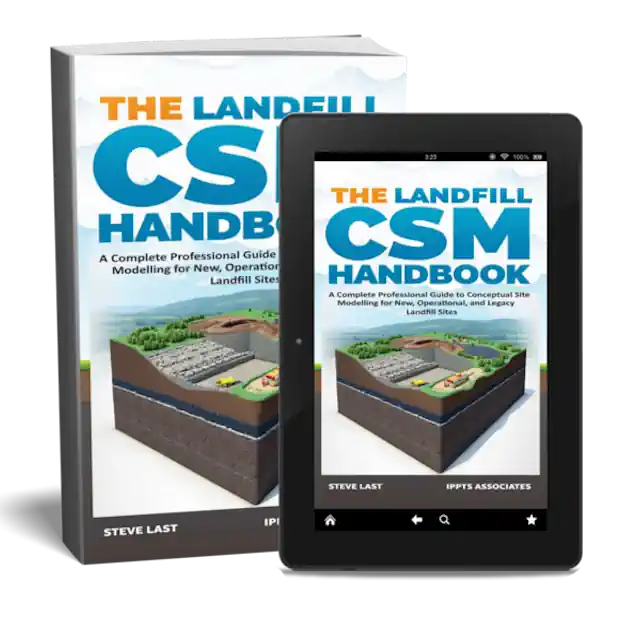
The Conceptual Site Model (CSM) for Landfill Design and Environmental Management is a complete professional handbook written specifically for UK local authority officers, environmental consultants, landfill operators, and contaminated land practitioners who need to develop, maintain, or critically evaluate a landfill CSM. It covers new site design, operational engineered landfills, and legacy closed sites in a single, fully referenced volume, grounded in the current UK regulatory framework and the post-Brexit EU legislative landscape.
It contains the step-by-step methodology, the SPR application frameworks, the regulatory clarity, and the practical guidance that this article has deliberately withheld — because some things are genuinely better learned from a resource built around them than from a single article that can only scratch the surface.